Ingredients and steps on one page. Print it, or choose “Save as PDF” in the print dialog.
Sekai Gohan
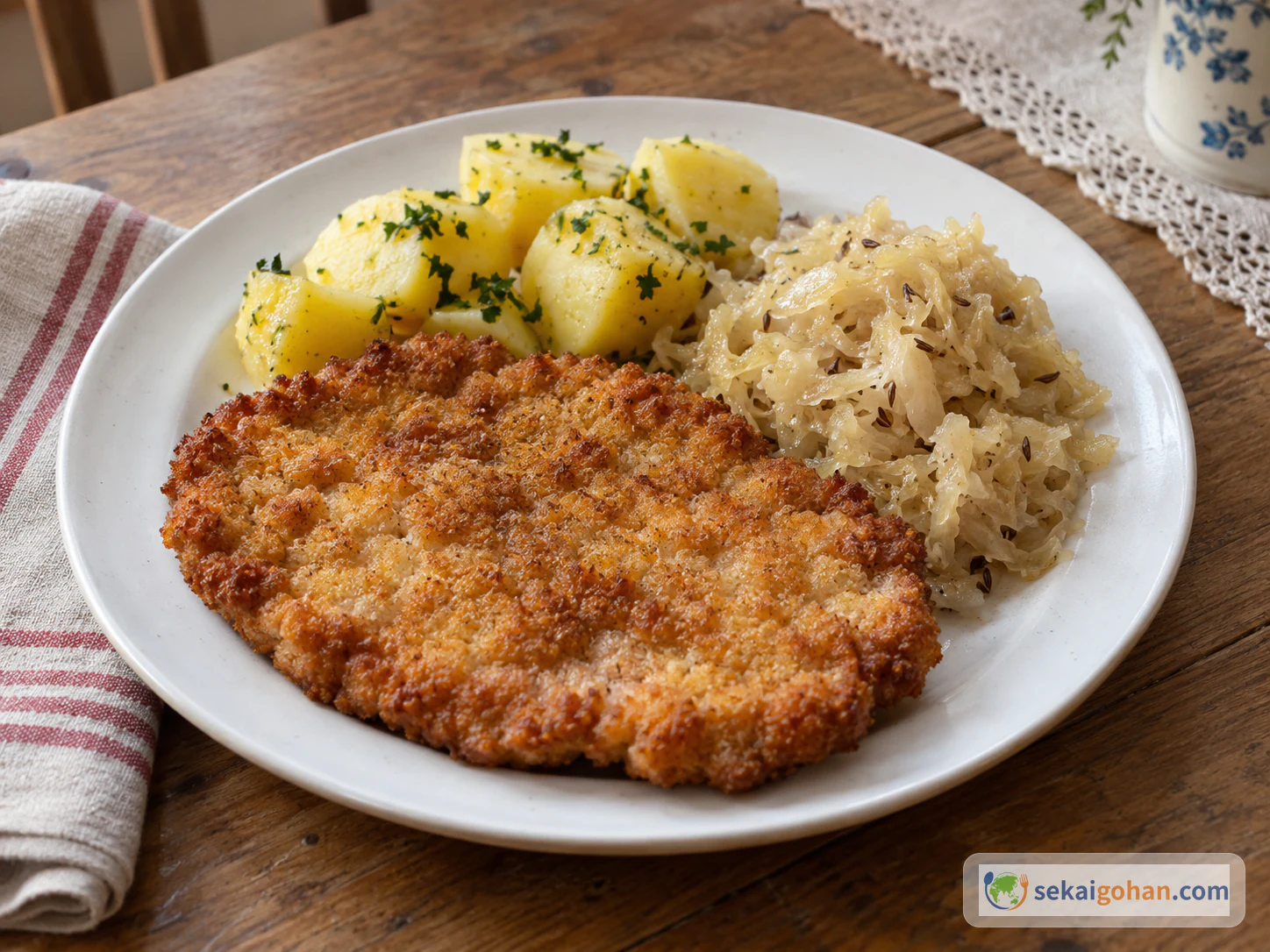
Kotlet Schabowy: Polish Breaded Pork Cutlet with Potatoes and Sauerkraut
Ingredients
Cutlets
| Ingredient | Amount | Substitutes & notes |
|---|---|---|
| Pork loin (boneless) | 600 g (about 150 g × 4 pieces) | About 1.3 lb. Start from a 1 cm thick piece and pound to 7–8 mm. If bone-in, even out the edible portions and check the internal temperature |
| Salt | 4 g | For the meat. Don't add separate salt to the fermented cabbage |
| Black pepper | 1 g | Freshly ground. White pepper works, but the aroma changes |
| Cake flour | 60 g | Coats the surface of the meat thinly. Shake off the excess |
| Eggs | 4 | For the egg wash. Use all 4 if small; if large, use only as many as you need to coat the meat |
| Milk | 100 ml | About 1/2 cup less 1 tbsp. 50 ml for soaking the meat, 50 ml for the egg wash. If avoiding dairy, replace with water |
| Dried breadcrumbs | 120 g | Coarse crumbs work best. Stands in for dry wheat rolls |
| Lard | 80 g | The traditional choice. Substitute unsalted butter mixed with vegetable oil, or a neutral frying oil |
| Fresh marjoram (optional) | 5 g | Optional herb. If you don't have it, leave it out |
Tangy cabbage
| Ingredient | Amount | Substitutes & notes |
|---|---|---|
| Sauerkraut (fermented cabbage) | 12.5 oz (350 g) | If very sour, rinse briefly and squeeze dry. Rinsing too much washes out the flavor |
| Onion | 3.5 oz (100 g) (1/2 onion) | Thinly sliced. Cook off the moisture to bring out sweetness |
| Carrot | 1.75 oz (50 g) | Cut into thin strips. Goes into the cabbage side |
| Apple | 3.5 oz (100 g) (1/2 apple) | Optional. Add it only if you want more sweetness |
| Caraway seeds | 1 tsp (about 2 g) | A regional touch for fermented cabbage. Cumin smells different, so don't swap it one for one |
| Butter or vegetable oil | 10 g or 2 tsp (10 ml) | For warming the onion and cabbage. Lard also works |
Potatoes and finishing
| Ingredient | Amount | Substitutes & notes |
|---|---|---|
| Potatoes | 1.25 lb (600 g) | A floury (starchy) variety. Boiled or roasted both work; here they are boiled and tossed in butter |
| Salt | 2 g | For the cooking water. Mind the salt in the cabbage and meat and don't add more at the end |
| Butter | 20 g | For the boiled potatoes. Vegetable oil gives a lighter finish |
| Dill | 5 g | Optional garnish. The dish holds together without it |
Steps
1Cut the meat and pound it thin
about 10 min
Cut 1.25 lb (600 g) of pork loin into 4 pieces and look at them from the side to make sure no thick spots remain. Sandwich the 0.5 inches (1 cm) thick meat between sheets of plastic wrap and pound from the center outward with the flat side of the mallet until it is about 0.375 inch (7–8 mm) thick. About 0.375 inch (7–8 mm) thick, with no holes is the goal. If only the edges get thin, fold them back to tidy the shape. If cooking bone-in, don't force the meat around the bone thin; make cuts in the thick parts instead and prioritize checking the internal temperature. Wipe the surface with paper towels and season both sides with salt and black pepper.
2Soak in milk and line up the breading plates
about 20 min
Soak the meat in 3.5 tbsp (50 ml) of milk for 10–15 minutes, then lift it out and lightly pat the surface dry. Discard the soaking milk; don't use it for the coating. Soaking too long makes the meat watery, so keep it short. Set out 3 shallow plates in a single row: flour, an egg wash of the 4 eggs mixed with the remaining 3.5 tbsp (50 ml) of milk, and dried breadcrumbs, in that order. Beat the egg wash until no strands of white remain and the color is even. Breading plates go flour, egg, breadcrumbs, placed so they don't overlap. If you're not using milk, just add a little water to the egg wash. If you avoid dairy, check the ingredient label on the breadcrumbs too.
3Bread the cutlets and let them rest
about 10 min
Dust both sides of the meat thinly with flour, shake off the excess, then pass it through the egg wash. Lay it on the plate of breadcrumbs and press lightly with your fingertips so the crumbs cling to the surface. Don't press so hard that the coating becomes packed and stiff. Knock off any thick corners of coating or clumps of flour, then rest the cutlets on the wire rack for 5 minutes. As they rest, the crumbs absorb the egg wash; when the surface looks moist and glossy and the coating has set evenly against the meat, they're ready to go into lard heated over medium heat. Touch up any floury patches by lightly pressing on more crumbs. Don't leave them until they dry out completely. The coating falls off for three reasons: moisture on the meat, too much flour, and moving the cutlet right after it goes into the fat. Press the crumbs, rest them, don't move them.
TipKeep one hand for flour and egg wash and the other only for breadcrumbs, so the coating doesn't build up on your fingertips. Don't stack breaded cutlets; lay them on a rack or on a tray lightly scattered with breadcrumbs. Fry the first one as a test, and if the coating darkens too quickly, lower the heat before adding the rest.
4Finish the potatoes and cabbage
about 15 min
Cut 1.25 lb (600 g) of potatoes into bite-size pieces and boil in water with 2 g of salt for 12–15 minutes, until a skewer slides through. Drain, return to the pot and shake for about 1 minute, then toss with 20 g of butter and the dill, cover and keep warm. In another pot or frying pan, warm 10 g of butter or oil with the onion and carrot over medium-low heat for 4–5 minutes. Add 12.5 oz (350 g) of sauerkraut and 1 tsp of caraway seeds and sauté for 3–4 minutes. If using apple, slice it thin and add it for the last 2 minutes. If the cabbage looks dry, add just 1 tbsp of water. Taste before salting, and add only a tiny pinch if it truly needs it. Keep the tang, lose the liquid; that's the finish you want.
5Shallow-fry both sides in lard
6–8 min per cutlet
Put 80 g of lard in a heavy frying pan and heat over medium heat. Drop in a single breadcrumb; when it immediately bubbles in fine bubbles, the fat is ready. The target is 160–170°C (320–340°F), never so hot that the fat smokes. If you don't have much lard, tilt and shift the pan so it reaches the whole cooking surface. Once the meat goes in, don't move it for the first 2 minutes. When the edges of the coating have set, flip it once with a spatula.
The 3 minutes per side in the official modern interpretation is a working guide. Even when both sides are golden brown, check the internal temperature of the thickest part with a thermometer. The standard based on Japan's Ministry of Health, Labour and Welfare is 63°C (145°F) at the center for 30 minutes, or the equivalent or more, such as 75°C (167°F) for 1 minute. At home, confirm 75°C for 1 minute. If you can't check, don't rely only on cutting it open to look for pink; give it more time. If the coating darkens first, lower the heat, move the cutlet to a rack, and you can finish it to the center in an oven at about 160°C (320°F). 3 minutes per side is the starting point; internal temperature is the finish line.
CautionDon't reuse tongs or plates that touched raw meat for the finished cutlets or the sides. When adding meat to the fat, pat it dry and lay it in gently, away from the side of the pan; leftover water droplets make the fat spatter. Never pour water into the pan to cool the fat. If the fat ever catches fire, turn off the heat and smother it with a lid or a fire extinguisher. Pork can't be eaten raw, and white color alone doesn't mean it's safe.
6Rest on a rack and serve with potatoes and cabbage
3–5 min
Transfer the hot cutlets, confirmed at 167°F (75°C) for 1 minute at the center, to a rack and rest for just 2–3 minutes. Setting them directly on a plate makes the underside steam and go soggy, so avoid that. Put the potatoes on one side of the plate and the tangy cabbage on the other, with the cutlet in the middle or at the front. Lemon or a heavy sauce is not the star here. The aim is to layer the aroma of lard, the breaded meat, the tang of the cabbage and the gentle sweetness of the potatoes in a single bite. Cut the first cutlet in half through the middle to check that it's cooked to the center, and serve the rest while hot. Rest it on a rack so the coating stays crisp, and the moment your fork goes in, you hear Sunday.