Ingredients and steps on one page. Print it, or choose “Save as PDF” in the print dialog.
Sekai Gohan
Vatrushka: Russian Sweet Yeast Buns Filled with Farmer's Cheese
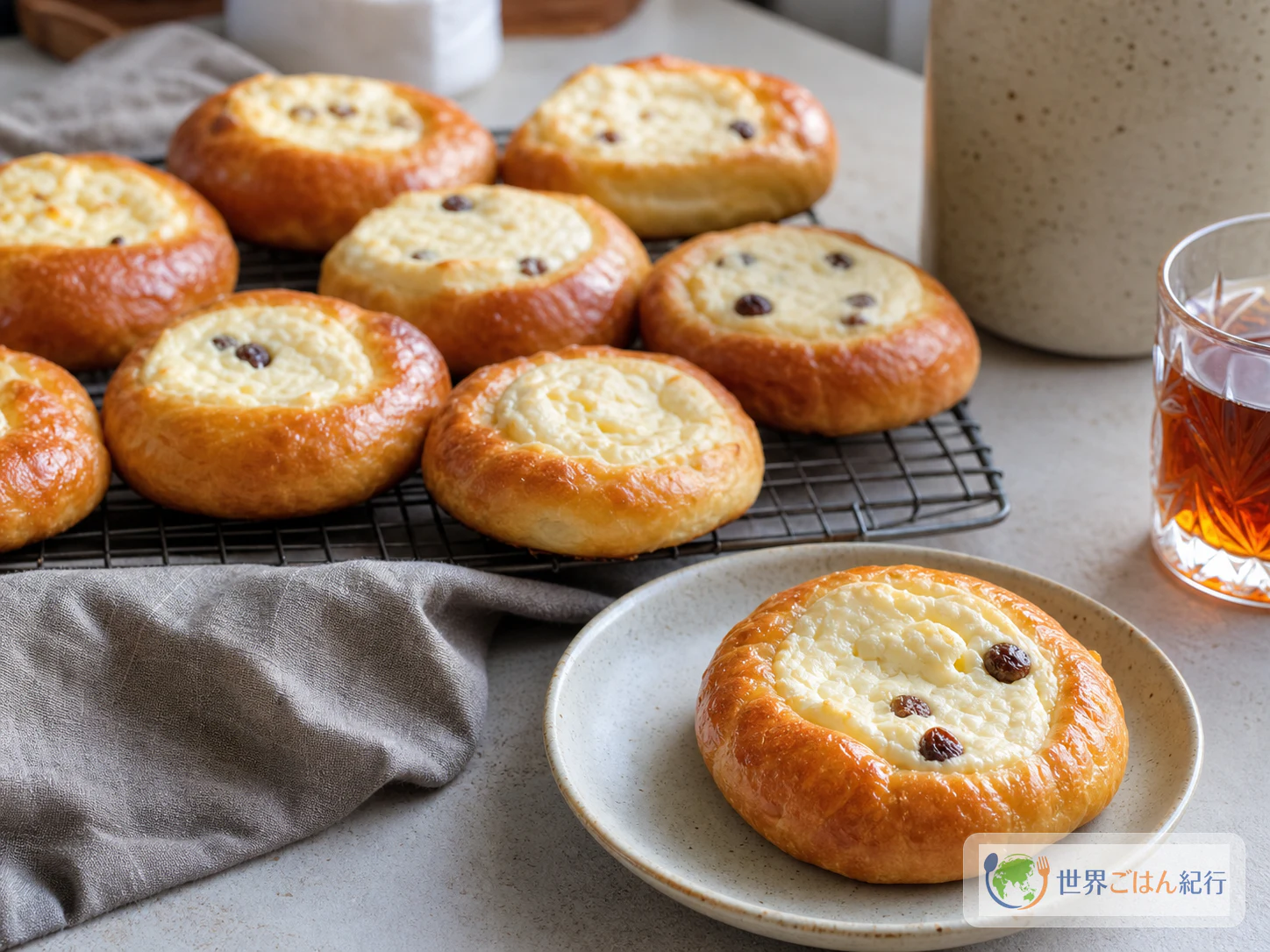
Ingredients
Dough
| Ingredient | Amount | Substitutes & notes |
|---|---|---|
| Bread flour | 260 g | Makes the fluffy rim |
| Cake flour (low-protein flour) | 70 g | Lightens the mouthfeel compared with bread flour alone |
| Milk | 150 ml | Warm to 35 to 38°C (95 to 100°F) |
| Instant dry yeast | 5 g | Even the type that needs no pre-proofing, watch the temperature |
| Granulated sugar | 45 g | For the dough. Caster or white sugar also works |
| Salt | 5 g | Tightens the sweetness |
| Egg | 1, 50 g | For the dough. Beat it, use 40 g in the dough and the rest for glazing |
| Unsalted butter | 35 g | At room temperature |
| Dusting flour | 1 to 2 tbsp | Only for shaping |
Cheese filling
| Ingredient | Amount | Substitutes & notes |
|---|---|---|
| Cottage cheese | 10.5 oz (300 g) | Drain 15 minutes. Grainy is recommended over the strained type |
| Greek yogurt | 1.5 oz (40 g) | Makes up the tang and cohesion of tvorog |
| Egg yolk | 1 | Sets the filling |
| Granulated sugar | 1.5 oz (45 g) | Keep the sweetness modest. Up to 2 oz (55 g) to taste |
| Cake flour (low-protein flour) | 12 g | Holds back moisture. Cornstarch also works |
| Lemon zest | 1/2 lemon | Grate only the yellow part |
| Vanilla extract | 3 drops | Do not overdo it |
| Raisins | 1.25 oz (35 g) | Soak 5 minutes in lukewarm water and wipe dry |
| Salt | a pinch, 1 g | Brings out the sweetness of the milk |
Finish
| Ingredient | Amount | Role |
|---|---|---|
| Beaten egg | about 10 g left from the dough | Glazes the rim |
| Milk | 1 tsp | Makes the beaten egg easier to brush |
| Powdered sugar | 1 tsp | Lightly, just before eating, to taste |
Steps
1Warm the milk and blend in the yeast
8 min
Put 150 ml milk in a small pot and warm over low heat to 35 to 38°C (95 to 100°F). To the touch it is slightly cooler than a lukewarm bath. Going well above 40°C (104°F) weakens the yeast, so check with a thermometer here if you have one. Turn off the heat, move the milk to a bowl, mix in 5 g instant dry yeast and just 1 tsp of the 45 g granulated sugar, and leave 5 minutes until fine bubbles appear on the surface.
2Knead the dough and give it the first rise
60 min
No heat is used. In a large bowl, mix 260 g bread flour, 70 g cake flour, the rest of the sugar and 5 g salt. Add the warm milk with yeast and 40 g beaten egg and mix until the dry flour is gone. Add 35 g room-temperature unsalted butter, turn it out onto the counter and knead 8 minutes. The dough should be slightly sticky to the hand, the surface stretches thin, and when pulled it starts to form a film without tearing at once. Round it, return it to the bowl and proof at 25 to 28°C (77 to 82°F) for 45 to 55 minutes, until it has risen about 1.8 times.
3Mix the cheese filling, keeping the grain
12 min
No heat is used. Drain 10.5 oz (300 g) cottage cheese for 15 minutes in a colander lined with paper towels. Move it to a bowl and add 1.5 oz (40 g) Greek yogurt, 1 egg yolk, 1.5 oz (45 g) sugar, 12 g cake flour, lemon zest, vanilla and 1 g salt. The finished mix should be a thickness that falls slowly when scooped and does not collect water at the bottom of the bowl. Mix by mashing with a fork, and at the end add 1.25 oz (35 g) raisins, soaked and wiped dry. The raisins should be evenly scattered, visible as dots in the white paste. If loose, add 1 tsp cake flour; if stiff, add 1 tsp yogurt.
4Divide the dough and round it
15 min
No heat is used. Turn the risen dough out onto the counter and press lightly with your palm to release only the large gas bubbles. Divide into 8, about 2.5 oz (70 g) each, and round, stretching the surface taut. Arrange them with space between on a baking sheet lined with parchment, cover with a dry cloth and rest 10 minutes. The rest is done when the surface has relaxed and puffed and a finger press leaves a shallow dent that slowly returns. Waiting this long keeps the rim from splitting when you make the well next. Use dusting flour thinly only if the counter is sticky.
5Press a deep well and give the second rise
35 min
No heat is used. Press the bottom of a glass, lightly floured, into the center of each round to make a well about 5 cm across. Leave a rim about 1.5 cm high, and do not thin the bottom too much. Cover with a cloth and proof the second time at 25 to 28°C (77 to 82°F) for about 25 minutes. If the dough has puffed back and the well is shallower, press it again lightly with the bottom of the glass just before baking. Making the depth here keeps the filling from running.
6Fill and brush the rim with egg
8 min
No heat is used. Preheat the oven to 190°C (375°F). Put just under 2 tbsp, about 45 g, of the cheese filling into each well. The filling is done when the center is slightly mounded and about 2 mm of margin remains inside the plump rim. Mix 1 tsp milk into the beaten egg set aside for the dough and brush a thin coat on the rim only. It is done when the rim is just glossy-wet, not so thick that the egg pools. If egg wash runs onto the filling the surface bakes in patches, so brush by stroking the rim without standing the brush upright.
7Bake at 190°C (375°F), cool a little and eat
22 min
Bake 18 minutes on the middle rack of an oven preheated to 375°F (190°C). The guide is when the rim is golden, the surface of the cheese does not jiggle, and it springs back softly when pressed gently in the center. If the color is weak, add 2 minutes. Baking until the cheese is fully dry makes it crack, so stop while the surface is still pale. Move from the sheet to a rack and cool 10 minutes before eating. Right after baking the filling is hot and the flavor has not settled.