Ingredients and steps on one page. Print it, or choose “Save as PDF” in the print dialog.
Sekai Gohan
Shah Plov: Azerbaijan's Crowned Saffron Pilaf in a Golden Crust
Ingredients
Saffron rice
| Ingredient | Amount | Substitutes & notes |
|---|---|---|
| Basmati rice | 500 g | Jasmine rice works (slightly stickier). About 2 1/2 US cups |
| Saffron | 1/2 tsp (about 0.5 g) | Steep in 3 tbsp boiling water |
| Salt | 2 tbsp | 1 for soaking, 1 for parboiling |
| Unsalted butter | 110 g | Total of 30 g for the dough, 30 g for frying the fruit, 20 g for greasing the pot and 30 g for finishing the layers (about 7 1/2 tbsp) |
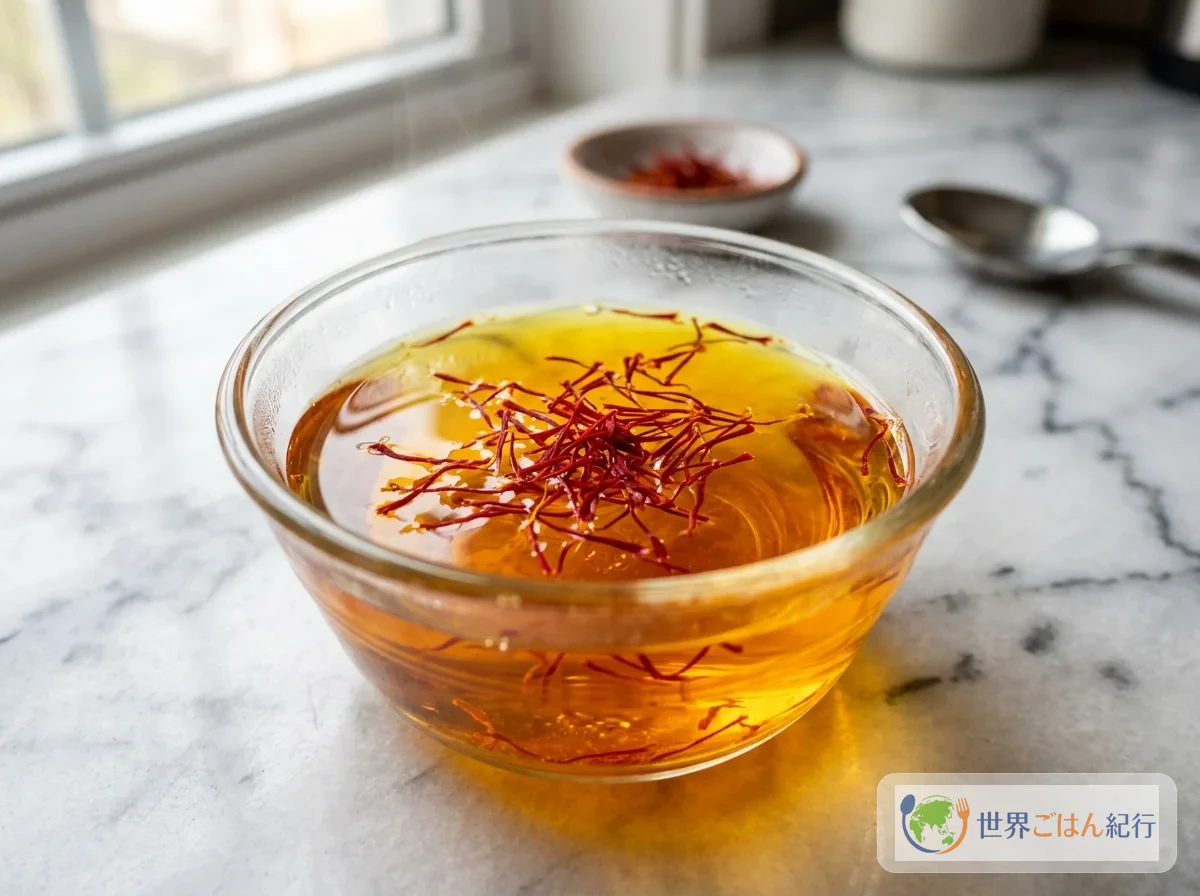
Saffron's aroma is the core of shah plov. Cheap saffron is sometimes bulked out with coloring: it tints the rice but barely smells of anything. Choose Spanish La Mancha or Iranian saffron, and make the saffron water by steeping it in 3 tbsp boiling water 30 minutes before you use it. Good saffron is expensive, but 0.5 g is enough for six servings.
Qazmaq (pastry dough)
| Ingredient | Amount | Substitutes & notes |
|---|---|---|
| Cake flour (or all-purpose flour) | 200 g | About 1 2/3 US cups |
| Egg | 1 | — |
| Butter, melted | 30 g | About 2 tbsp |
| Salt | 1/4 tsp | — |
| Saffron water | 1 tbsp | Taken from the saffron water above |
| Water | 60 ml | About 1/4 cup. Adjust to the feel of the dough |
Qazmaq is one of the key ideas in Azerbaijani pilaf cooking. It is the crisp crust that forms on the bottom of the pot; in an everyday plov it is made from a thin layer of bread dough or sliced potatoes. Shah plov takes the idea further and uses the dough as a "vessel" that wraps the whole pilaf. For many cooks, the qazmaq is the best part of the plov.
Dried fruit and chestnuts
| Ingredient | Amount | Notes |
|---|---|---|
| Dried apricots | 2.75 oz (80 g) | Halved |
| Prunes (pitted) | 2 oz (60 g) | Halved |
| Raisins | 2 oz (60 g) | Golden raisins (sultanas) recommended |
| Dried cranberries | 1.5 oz (40 g) | Optional |
| Chestnuts (roasted, peeled) | 2.75 oz (80 g) | Ready-to-eat roasted or candied chestnuts are fine |
| Butter (for sautéing) | 1 oz (30 g) | About 2 tbsp |
This dish contains wheat flour (the dough), egg, dairy (butter), and chestnuts. Leave out the chestnuts if you need to avoid nuts. For a gluten-free version, skip the qazmaq and cook it as a regular Azerbaijani-style plov.
Steps
1Soak the basmati rice
30 min
Put 1 lb (500 g) basmati rice in a bowl and wash it in plenty of water 3–4 times. When the water runs clear, soak the rice for 30 minutes in water with 1 tbsp salt added. Soaking lets every grain absorb water evenly so no hard core is left after cooking.
Meanwhile, steep 1/2 tsp saffron in 3 tbsp just-boiled water to make saffron water, and soak the dried fruit in lukewarm water for 10 minutes to soften it.
2Make the qazmaq dough
20 min
Put 7 oz (200 g) flour and 1/4 tsp salt in a bowl and make a well in the center. Add 1 egg, 1 oz (30 g) melted butter, 1 tbsp saffron water, and ¼ cup (60 ml) water, and knead by hand into a smooth dough. Knead for about 5 minutes until springy, then wrap in plastic wrap and let rest for 15 minutes.
The saffron tints the dough a pale gold, and that is the color it will bake to, so be careful: too much saffron water makes it too dark, too little leaves it pale.
How firm should the dough be?Aim for slightly firmer than an earlobe. Dough that is too soft tears in the pot and the pilaf leaks out; dough that is too firm won't bake crisp and turns rubbery. Flours absorb water differently, so treat ¼ cup (60 ml) water as a guide and add it a little at a time.
3Parboil the rice
7 min
Bring a large pot of water to a boil and add 1 tbsp salt. Drain the soaked basmati, add it to the boiling water, and boil for 7 minutes. You are not cooking it through, only about 70 percent of the way.
Bite a grain: it is perfect when the outside is tender and a tiny hard core remains in the center. Drain in a colander and let the excess water drip off.
Don't overcook itPast 8 minutes the rice gets too soft and turns mushy during the steaming that follows. Use a timer and drain it at exactly 7 minutes. Like pasta cooked al dente, the key is not to cook it through at this stage.
4Sauté the dried fruit in butter
5 min
Melt 1 oz (30 g) butter in a skillet over medium heat. Add the drained halved apricots and prunes, the raisins, and the cranberries, and sauté for 3 minutes. When the fruit plumps up and the butter is bubbling and glossy, add the chestnuts, sauté for 1 minute more, and turn off the heat.
Sautéing the dried fruit in butter marries the fruit's sweetness with the richness of the butter, and makes it stand out against the saffron rice.
5Line the pot with the qazmaq
10 min
On a floured surface, roll the rested dough into a 0.125 inch (3 mm) thick round, about 4 inches (10 cm) wider than the mouth of your pot. Generously butter the bottom and sides of the pot (a heavy pot 9 1/2–10 inches (24–26 cm) across is ideal) with 20 g butter.
Lay the dough into the pot. Press it against the bottom, run it up the sides, and leave about 2 inches (5 cm) hanging over the rim. This overhang is folded over at the end to form a lid.
6Layer the pilaf and fruit
5 min
Spread half of the parboiled rice evenly in the lined pot. Scatter all of the dried fruit over it evenly, then cover the fruit with the remaining half of the rice.
Drizzle the rest of the saffron water (about 2 tbsp) over the surface of the rice, then pour 1 oz (30 g) melted butter over everything so it reaches all the rice.
Fold the overhanging qazmaq inward to enclose the rice completely. Check that the rice stays fluffy rather than packed down and that the folded dough has no tears. If the overhang is too short, roll out leftover dough thinly and lay it on top as a lid.
7Bake-steam on the stove
60–70 min
Wrap the pot lid in a clean kitchen towel before putting it on. The towel absorbs the drops that form under the lid so the qazmaq doesn't go soggy.
Cook over medium heat for the first 10 minutes to brown the qazmaq on the bottom slowly. Then lower the heat to low and cook for 50–60 minutes. A light sizzle from the bottom of the pot and a toasty smell mean the qazmaq is browning just right.
The towel trickWrapping the lid in a cloth is a traditional technique shared by Azerbaijani and Iranian pilaf cooking. If steam condenses on the lid and drips onto the pilaf, the top layer of rice turns mushy and the qazmaq gets soggy. The towel soaks up those drops, so the pot lets steam circulate without dripping water. The same method is used for Iranian tahchin (see tahchin, in Japanese).
8Flip it and serve
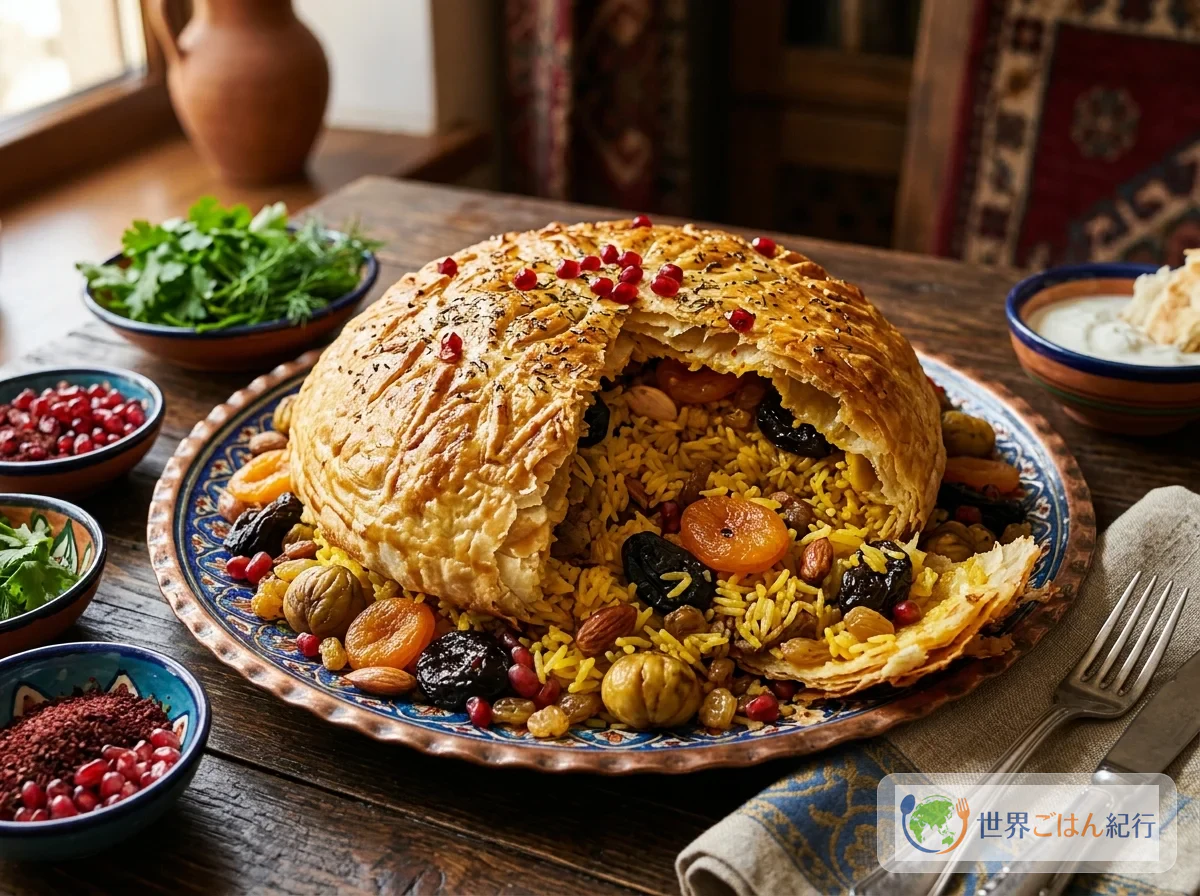
Turn off the heat and let it rest for 5 minutes. Now comes the big moment: set a large platter over the pot and flip it over in one go. Lift the pot slowly, and a golden dome of qazmaq appears, releasing the scent of saffron.
At the table, break open the top of the qazmaq with a knife or spoon, show off the pilaf and fruit inside, then serve. Crisp qazmaq, fluffy saffron rice, and sweet-tart dried fruit come together in every bite.