Ingredients and steps on one page. Print it, or choose “Save as PDF” in the print dialog.
Sekai Gohan
Ugro Palav: Tajik Pilaf with Hand-Cut Egg Noodles
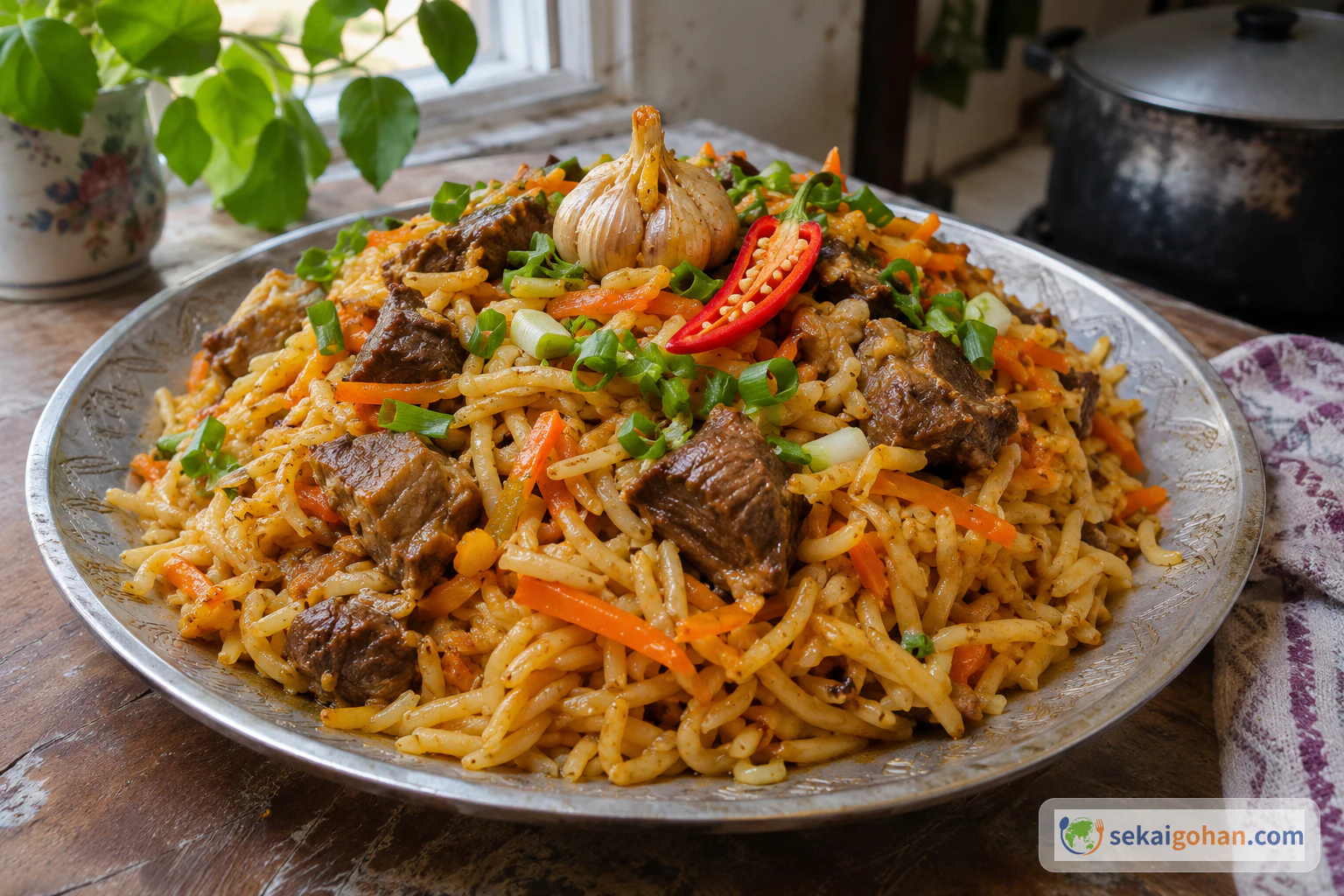
Ingredients
| Ingredient | Amount | Role |
|---|---|---|
| Large eggs | 3 | Bind the noodle dough and give it a pale yellow colour |
| Wheat flour | About 2 cups, as much as the dough takes | Body of the noodles. Add it until the dough is stiff |
| Salt, for the dough | A little | Seasons the noodles from inside |
| Lamb or veal, including bone-in pieces | 1⅓ lb (600 g) | Main flavour of the zirvak. Bones go in first for browning |
| Vegetable oil (or rendered tail fat) | ⅓ to scant ½ cup (80–100 ml) | Frying and cooking fat |
| Carrots, cut in long thin strips | 1 lb 2 oz (500 g) | Sweetness and colour |
| Large white onions, cut in half-moons | 2 | Sweet base of the zirvak |
| Garlic | 1 whole head, top papery skin peeled off | Cooks whole in the pot and is served on top |
| Dried red chilies | 1–2, whole | Aroma and gentle heat |
| Ground black pepper | ⅓ tsp | Seasoning for the zirvak |
| Cumin seeds (zira), for the zirvak | 1 tsp | The scent that makes it palav |
| Cumin seeds (zira), for the noodle mound | 1 tsp | Sprinkled over the noodles before the rest |
| Salt, for the zirvak | To taste, go easy | Seasoning. The noodles already have salt |
| Water | Enough to reach the top of the carrots, plus a little boiling water as needed | Cooks the zirvak and then the noodles |
| Green onions, chopped | To taste, generously. Wash well under running water before chopping | Fresh finish on the platter |
| Tomato and thinly sliced onion salad | As needed (optional). Wash the vegetables well under running water first | Fresh, sharp side dish |
Steps
1Make and rest the egg dough
Heap the flour on a board, make a well and crack in the 3 eggs with a little salt. Draw the flour into the eggs with your fingers until a shaggy mass forms, then knead it into a stiff dough, adding flour as needed. Once it holds together, knead for another 5–8 minutes. Let it rest for about 30 minutes. It is ready when it is firm, smooth and even all the way through and springs back slowly when pressed.
2Roll thin and cut fine noodles
Divide the dough into two pieces and roll each one out on a lightly floured surface to about ⅛ inch (3 mm) thick. Cut the sheets into strips 1¼–1½ inches (3–4 cm) wide. Stack 3–4 strips on top of each other and slice across them into very fine noodles. You are done when you have a pile of short, thin strands, all close to the same width.
3Shake the noodles apart and dry them overnight
Right after cutting, toss the noodles between your fingers and shake them apart. Spread them in a thin, loose layer on a board or wire rack and leave them to dry overnight. If you are short of space or time, dry them in a low oven with the door ajar. They are ready when they feel dry and stiff, separate easily, and are no longer tacky.
Drying decides the textureDry noodles stay separate in the pot. Damp ones glue together into lumps as soon as they meet the broth. Don't skip shaking them apart after cutting or the overnight drying. Together they are what makes the noodles cook up loose, like grains of rice.
4Heat the oil and brown the bone-in meat
Pour the oil into the heavy pot and heat it over medium-high. Drop in a pinch of salt. When it hisses sharply, the oil is hot enough. Add the bone-in pieces first and fry them, turning, until they are deep brown on all sides. The pot should sizzle steadily without smoking.
Hot oilIn Tajikistan the oil is traditionally heated in the dry cauldron until it smokes lightly. At home, stop at the salt test and never heat oil until it smokes. Lower the meat in gently, away from your body, and keep the pot handles turned in from the edge of the stove. If the oil starts to smoke, take the pot off the heat and let it cool a little before adding food.
5Fry the onion, the rest of the meat and the carrots, then add the spices
Add the onion half-moons and fry them until golden. Add the remaining meat and fry until browned. Add the long carrot strips and keep frying until they turn golden and start to soften. Add the black pepper, 1 tsp of the cumin seeds and the chilies, then set the whole head of garlic into the middle. The zirvak is ready when it smells of toasted cumin and the carrots are glossy and golden, with nothing scorched.
6Add water and simmer the zirvak
Pour in water until it reaches the top of the carrots and no higher. This is less water than a rice plov takes. Simmer gently over low heat for 30–40 minutes, or about 30 minutes for young veal. Taste the broth near the end and salt it lightly. It is done when the meat is tender and the broth tastes rich.
Salt with a light handThe noodles were salted in the dough, and they will soak up the broth. Season the zirvak less than tastes right on its own. Ugro palav goes too salty easily, and once the noodles have soaked up salty broth you cannot take it back out.
7Add the noodles and cook until the liquid is almost gone
Lift the garlic, chilies and bones out of the pot and set them aside. Scatter in the dry noodles. Fold them through from the bottom up with a wide slotted spoon so every piece reaches the broth. If the pot looks dry before the noodles soften, add a few spoonfuls of boiling water. Keep folding gently until the noodles are soft but still firm to the bite and the liquid has almost disappeared.
8Mound, cover and rest
Gather the noodles into a hill in the centre of the pot and scatter the second 1 tsp of cumin seeds over the top. Set the garlic, chilies and bones back on the mound. Cover tightly and cook over the lowest heat for 5 minutes. Turn the heat off. Seal the pot with a clean towel folded under the lid, or with a deep bowl turned upside down over it, and leave it for 20–25 minutes. When you uncover it, the noodles should be plump and separate, with no liquid left in the bottom.
9Mix and heap onto the platter
Lift off the garlic, chilies and bones again. Mix the noodles with the meat and carrot underneath, then heap everything high on a large round platter. Set the bones, garlic and chilies back on top and scatter green onion generously over it. Serve right away with the tomato and onion salad on the side, while the noodles are still steaming.