Ingredients and steps on one page. Print it, or choose “Save as PDF” in the print dialog.
Sekai Gohan
Manti: Uzbekistan's Big Steamed Lamb Dumplings
Ingredients
Dough
| Ingredient | Amount | Substitutes & notes |
|---|---|---|
| Bread flour | 300 g | All-purpose flour also works. Cake flour stretches poorly and tears easily, so avoid it |
| Water (room temperature) | 150 ml | About 2/3 cup |
| Egg | 1 | Gives the dough strength. Optional, but it makes the dough easier to handle |
| Salt | 1/2 tsp | — |
| Vegetable oil | 1 tbsp | Makes the dough supple |
Filling
| Ingredient | Amount | Substitutes & notes |
|---|---|---|
| Lamb (shoulder or leg) | 300 g | Hand-chopped is the standard. Ground lamb works, but the texture is different (about 10.5 oz) |
| Onions | 2 (400 g) | At least as much onion as meat is the Central Asian rule. The heart of the juiciness |
| Lamb fat (fat-tail fat) | 30 g | If hard to find, use a piece of beef suet. A source of flavor and juiciness |
| Ground cumin | 1 tsp | The key aroma of manti. Don't leave it out |
| Black pepper | 1/2 tsp | — |
| Salt | 1 tsp | — |
| Water | 2 tbsp | Adds moisture for a juicier filling |
Yogurt sauce
| Ingredient | Amount | Substitutes & notes |
|---|---|---|
| Plain yogurt (unsweetened) | 7 oz (200 g) | No need to strain. Use it at its natural thickness |
| Garlic (grated) | 1 clove | — |
| Salt | 1/4 tsp | — |
| Dried mint | 1 tsp | Chopped fresh mint also works |
Tomato sauce (optional)
| Ingredient | Amount | Substitutes & notes |
|---|---|---|
| Canned diced tomatoes | 1/2 can (7 oz / 200 g) | — |
| Butter | 15 g | About 1 tbsp |
| Paprika | 1/2 tsp | — |
| Salt | a pinch | — |
Steps
1Make the dough
10 min + 30 min resting
In a large bowl, mix 10.5 oz (300 g) bread flour and 1/2 tsp salt. Make a well in the center and add 1 beaten egg, ½ cup (150 ml) water and 1 tbsp vegetable oil. Stir roughly with chopsticks, then turn the dough out onto a floured surface and knead by hand. For 8–10 minutes, push, fold and turn the dough over and over until the surface is smooth.
Shape the kneaded dough into a ball about 4.5 inches (12 cm) across, wrap it in plastic, and let it rest at room temperature for at least 30 minutes. This resting time relaxes the gluten so the dough is easier to roll. Roll it without resting and it shrinks back and tears easily, so give it at least 30 minutes, or an hour if you have time.
2Make the filling
15 min
With a knife, chop 10.5 oz (300 g) lamb into rough pieces of about 0.25 inch (5 mm). Don't use a food processor. Chopping by hand keeps the meat fibers intact, so juices burst out when you bite in. That's the real pleasure of manti. In Central Asia, finely chopping the meat with a knife is considered the traditional method.
Finely chop 1 oz (30 g) lamb fat (fat-tail fat) as well. Fat-tail fat is hard to find in many places, so a piece of beef suet (about 20 g) makes a good substitute. Butchers can often supply suet for little or nothing.
Dice 2 onions into 0.25 inch (5 mm) pieces. Using as much onion as meat, or more, is the Central Asian rule. The moisture from the onions turns into a juicy broth as the manti steam. In Uzbek homes, the saying goes: "a little more onion than meat is just right."
In a bowl, combine the lamb, fat and onion, add 1 tsp ground cumin, 1/2 tsp black pepper, 1 tsp salt and 2 tbsp water, and mix well for 2–3 minutes. Work the seasonings through with your hands; the filling is ready when it has turned slightly sticky and glossy.
Cumin is the soul of mantiCumin is the foundational spice of Central Asian cooking. The scent of cumin in manti is what sets them furthest apart from Japanese gyoza. For an even richer aroma, lightly toast cumin seeds in a dry pan and grind them. If you don't like cumin, ground coriander can stand in, but the flavor will be quite different.
3Roll out and cut the dough
10 min
Turn the rested dough out onto the counter, dust it with flour and roll it thin with a rolling pin. Aim for a thickness of about 1/16 inch (1.5–2 mm). That's thicker than store-bought gyoza wrappers (about 0 inch (0.8 mm)), because the dough has to hold the weight of the manti filling. Roll it too thin and it will tear after you fill and shape it, letting the juices run out.
Cut the rolled dough into squares of about 4 inches (10 cm). A knife or pizza cutter gives clean edges. Gather the scraps, reroll them and use them too. You should get about 24 squares. The ideal thickness won't tear when lifted and lets a little light through.
Using store-bought dumpling wrappersLarge dumpling wrappers (4 inches (10 cm) or more across) can stand in. Store-bought wrappers are thin, though, so use 2 stacked together. Think of it as a backup plan for when there's no time to make the dough from scratch. The texture is different, but the flavor is still very good.
4Fill and fold: three ways to shape them
20 min
Place a generous tablespoon (about 25 g) of filling in the center of each square. Here are three folds; pick whichever shape you like.
[Beginner] Four corners together (Tashkent, Uzbekistan style)
Bring the four corners of the square together in the center and pinch them firmly closed. Then draw in the midpoints of the neighboring edges and pinch those too. You get a flower-like shape. This is the easiest fold and the one to start with.
[Intermediate] Boat-style closure (Kazakh style)
Lift opposite edges of the square (top and bottom) and join them in the center, then lift the left and right ends and join them in the center too. With all four sides gathered and sealed in the middle, you get a plump square shape.
[Advanced] Pouch shape (Turkish-style manti)
Lift the entire edge of the dough and twist the top to close it. It looks like a drawstring pouch, which is pretty and has the advantage of keeping the filling's juices from escaping.
Whatever fold you use, sealing them tightly matters most. If a seam is loose, the juices leak out while the manti steam and you lose all that precious broth. When you're done, each manti should have a flat bottom and a top seam that stays shut when you pinch it.
5Steam the manti
40–45 min
Brush the steamer tiers (in Uzbekistan, a dedicated manti steamer called a mantykaskan is used) with a thin coat of about 1 tsp vegetable oil. Arrange the manti about a finger's width (about 1 inch / 2 cm) apart so they don't stick to each other.
Bring water in the pot to a boil over high heat and set the steamer on top. Steam on high for the first 5 minutes, then reduce to medium and steam for 35–40 minutes more, for a total of about 40–45 minutes. A bamboo steamer or a stainless-steel steamer both work.
Mind when you lift the lidDon't open the lid for the first 20 minutes of steaming. A sudden temperature change makes the dough shrink and can cause the manti to burst. After 30 minutes, it's fine to open the lid once to check how they're doing. When the dough turns translucent and you can faintly see the filling's juices through it, they're done.
Manti aren't something to rush. As they steam slowly, the onions release moisture and the meat juices pool inside the dough. The broth that floods out when you bite in is the best part of eating manti.
6Make the yogurt sauce and finish
5 min
While the manti steam, make the sauce. Mix 7 oz (200 g) plain yogurt with 1 clove grated garlic, 1/4 tsp salt and 1 tsp dried mint. If the yogurt is straight from the fridge, let it sit at room temperature for 5 minutes; served not-too-cold, it suits the piping-hot manti. The cool mint brings out the rich flavor of the lamb, and the tang of the yogurt cuts through the fat in the filling.
For the optional tomato sauce, melt 15 g butter in a small saucepan, add 1/2 can tomatoes, and simmer over low heat for 5 minutes. When some of the liquid has cooked off and it has thickened, season with 1/2 tsp paprika and a pinch of salt. In Uzbek canteens it's common to pour both yogurt sauce and tomato sauce over the top, for a striking contrast of white and red.
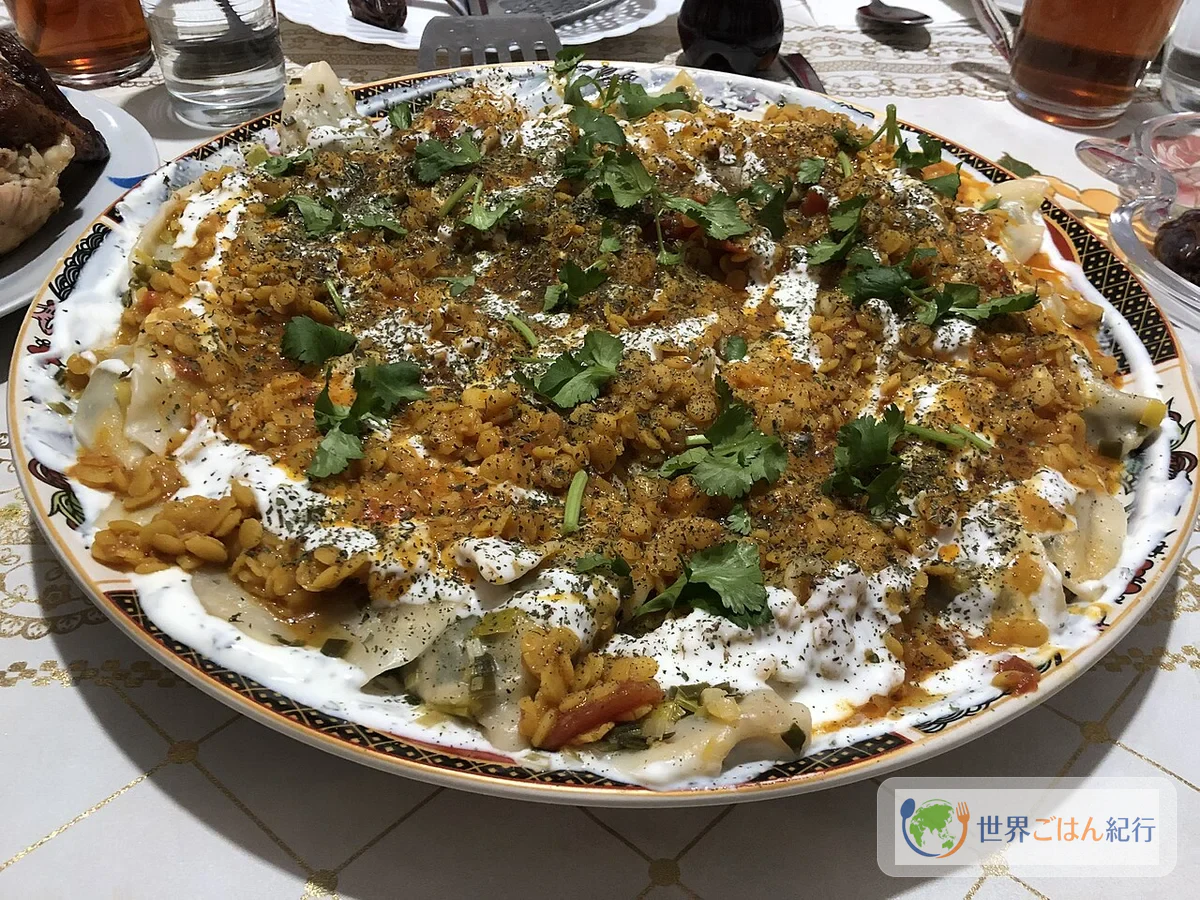
Plate the steamed manti and spoon plenty of yogurt sauce (and tomato sauce) over them. A scattering of dried mint or fresh mint leaves at the end adds both color and fragrance.