Ingredients and steps on one page. Print it, or choose “Save as PDF” in the print dialog.
Sekai Gohan
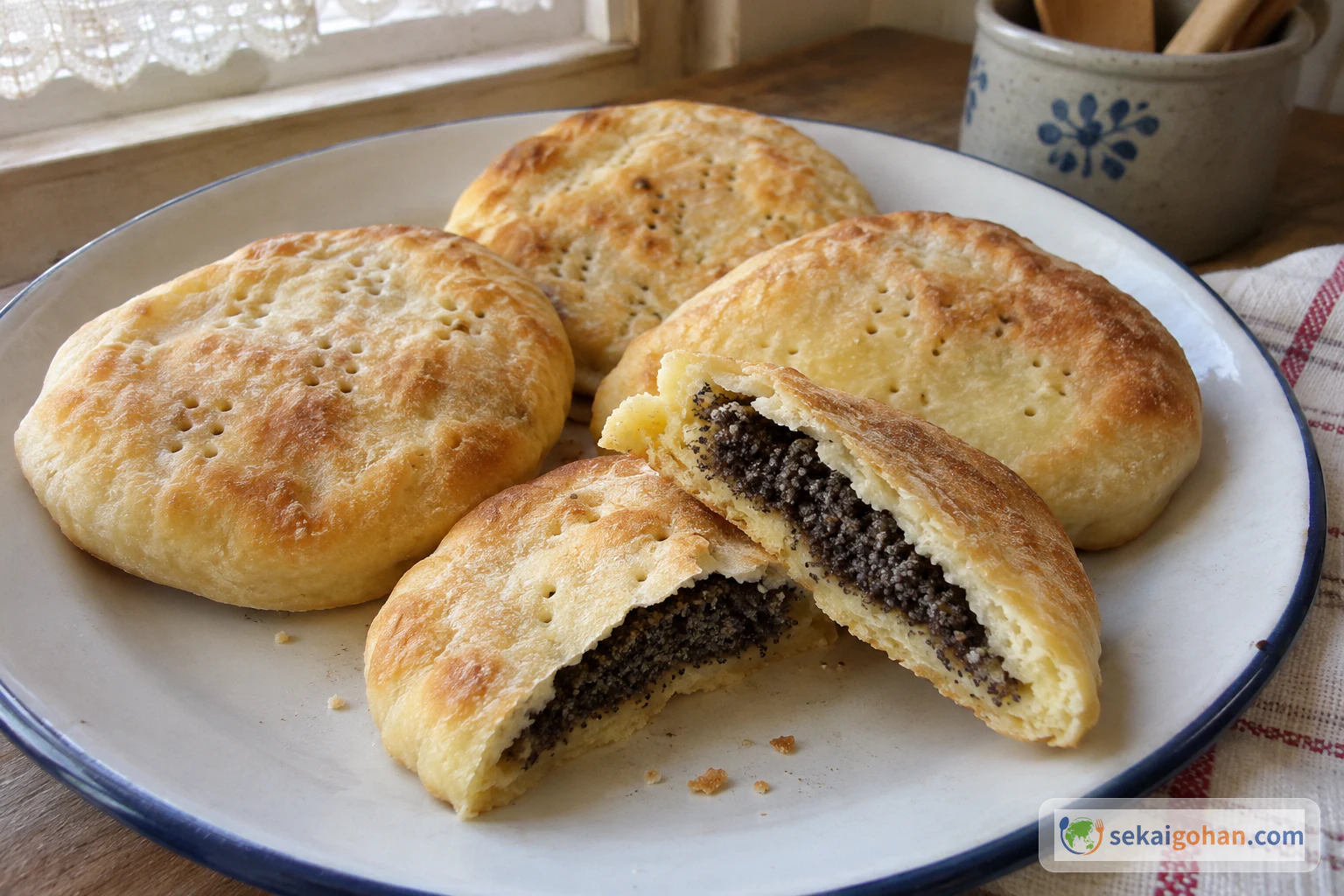
Mohnzelten: Austrian Potato Pastries Filled with Sweet Poppy Seed
Ingredients
| Ingredient | Amount | Role |
|---|---|---|
| Floury potatoes, boiled, cooled and riced (Erdäpfel) | 10½ oz (300 g) | Dough: softness and moisture |
| Plain soft wheat flour (glattes Mehl) | 1 lb 2 oz (500 g) | Dough: structure |
| Cold butter, finely chopped | 9 oz (250 g) | Dough: flavor and a short, tender bite |
| Sour cream (Sauerrahm) | 2 tbsp | Dough: richness, a light tang, binding |
| Eggs | 2 | Dough: binding, keeps the seams from cracking |
| Dry yeast (Trockengerm) | 1 sachet | Dough: a little lift and a bready aroma |
| Salt | ½ tsp | Dough: a savory edge against the sweet filling |
| Grey poppy seed, ground or crushed (Graumohn) | 14 oz (400 g) | Filling: the main flavor, nutty and dark |
| Granulated sugar | 4¼ oz (120 g) | Filling: sweetness, helps it hold its shape |
| Vanilla sugar | ½ tbsp | Filling: aroma |
| Honey | 1 tbsp | Filling: keeps it moist through chilling |
| Rum (optional) | 4 tsp (20 ml) | Filling: aroma |
| Milk | 1 cup (250 ml) | Filling: soaks the poppy so it sets firm |
| Melted butter | 3 oz (80 g) | Filling: smooth mouthfeel, binding |
| Ground cinnamon | a pinch | Filling: warmth |
| Powidl (thick plum butter) | 1 tsp | Filling: tartness and depth |
Steps
1Mix the filling and chill it
Put the ground poppy seed, sugar, vanilla sugar, honey, rum if using, milk, melted butter, cinnamon and Powidl into a bowl. Fold everything together with a wooden spoon until no dry seed is left and the mixture is evenly dark and glossy. Cover it, pressing plastic wrap onto the surface so it does not dry out, and refrigerate it for several hours or overnight. It is ready when a spoonful holds its shape and a lump squeezed in your hand stays a firm ball.
2Boil, cool and rice the potatoes
Boil the potatoes in their skins until tender, then let them cool completely. Peel them and press them through a potato ricer into a large bowl. Riced while still warm, they release steam and the dough turns sticky, so wait until they are cold through. You can boil them the day before and keep them in the refrigerator. Move on when the bowl holds fine, dry, pale strands with no lumps.
3Knead the dough
Add the flour, cold chopped butter, sour cream, eggs, yeast and salt to the riced potatoes. Work everything together with your hands, then knead until the dough is smooth. If it sticks, dust in a little flour at a time; too much flour makes the dough crumbly and hard to wrap. The dough is right when the surface looks smooth and a fingertip pressed into it springs back slowly.
4Divide the dough into 15 pieces
Lightly flour a board and roll the dough into an even log. Cut it into 15 equal pieces with a knife. Even pieces matter, because each one has to wrap a ball of filling of the same size. Line them up on the board as you go. They are ready when all 15 look the same size side by side.
5Shape the filling into 15 balls
Take the filling from the refrigerator and divide it into 15 portions. An ice cream scoop gives even portions quickly. Roll each one into a ball between your palms and set it on a parchment-lined tray. If the filling softens from the heat of your hands, wet your hands or put the tray back in the refrigerator for a few minutes. The balls are ready when they are firm, round and matte and keep their shape on the tray.
6Wrap the filling in dough
Press a piece of dough flat in your palm into a round. Set a ball of filling in the center and draw the edges up around it. Pinch the seam closed, then pinch it a second time to be sure. If the dough tears, press a thin scrap of dough over the hole. Each parcel is done when no filling shows anywhere and the seam is fully sealed.
7Press flat and prick the tops
Heat the oven to 425°F (220°C) on the convection setting. Set the parcels seam side down on a parchment-lined baking sheet with space between them. Press each one flat with your palm into an even disc, keeping the center no thicker than the edge; a thick center stays raw while the rim burns. Prick the top of each disc a few times with a fork so steam can escape and the color comes out even. They are ready to bake when the discs are flat and level with no cracks at the edges.
8Bake the first side
Put the sheet in the oven and bake for 15 minutes. Then take the sheet out. The underside is golden brown and the top is still pale.
9Turn and bake the second side
Turn each disc over with a thin spatula so the golden side faces up. Return the sheet to the oven and bake for 10 more minutes. Both bakes are needed: baked on one side only, the bottom burns before the top cooks through. They are done when both faces are an even golden brown, the sides have puffed slightly and the pastry feels springy when pressed.
10Rest and cool
Leave the pastries on the sheet for 5 minutes, then move them to a wire rack to cool. While warm, the filling is soft and the pastry breaks apart easily. As they cool, the dough firms and the filling sets. They are ready to cut when a knife passes through cleanly and the filling shows a dense, dark layer that holds its shape.