Ingredients and steps on one page. Print it, or choose “Save as PDF” in the print dialog.
Sekai Gohan
Flæskesteg: Denmark's Crackling Roast Pork for Christmas Eve
Ingredients
Roast pork
| Ingredient | Amount | Substitutes & notes |
|---|---|---|
| Skin-on pork belly block | 2.75 lb (1.2kg) | A cut close to Denmark's ribbenssteg. Choose one of even thickness |
| Coarse salt | 1 1/2 tbsp | For rubbing into the skin. Large-grained sea salt suits it |
| Black peppercorns | 1 tsp | Goes into the water in the roasting pan |
| Bay leaves | 5 | Pushed into the scores in the skin |
| Cloves (whole) | 10 | Optional. Can be omitted if you dislike them |
| Boiling water | about 2 cups (500 ml) | Enough to submerge the skin. Varies with the size of the pan |
Steps
1Score the skin
about 10 min
With a sharp knife or a utility cutter, make parallel cuts in the skin 0.25 inch to 0.5 inches (5 mm to 1 cm) apart. The trick is to cut firmly through to the fat layer under the skin without reaching the lean meat. Make each cut from one end of the block to the other without breaks. The skin is tough, so pull the knife in several passes to work your way through.
2Set skin side down in hot water and bake 20 minutes
Preheat the oven to 400°F (200 °C). Put the peppercorns and cloves in a heatproof roasting pan and set the pork in it skin side down. Pour in boiling water, about 2 cups (500 ml), enough to submerge the skin, and bake in the 400°F (200 °C) oven for 20 minutes. The water should be about 0.5–1 inches (1–2 cm) deep and cover the whole skin surface. Baking the skin soaked in water softens the hard skin, which makes it easier to re-cut the scores and rub in salt afterward.
3Turn it over and rub in salt
about 5 min
Take out the roasting pan and turn the pork over so the skin is on top. It is hot, so use tongs and heavy oven mitts. Run a knife along the scores in the softened skin once more, evening them out at 0.25 inch to 0.5 inches (5 mm to 1 cm) spacing and deep enough to reach the fat layer. Rub coarse salt deep into the scores with your fingers and push bay leaves into every second or third score. If the skin is tilted, only part of it will burn, so wedge crumpled aluminum foil under the lower side so the skin is level. Leave the water in the roasting pan as it is.
4Bake at 400°F (200 °C) for 50 minutes
Return the pan to the oven with the skin up and bake at 400°F (200 °C) for 50 minutes. If the water in the pan seems about to dry up partway, add about ½ cup (100 ml) boiling water. As long as water remains, the underside of the meat is less likely to burn, and these pan juices become the base of the gravy later. After 50 minutes, the surface of the skin is dry and hard, small bubbles have started to appear here and there, and it is a pale golden brown. Spots that still feel soft and flabby to a finger will be puffed in the next high-heat stage.
5Raise to 450°F (230 °C) to puff the skin
10–20 min
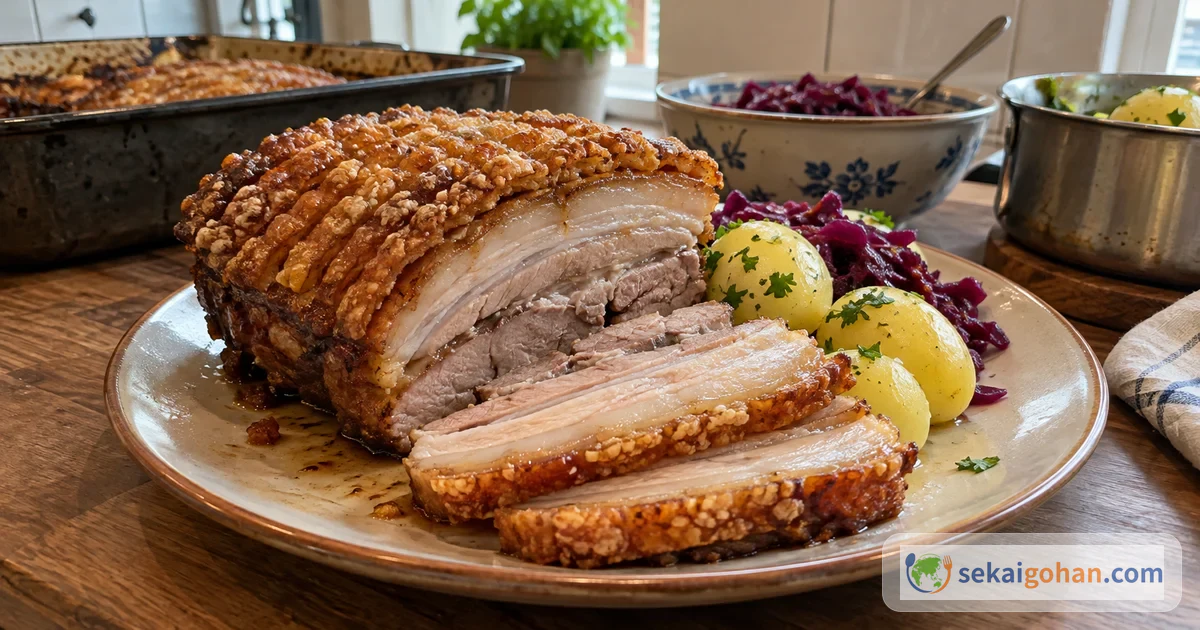
Move the water from the roasting pan into a heatproof container and keep it. Raise the oven to 450°F (230 °C), return the pork, and bake 10 minutes. It is done when the whole skin has puffed like small bubbles and tapping it with a finger gives a dry "knock-knock" sound. If soft spots remain, rotate the pan and add 5 minutes at a time. At this stage the skin goes from golden to black in a few minutes, so do not leave the front of the oven. When it is done, insert a thermometer in the thickest part and confirm that the center has been heated to 167°F (75 °C) for at least 1 minute.
6Rest 15 minutes and carve
Set the roast on a rack and rest it for about 15 minutes without covering it with a lid or foil, because covering lets the steam soften the skin. Remove the burnt bay leaves and cut along the scores in the skin into slices about 0.5 inches (1.5 cm) thick. If the skin is hard to cut, cutting the skin first with kitchen scissors makes clean slices.