Ingredients and steps on one page. Print it, or choose “Save as PDF” in the print dialog.
Sekai Gohan
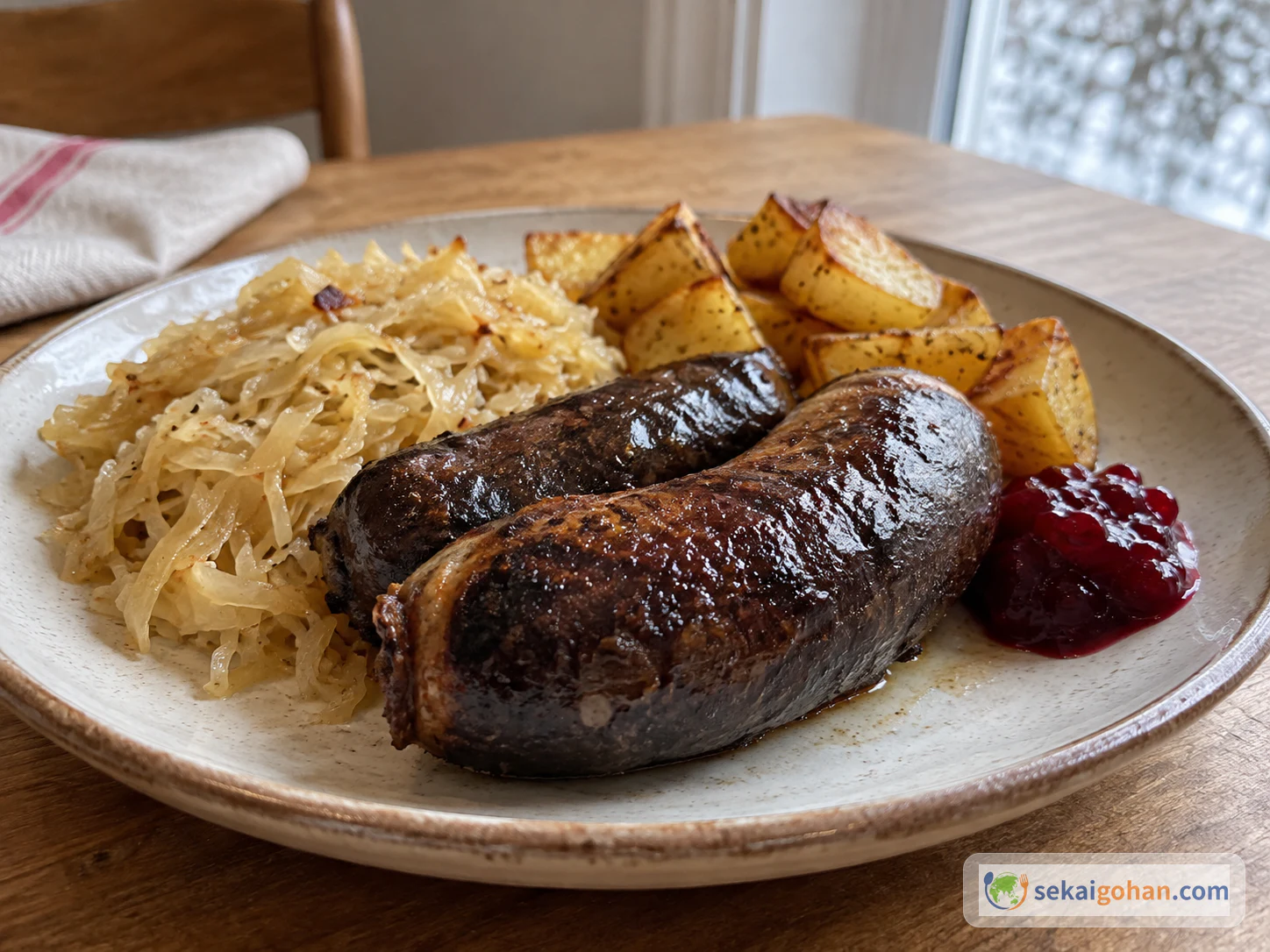
Verivorst: Estonian Blood and Barley Sausage
Ingredients
| Ingredient | Amount | Role |
|---|---|---|
| Raw fatty pork, such as shoulder or belly (liha) | 1.5 lb (625 g) | Meat and fat. Use fresh, not cured or salted, pork |
| Whole pearled barley groats (odrakruubid) | 1 lb (500 g), weighed before cooking | The body of the filling |
| Onion | 9 oz (250 g) | Chopped or diced; browned with the pork |
| Food-grade pig blood (veri) | 2 cups (500 ml), up to about 2½ cups (600 ml) if needed | Binds and colors the filling. Strain before use |
| Water for the barley | 1.25 quarts (1.25 L) | For simmering the groats |
| Water for the pork | a little | Starts the pork cooking and helps release its fat |
| Water for poaching | as needed | For cooking the filled sausages |
| Salt | to taste | A little in the barley water and poaching water; to taste in the filling |
| Black pepper | to taste | Seasons the filling |
| Dried marjoram | about 1 heaped tbsp | Main herb |
| Oregano | to taste | Seasons the filling |
| Caraway | to taste | Seasons the filling |
| Salted natural hog casings | up to 10 m | Hold the sausage. Prepare only what you use |
| Bay leaves | 1–2 | Optional; for the poaching water |
| Cooking oil | a little | For greasing the baking tray |
Steps
1Simmer the barley
Wash the barley and put it in a large pot with 1.25 quarts (1.25 L) water and a little salt. Simmer over fairly low heat for about 45 minutes, but go by the grain rather than the clock. Stop when the grains have swollen but remain whole and separate, not porridge. If the water runs short, add hot water. If any is left at the end, drain it off.
2Brown the pork and onion
Cut the pork into knuckle-sized chunks. Heat them in a heavy pot with a little water until the fat renders and the pork starts to brown. A frying pan also works for browning. Add the onion and cook until brown, about 30 minutes.
3Combine, season and cool
Mix the pork and onion into the barley. Season with black pepper, marjoram, oregano and caraway, then leave the mixture to cool. The blood does not go in yet.
4Fold in the blood and test the seasoning
Wait until the mixture is no warmer than you can comfortably stir by hand, because heat will set the blood. Strain the blood through a fine sieve, then pour in 2 cups (500 ml) and fold gently so that it doesn't foam.
The filling should flow through a funnel with only slight guidance. If it is too thick, add more blood up to about 2½ cups (600 ml).
Take about 1 tsp of the filling and fry it until cooked through. Taste the cooked spoonful and adjust the salt, adding it gradually so that you don't overdo it. If the blood is already salted, check its label before adding more. Do not taste the filling raw.
5Prepare and fill the casings
Rinse the casings twice, then soak them in water. Fit a casing over the funnel and fill it loosely, to less than three-quarters full. Leave slack at both ends and tie them with thread. Short lengths of 10–12 cm mean you lose less if one bursts. Poach the sausages right away rather than leaving them to stand.
6Poach without boiling
Heat a wide pot of water with a little salt and the bay leaves, if using. Lower in the sausages and keep the heat below a boil for 15–20 minutes, because boiling can burst the casings.
If a sausage floats, air is trapped inside. Use a clean, fine needle to make a small hole only where needed. Keep poaching until the hole no longer releases red liquid. The temperature check comes later.
7Drain on a rack
Lift the sausages onto a wire rack and let them drain. If you aren't baking them right away, cool them quickly and refrigerate at 50°F (10°C) or below.
8Bake until crisp
Grease a baking tray with oil and lay the sausages on it. Bake at 350°F (175°C) for 20–30 minutes, until the casing is crisp. Thick sausages may need longer, up to about 1 hour. Avoid a much hotter oven, as high heat can burst the casings.
9Check the center temperature
Insert a food thermometer into the center of the thickest part of a sausage. It must reach 167°F (75°C) and stay there for at least 1 minute. If it falls short, keep baking and check again. Do not judge doneness by time or color.
10Serve
Serve hot. Sauerkraut, potatoes and lingonberry jam are all optional, traditional accompaniments.