Ingredients and steps on one page. Print it, or choose “Save as PDF” in the print dialog.
Sekai Gohan
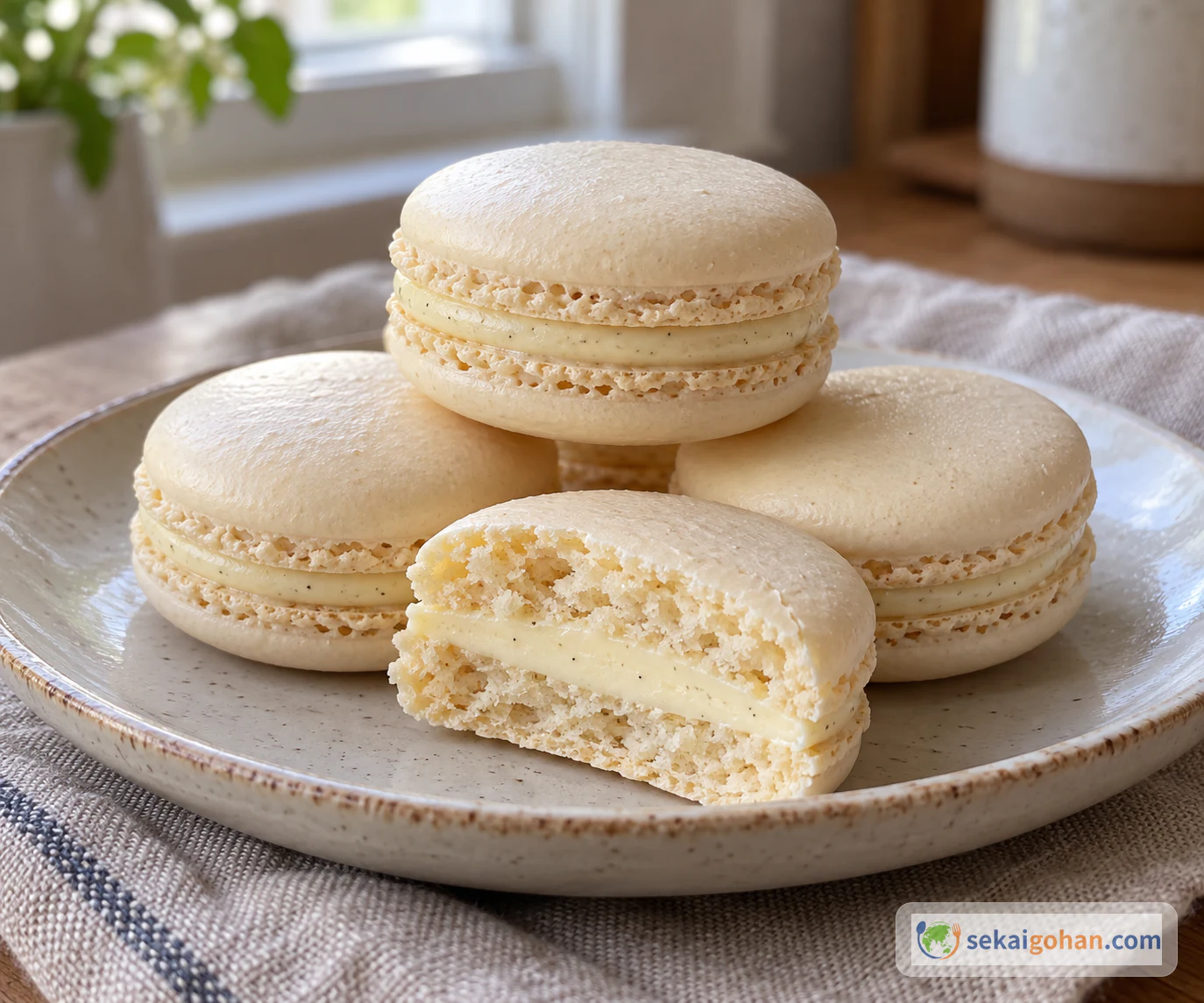
French Macarons: Parisian Almond Sandwich Cookies, From Batter Check to Home Oven
Ingredients
Shells
| Ingredient | Amount | Role and how to choose |
|---|---|---|
| Egg whites, room temperature | 2.75 oz (75 g) | Separate the eggs and weigh the whites rather than counting eggs by size |
| Granulated sugar | 2.75 oz (75 g) | Whipped into the meringue. Don't change the type or ratio of sugar |
| Cream of tartar | 1/4 tsp | Part of the formula. Leaving it out changes the recipe |
| Confectioners' sugar | 3.5 oz (100 g) | Sifted together with the almond flour |
| Almond flour | 3 oz (85 g) | As fine and dry as you can find |
Filling
| Ingredient | Amount | Notes |
|---|---|---|
| French buttercream, finished (vanilla) | 7 oz (200 g) | Prepared in advance, or weighed out of the full batch below |
Optional: French buttercream, full separate batch
This is a separate recipe that makes about 4 cups, far more than the 200 g the macarons need. If you make it, make the whole batch and weigh 200 g from it.
| Ingredient | Full batch |
|---|---|
| Granulated sugar | 10.5 oz (297g) |
| Water | 4 oz (113g) |
| Egg yolks from large eggs | 8 |
| Table salt | 1/8 tsp |
| Vanilla bean paste | 14g |
| Unsalted butter, room temperature | 1 lb (454g) |
Steps
1Have the buttercream ready (or make the full batch)
If you are using 7 oz (200 g) of buttercream you've already prepared, simply have it ready and skip to step 2.
If you are making the full batch yourself: bring the 10.5 oz (297g) sugar and 4 oz (113g) water to a boil over medium heat, about 5 minutes, swirling the pan occasionally so the sugar dissolves. Lower the heat to keep it at a gentle boil. Meanwhile, whip the 8 egg yolks on medium-high speed for about 5 minutes, scraping down the bowl partway through. Add the salt and mix on medium speed for 30 seconds.
When the syrup reaches 240–250°F (116–121°C), take it off the heat. With the mixer running on medium, pour the syrup carefully in a thin stream down the side of the bowl into the yolks. Don't pour it onto the whisk. Once all the syrup is in, whip on high speed for about 5 minutes, until the mixture is pale and fluffy and has cooled to 80–90°F (27–32°C).
Return to medium speed and add the butter 1–2 tablespoons at a time, letting each addition blend in before the next, until all of it is in. Finally add the vanilla bean paste and mix on medium for 30 seconds. Weigh out 7 oz (200 g) for the macarons. The rest is surplus.
Hot syrupThe sugar syrup is very hot and can cause serious burns. Pour slowly and keep hands and face clear of the bowl. The temperatures above are for cooking the syrup and cooling the mixture enough for butter. They do not show that the egg yolks are pasteurized.
2Line the pan, start the whites, and sift the dry ingredients
Line a flat baking sheet with parchment paper. If you use a template, draw circles about 1 3/4 inches (about 4.4 cm) across.
Put the room-temperature egg whites (2.75 oz / 75 g), granulated sugar (2.75 oz / 75 g) and cream of tartar (1/4 tsp) in the mixer bowl and mix on medium speed for about 3 minutes to help dissolve the sugar. While it mixes, sift the confectioners' sugar (3.5 oz / 100 g) and almond flour (3 oz / 85 g) together into a bowl.
3Whip to glossy medium peaks
Raise the speed to medium-high and whip for 5–6 minutes. The meringue should be thick and glossy, and when you lift the whisk, the peak should stand with its tip bending over slightly, like the top of a soft-serve cone. Don't whip until it is dry and the peaks stand straight up.
4Fold the batter (macaronage)
Add the meringue to the sifted dry ingredients. Fold gently at first; once it is mostly combined, fold more firmly. There is no need to add the meringue in two portions; what changes is the motion, from gentle folding to firmer folding.
When no dry streaks remain, spread the batter against the side of the bowl with the spatula and fold it back over itself. This pressing and turning is macaronage. Stop when the batter is glossy, falls from the spatula in a ribbon, and the trail slowly sinks back into the surface.
5Pipe even rounds and release the air
Fill a piping bag fitted with the 1/2-inch (about 1.3 cm) round tip and pipe circles about 1 3/4 inches (about 4.4 cm) across onto the parchment. The batter is loose enough when the little peak left by the tip smooths out. Rap the baking sheet on the counter several times to knock out air bubbles.
6Rest uncovered until a skin forms
Leave the piped rounds uncovered at room temperature for at least 30 minutes, and up to 2 hours when the air is humid. They are ready when the surface looks matte, a thin skin has formed, and a light touch leaves no batter on your finger. Go by the surface rather than the clock.
7Bake, then cool completely on the pan
Bake in an oven preheated to 320°F (about 160°C) for 15–20 minutes, until the tops are set. If the shells start to take on color, lower the temperature to 300°F (about 149°C) and let them finish setting. Note your rack position, preheating and any convection setting so you can adjust next time.
Let the shells cool completely on the baking sheet. If they stick to the parchment, put the whole baking sheet in the freezer for 15–20 minutes, then lift them off.
8Pair the shells and fill
Match the shells into pairs of similar size. Pipe a heaping teaspoon of buttercream onto one shell of each pair, then set the other shell on top and press gently until the filling reaches the edge evenly all around.
9Rest in the refrigerator, then bring to room temperature
Place the filled macarons in an airtight container and refrigerate for 24–48 hours, so the shells soften slightly against the filling. Take them out at least 1 hour before eating.