Ingredients and steps on one page. Print it, or choose “Save as PDF” in the print dialog.
Sekai Gohan
Pain au Chocolat: Laminated French Chocolate Pastry (Chocolatine)
Ingredients
Dough
| Ingredient | Amount | Role |
|---|---|---|
| Croissant flour (T55 type, about 11–12% protein) | 1.5 lb (700g) | Main dough flour |
| Plain (all-purpose) flour (about 9–10% protein) | 10.5 oz (300g) | Softens the dough flour blend |
| Salt | 25g | Dough |
| Sugar | 4 oz (120g) | Dough |
| Fresh yeast | 1.5 oz (40g) | Leavening. Use fresh yeast as listed |
| Whole milk | 9.5 oz (265g), 41°F (5°C) | Dough liquid |
| Water | 9.5 oz (265g), 77°F (25°C) | Dough liquid |
| Unsalted butter, softened | 1 oz (30g) | Dough butter |
Butter block
| Ingredient | Amount | Role |
|---|---|---|
| Regular unsalted butter | 1 lb (500g) | Laminating butter |
| Plain flour or croissant flour | 1.75 oz (50g) | Mixed into the regular butter for the block |
Filling
| Ingredient | Amount | Role |
|---|---|---|
| Chocolate batons | 3 per pastry | The chocolate core |
Egg wash
| Ingredient | Amount | Role |
|---|---|---|
| Whole eggs | 2 | Egg wash |
| Egg yolks | 2 | Egg wash |
For working
| Ingredient | Amount | Role |
|---|---|---|
| Flour for dusting | As needed | Keep to the minimum |
Steps
1Mix and knead the dough, then chill it overnight
Combine the milk at 41°F (5°C), the water at 77°F (25°C) and the fresh yeast, then add the croissant flour, plain flour, salt, sugar and the 1 oz (30g) softened butter. Knead for 8 minutes on low speed, then 7–8 minutes on medium speed as a starting point. Mixers differ, and it can take up to about 15–18 minutes in total. The dough is ready when you can stretch a small piece into a thin film that light shows through.
Shape the dough into a rectangle, wrap it in plastic wrap leaving some room for it to expand, and refrigerate for 8–15 hours, ideally 12 hours. This long cold rest builds flavor and gives you a firm, cold dough that is easier to laminate.
2Shape the butter block and chill it overnight
Mix the 1 lb (500g) regular unsalted butter with the 1.75 oz (50g) flour, then shape it into an even sheet 12 inches (30 cm) by 20 cm. Keep the thickness uniform so it rolls out at the same rate as the dough. Refrigerate the block overnight alongside the dough.
Before laminating, let the butter reach about 11–15°C (59°F at the top of that range) as a guide. Too cold and it cracks inside the dough; too warm and it smears into the dough. You want butter that bends without breaking and without feeling greasy.
3Enclose the butter in the dough
Roll the cold dough out to about twice the width of the butter block. Place the butter in the center, bring the two sides of dough over it so they meet, and seal the seam. Dust the work surface lightly; too much flour gets trapped between the layers.
4Make three letter folds, chilling between each
Roll the dough into a long, even rectangle and fold it in thirds like a letter. After the first fold, freeze for 10 minutes, then refrigerate for 5 minutes. Roll and fold again; after the second fold, freeze for 15 minutes, then refrigerate for 10 minutes. Make the third fold, freeze for 15 minutes and refrigerate for 10 minutes, then refrigerate for a further 30 minutes.
If at any point the butter starts to soften and smear, or feels hard enough to crack, do not rush on. Chill the dough or let it sit briefly until the butter is pliable again.
5Roll out the final sheet and cut rectangles
Roll the laminated dough to about 0.5 inches (1 cm) thick; 0.25 inch (5 mm) is ideal. Cut it into 6.5 inches (17 cm) by 8 cm rectangles with a ruler and a pastry wheel or sharp knife, cutting cleanly rather than dragging so the layers at the edges stay open.
6Roll each rectangle around three chocolate batons
Place two chocolate batons along the top edge of a rectangle and roll the dough over them. Lay the third baton where the first turn overlaps, then continue rolling. Set each pastry seam side down on a baking tray, leaving space between them, about 6 per tray.
7Proof until doubled and jiggly
Proof the pastries in a switched-off oven with ½ cup (150 ml) of hot water in a container, replacing the water every 30 minutes. This water is only for the proofing environment and is separate from the dough water. Watch out: if the oven gets too warm, the butter leaks out. Check the temperature inside with a thermometer, use less hot water if it is getting warm, and if you cannot keep the space gently warm rather than hot, proof at room temperature instead.
Allow about 2.5–3 hours as a guide, though it can take as long as 5 hours depending on conditions. Judge by the pastry, not the clock: they should at least double in volume, look puffy, and jiggle gently when you move the tray.
8Rest for 10 minutes, then brush with egg wash
Beat the 2 eggs and 2 egg yolks together. Take the proofed pastries out of the oven and leave them at room temperature for 10 minutes so the surface settles; use this time to preheat the oven to 350°F (180°C), no fan. Brush a thin coat of egg wash over the top of each pastry, avoiding the cut edges where the layers show, since wash there can glue the layers together.
9Bake each tray to a deep golden brown
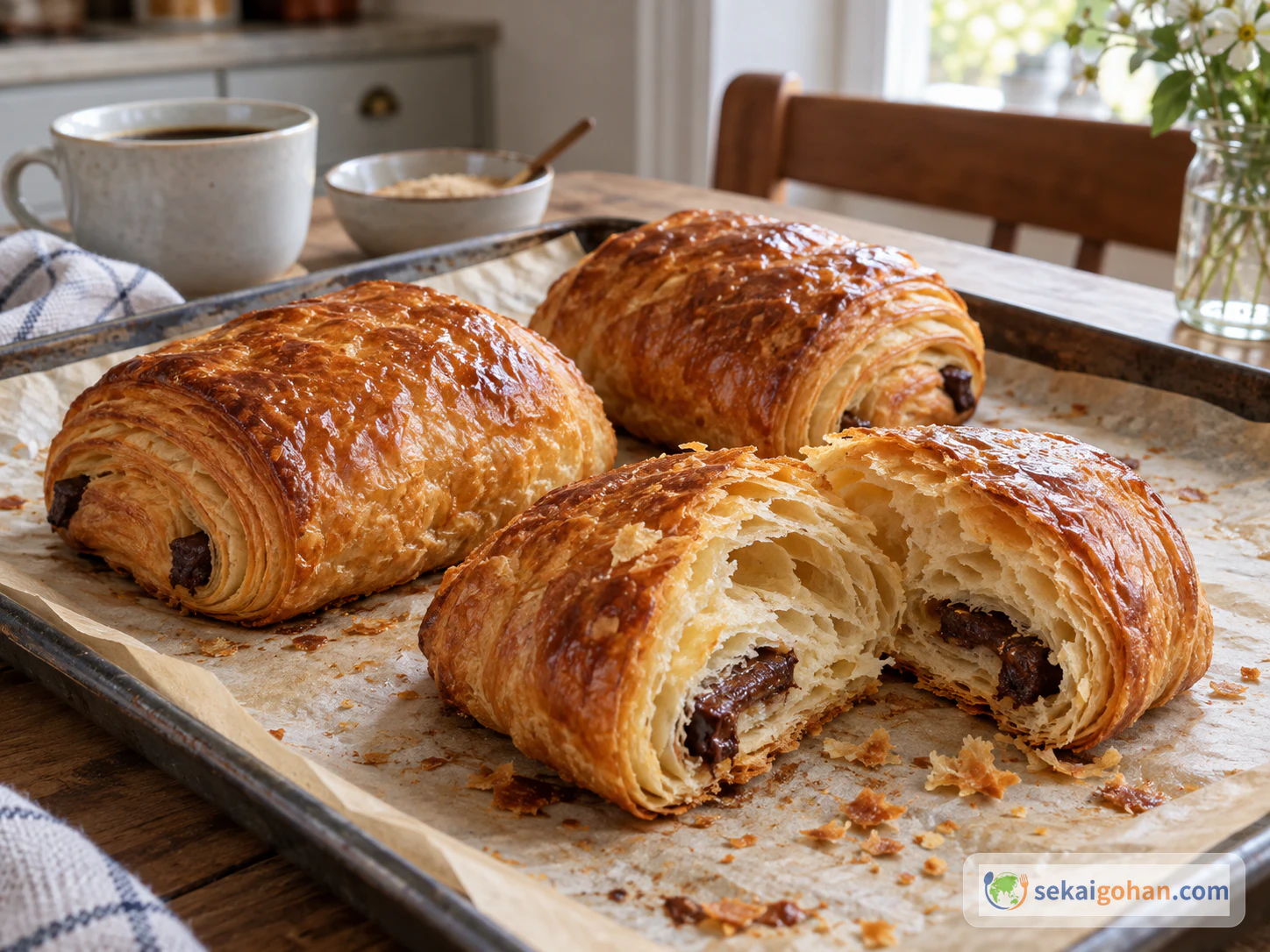
Bake one tray at a time at 350°F (180°C), no fan, for 25–30 minutes, until deep golden brown. This time is per tray, not for the whole batch. Home ovens vary, so let the color guide you as much as the timer. Let the pastries cool after baking before serving; the chocolate inside is very hot straight from the oven.