Ingredients and steps on one page. Print it, or choose “Save as PDF” in the print dialog.
Sekai Gohan
Pissaladière: Nice's Onion Tart with Anchovies and Olives
Ingredients
Dough
| Ingredient | Amount | Role & substitutes |
|---|---|---|
| Bread flour | 180 g | Makes a chewy base. You can use all medium-strong flour instead |
| Cake or all-purpose flour | 70 g | Lightens the bite. Without it, 250 g bread flour also works |
| Lukewarm water | 150 ml | 35 to 38°C (95–100°F). Too hot slows fermentation |
| Dry yeast | 3 g | A scant 1 tsp |
| Sugar | 6 g | Helps fermentation. 1 tsp honey also works |
| Salt | 5 g | For the dough. Count it separately from the salt for the onions |
| Olive oil | 20 ml | Adds aroma and suppleness to the dough |
Onions and finish
| Ingredient | Amount | Role & substitutes |
|---|---|---|
| Onions | 1.5 lb (700 g) | About 4 medium. Thinly sliced |
| Olive oil | 3 tbsp (45 ml) | Sweetens the onions without scorching |
| Garlic | 1 clove (5 g) | Crush it, just for aroma. Skip if you dislike it |
| Thyme | 2 sprigs | 1/2 tsp if dried |
| Bay leaf | 1 | Tightens the sweetness of the onions slightly |
| Salt | 3 g | For the onions. Keep it light, depending on the salt of the anchovies |
| Black pepper | a little | A light dusting just before baking |
| Anchovy fillets | 10 to 12 (about 1.25 oz (35 g)) | Rinse lightly if salt-packed; drain the oil if oil-packed |
| Black olives | 16 to 20 (about 2 oz (60 g)) | Niçoise olives are ideal. Pitted black olives are fine |
| Herbes de Provence | 1/2 tsp | Optional. Too much leaves only a dry aroma |
Steps
1Knead the dough and let it rest
12 min
No heat is needed. Keep the lukewarm water at 35 to 38°C (95–100°F). Put the bread flour, cake flour, dry yeast and sugar in a bowl and mix, then add the lukewarm water and olive oil. When no dry flour remains, add the salt and knead by hand for 8 minutes. The surface should be slightly smooth, and pressed with a finger it should spring back slowly. Round it, return it to a lightly oiled bowl, cover it so it doesn't dry out, and rest it for 30 minutes.
2Slice the onions thin
10 min
No heat is needed. Halve the onions lengthwise and, leaving a little of the core, slice along the grain 2 mm to 0.125 inch (3 mm) wide. Sliced onions should be thin ribbons that separate one by one when you loosen them lightly with your fingers and sit airily in the bowl. Cutting across the grain into rings makes them collapse quickly, but they tend to release too much water and turn into sweet mud. Crush the garlic, tear the anchovies lengthwise in half if large, and blot the black olives dry.
3Cook the onions slowly
35 min
In a heavy skillet, put 3 tbsp (45 ml) olive oil, the garlic, onions, thyme and bay leaf and warm over medium-low heat for 5 minutes. When the onions have softened, add 3 g salt, drop to low heat and cook 25 to 30 minutes. The guide is a small sizzle on the bottom of the pan without the edges browning and burning. Push them aside with a wooden spoon: when they slowly flow back and the whole is pale amber, turn off the heat. If they are about to scorch, add 1 tbsp water and scrape the bottom of the pan.
4Roll out the dough onto the baking sheet
8 min
Preheat the oven to 220°C (430°F). Press the dough lightly to release air and stretch it to about 30 cm × 24 cm on a baking sheet lined with parchment. The oven isn't being used for baking yet, but heat it properly now. The thickness is 5 to 7 mm in the center and slightly thicker at the edge. At this step you are not adding color; the dough should be soft, lift without tearing, and a fingerprint should spring back shallowly. Too thin and it can't hold the oil from the onions; too thick and it reads as bread.
5Spread the onions thick
5 min
No heat is needed. Remove the bay leaf and any large thyme stems and spread the onions over the center of the dough. Leave about 0.5 inches (1 cm) at the edge, keep the center slightly thicker, and don't make the edge too thin. Dust lightly with black pepper. Taste the salt of the onions here, and if they are already salty enough, use fewer anchovies.
6Arrange the anchovies and olives
5 min
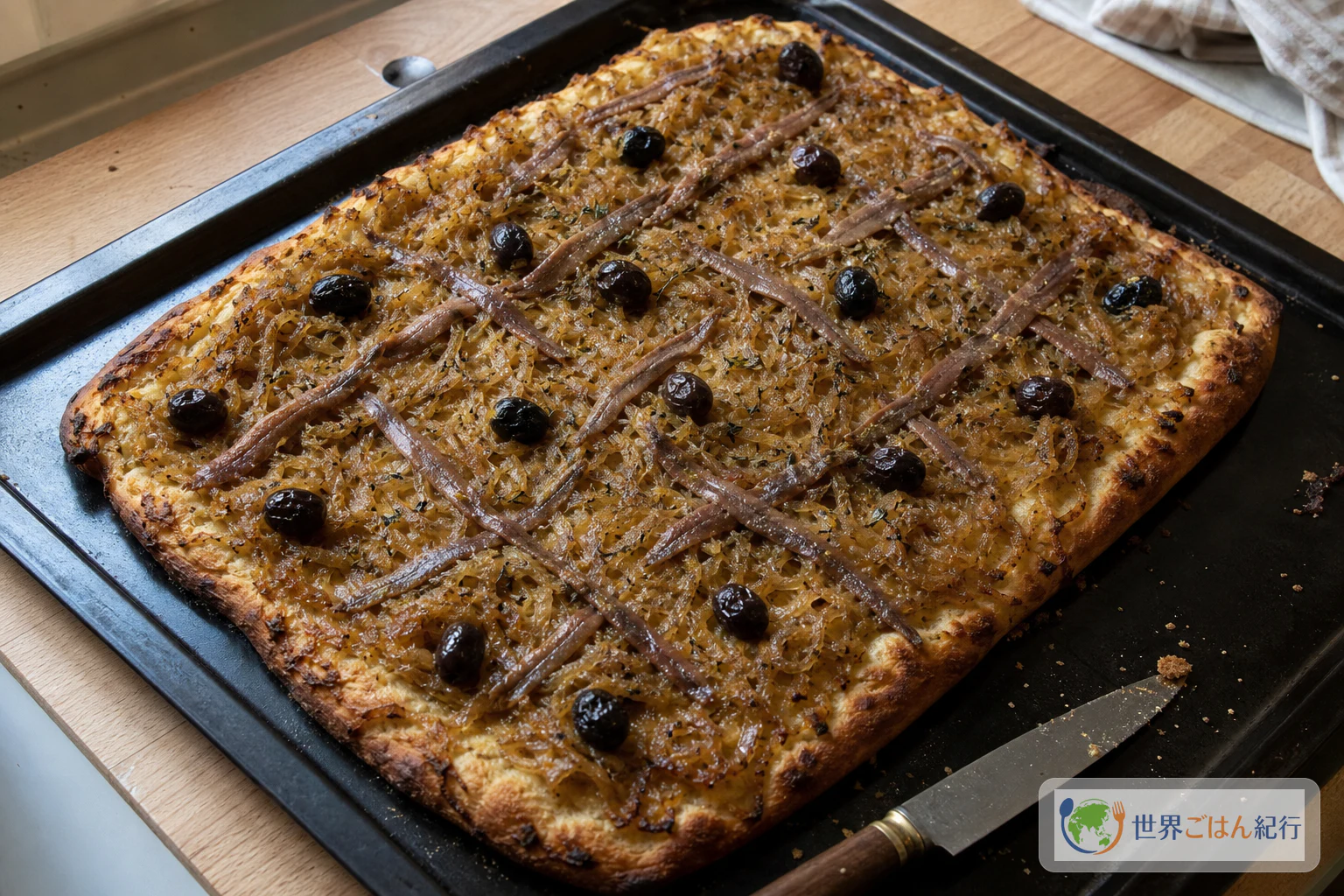
No heat is needed. Tear the anchovies into thin strips about 0.25 inch (5 mm) wide and lay them diagonally. For a lattice, make diagonal lines rather than straight rows so it is easier to cut. Put the black olives between the anchovies. Sprinkle just a little herbes de Provence over everything. Covering the whole surface with anchovies makes each bite too salty, so leave the sweet side of the onions.
7Bake briefly at high heat
18 min
Bake in the 220°C (430°F) oven for 15 to 18 minutes. Put the sheet on the middle rack and check the color of the edge after 10 minutes. It is done when the edge of the dough is golden, the base has a light color when lifted, and the tips of the onions are slightly dry. If it is about to scorch, lower to 200°C (390°F); if the base is still white, add 2 minutes on the lower rack. Take it out before the anchovies dry out.
8Rest and cut
7 min
Finish with the heat off. Rest it 5 minutes on the baking sheet, and drizzle about 1 tsp olive oil in a thin line. Cut into squares or long strips with a knife. For a starter, 2 inches (5 cm) squares; for lunch, rectangles of about 8 × 6 cm are an easy size. Fresh from the oven the salt of the anchovies is forward, but after 5 to 10 minutes it blends with the sweetness of the onions.