Ingredients and steps on one page. Print it, or choose “Save as PDF” in the print dialog.
Sekai Gohan
Tarte Flambée Recipe: Alsace's Paper-Thin Flatbread at Home
Ingredients
Dough
| Ingredient | Amount | Substitutes & notes |
|---|---|---|
| Cake flour (soft, low-protein flour) | 150 g | For a light bite. All-purpose flour also works |
| Bread flour (strong flour) | 100 g | Gives the dough the structure to roll out. Easier to handle than soft flour alone |
| Lukewarm water | 120 ml | 30–35°C (86–95°F). Do not use hot water |
| Olive or canola oil | 30 ml | Makes the dough easier to roll |
| Salt | 3 g | Adjust to the saltiness of the dairy and bacon |
Cream and toppings
| Ingredient | Amount | Substitutes & notes |
|---|---|---|
| Fromage blanc | 3.5 oz (100 g) | Can be replaced with 3.5 oz (100 g) drained Greek yogurt |
| Rich heavy cream or crème fraîche | 3.5 oz (100 g) | Sour cream (3.5 oz (100 g)) also works. If it is too loose, use less heavy cream |
| Yellow onions | 2 (about 9 oz (250 g)) | Slice 0 inch (1 mm) thick. Red onion changes the sweetness and color |
| Block smoked bacon | 180–200 g | Use the same amount of lardons if you have them. Cut sliced bacon into 0.25 inch (5 mm) strips |
| Nutmeg | 1/4 tsp | Optional, but it tightens the dairy aroma |
| Black pepper | a little | Coarse or fine |
| Oil for the onion | 1 tsp | Not needed if the bacon gives off plenty of fat |
Steps
1Bring the yeast-free dough together
5 min + 30 min rest
Mix 5.5 oz (150 g) cake flour, 3.5 oz (100 g) bread flour and 3 g salt in a bowl, then add ½ cup (120 ml) lukewarm water and 2 tbsp (30 ml) oil. Stir with chopsticks or a spoon until no dry flour remains, turn it out onto the counter and knead for about 3 minutes. Stop when the surface is a little smoother and the dough springs back slowly when pressed with a finger. Shape it into a ball, wrap it in plastic and rest it at room temperature for 30 minutes.
The dough has no yeast, so it won't puff up like bread. It bakes thin and crisp. If it sticks to your hands, add 1 tsp cake flour at a time; if cracks do not close, add 1 tsp water at a time. Adding a lot of flour at once makes the baked tart hard, so adjust little by little as you feel the dough.
2Prepare the onion and bacon to control their moisture
8 min
Slice the onions 0 inch (1 mm) thick along the grain, and cut the bacon into 0.25 inch (5 mm) sticks. Put the bacon in a cold pan and cook over medium-low heat for 2 minutes to render the fat. Add the onions, add just 1 tsp oil if it seems dry, and cook for 3–4 minutes.
Take the pan off the heat when the onion is translucent and not yet brown. Caramelizing it fully adds sweetness but releases even more water during baking, and the dough turns damp more easily. If fat collects in the pan, move the toppings to a rack or paper towels once and let them cool slightly.
3Heat the oven and baking surface thoroughly, then roll the dough thin
10 min
Set the oven to 250°C (480°F) with top and bottom heat, put in an upside-down baking sheet or an oven-safe flat steel plate, and preheat for 45 minutes. Divide the rested dough in two and place one piece on parchment paper. With a rolling pin, press from the center outward until it is 30 × 20 cm and 1–2 mm thick.
It should be thin enough that the pattern of the parchment faintly shows through. If you leave only the edge thick, the rim puffs up like bread before the center has baked. If the dough springs back and will not stretch, do not pull it; rest it 10 minutes and start again.
4Spread a thin layer of cream and scatter the toppings
5 min
In a bowl, mix 3.5 oz (100 g) fromage blanc, 3.5 oz (100 g) heavy cream or crème fraîche, nutmeg and black pepper. Taste for the bacon's saltiness and add only a pinch of salt if needed. It should be smooth, fall slowly off a spoon, and leave a trace that lasts a few seconds when stirred.
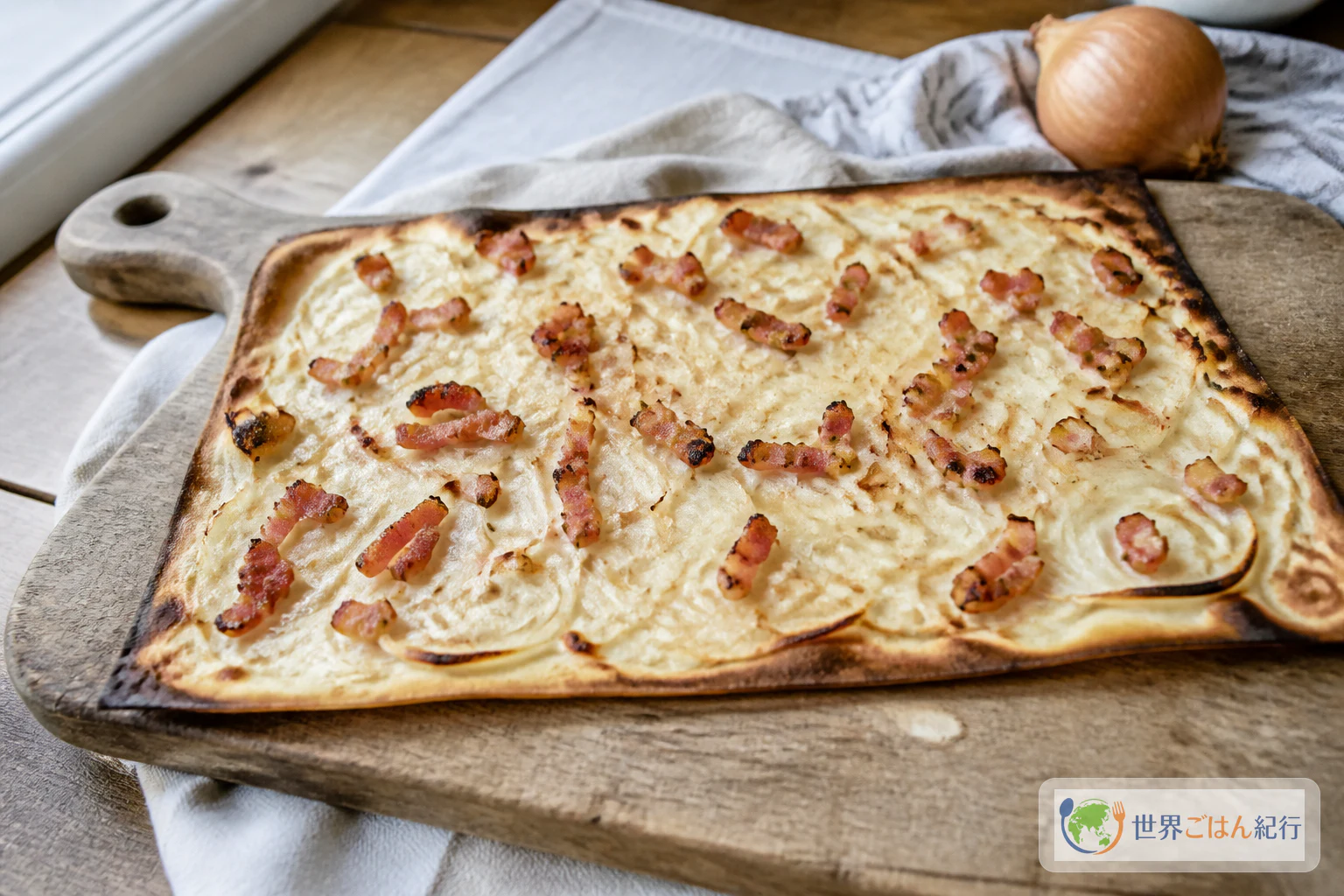
Spread the cream thinly over the rolled dough, leaving a border of about 0.25 inch (5 mm). Scatter the onion and bacon over the whole surface so the pieces do not overlap. Keep it to a layer where the cream still looks white, and do not pile it on thickly into a liquid layer.
5Bake briefly at 475°F (250°C)
6–10 min
Open the oven door and slide the tart, parchment and all, onto the hot surface. Bake one tart at a time at 250°C (480°F) for 6–10 minutes. Take it out when the edge is deeply browned with small charred spots, the onion tips are lightly browned and the cream in the center is set enough that it does not run.
If your home oven only goes to 230°C (445°F), plan on 9–12 minutes, but go by the color of the edge rather than the time. If the bottom is still pale, move the baking surface to a lower rack for the next tart. If only the top darkens, avoid the upper rack and move the tart to a position with strong bottom heat for the final minute. The baking surface becomes extremely hot, so use thick oven mitts to remove it.
6Cut and serve while hot
2 min
When it is baked, move it from the parchment to a rack and leave it for only about 30 seconds. Cut it with a pizza cutter or knife into strips 6–8 cm wide and eat it hot, as is or lightly folded. The longer it cools, the more moisture the dough absorbs and the less crisp it gets, so it works well to carry the first tart to the table while the second is baking.
Skip the plates. Set it on a large wooden board and let everyone take pieces, the casual way it is eaten in Alsace. Some people serve it with white wine or beer, but the dish holds up on its own.