Ingredients and steps on one page. Print it, or choose “Save as PDF” in the print dialog.
Sekai Gohan
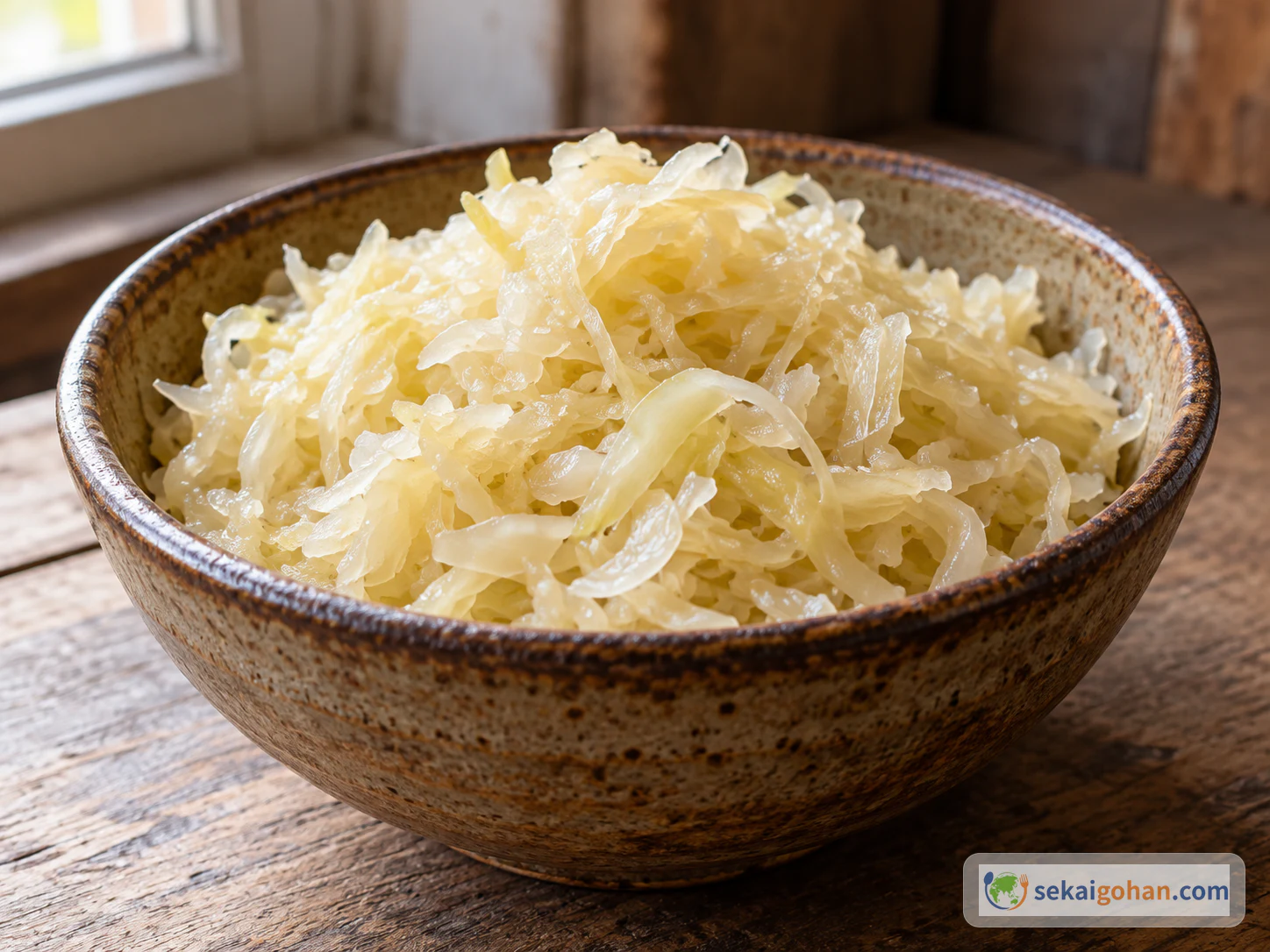
Sauerkraut: Homemade Fermented Cabbage with Just White Cabbage and Salt
Ingredients
| Ingredient | Amount | Role |
|---|---|---|
| White cabbage | 5 lb (about 2.27 kg), weighed after removing outer leaves and core and shredding | The whole body of the sauerkraut |
| Canning or pickling salt | 3 US tbsp (about 44.4 mL) | Draws juice from the cabbage and sets up the fermentation. Measured by volume, not converted to grams |
| Water for top-up brine (only if needed) | 1 US quart (about 946 mL) | Used only if the cabbage's own juice does not cover it |
| Canning or pickling salt for top-up brine (only if needed) | 1½ US tbsp (about 22.2 mL) | Dissolved in the top-up water. Not taken from the main 3 tbsp |
Steps
1Wash, core, shred and weigh the cabbage
Remove any damaged outer leaves, rinse the cabbage under running water and drain it. Cut it into quarters, remove the core, then slice it into thin, even shreds about 1/16 inch (about 1.5 mm) thick, the thickness of a US 25-cent coin, not 1/4 inch. Even shreds help the salt spread and the cabbage pack down more evenly. Weigh out 5 lb of the shredded cabbage.
2Mix in the salt and work out the juice
Put the shredded cabbage in the bowl, sprinkle on the 3 US tbsp of canning or pickling salt and mix it evenly. With clean hands, press and squeeze the cabbage until it softens and juice starts to collect. Don't reduce the salt, convert it to grams or adjust it by taste.
3Pack the crock firmly, layer by layer
Transfer the cabbage to the crock a layer at a time and press each layer down firmly. Pour in all the juice from the bowl. If the juice still does not cover the cabbage after thorough pressing, make top-up brine. Dissolve 1½ US tbsp of salt in 1 US quart of water, bring it to a boil and let it cool. Add only as much as you need to cover the cabbage, not the whole amount. Keep 4–5 inches (about 10–13 cm) of space between the cabbage and the rim.
4Weigh it down and cover
Set a clean plate that fits inside the crock on top of the cabbage. Weigh the plate down with a clean, sealed jar of water. Make sure the weight sits steadily and the whole mass of cabbage stays 1–2 inches (about 2.5–5 cm) below the brine. Cover the crock with a clean, heavy towel and stand it on a tray. Don't seal the crock with a rigid, airtight lid.
5Ferment at a measured temperature
Keep the crock out of direct sunlight. Aim for about 22°C (about 72°F), which falls within both 70–75°F and 68–72°F (20–22°C). Measure the temperature where the crock actually sits.
Fermentation time depends on temperature:
Temperature Guideline 70–75°F Fully fermented in about 3–4 weeks 60–65°F About 5–6 weeks Below 60°F Fermentation can fail to start Above 75°F Sauerkraut can turn soft Above 78°F, over-fermentation and spoilage become a risk. The 3–4 week figure applies to 70–75°F, so don't use it for a crock kept cooler, such as at 20°C. With a water-filled jar as the weight, check the crock 2–3 times a week. Each time, look at the brine level, the temperature and any signs of trouble.
6Check the pH and the bubbling
Fermentation is complete when the pH is 4.60 or below and the bubbling has stopped. If the bubbles have stopped but the pH is still above 4.60, measure again every 1–2 days.
To take a sample, use a clean spoon to move a little brine into a separate clean cup. Measure it there and don't pour the sample back into the crock. Follow your meter's instructions for calibration, sampling and temperature. A single pH reading or a photo of the liquid doesn't prove the whole batch is safe. Don't taste the sauerkraut during fermentation to decide whether it is done. If you see mold or sliminess, or smell something foul, discard the batch without tasting it. Skimming the surface doesn't make the rest safe to eat.
7Refrigerate the finished sauerkraut
Once fermentation is complete, move the sauerkraut and its brine into a clean container with a lid and refrigerate it. Refrigeration stops the fermentation. Use clean utensils every time you take some out, and keep the rest below the liquid. This recipe does not cover room-temperature storage or canning, which need a separate heat-processing method.