Ingredients and steps on one page. Print it, or choose “Save as PDF” in the print dialog.
Sekai Gohan
Sicilian Arancini: Saffron Rice Croquettes with Beef Ragù
Ingredients
Saffron rice
| Ingredient | Amount | Role |
|---|---|---|
| Short-grain Italian rice (Originario or Roma) | 1 lb (500 g) | Cooked by absorption so it turns compact and holds a shape |
| Vegetable broth, salted | 1.25 quarts (1.1–1.2 L) | Add gradually and judge by the rice |
| Saffron | 1 sachet, or a small pinch of threads | Aroma and the golden color |
| Unsalted butter | 1.75 oz (50 g) | Binds the rice. Unsalted makes the salt easier to control |
| Caciocavallo, grated | 2.75 oz (80 g) | Savory depth, and helps the rice hold together |
Beef ragù and the cheese center
| Ingredient | Amount | Role |
|---|---|---|
| Beef, coarsely ground | 14 oz–1 lb (400–500 g) | Ground beef comes together quickly and is easy to wrap |
| Onion, carrot, celery | A little of each | Finely chopped soffritto for aroma |
| Cooking oil | A little | For softening the soffritto |
| Red wine | About 1 glass | Lifts the browned bits from the pan; cooked off |
| Tomato passata | 14 oz (400 g) | The body of the ragù |
| Tomato paste | 1 tbsp | Concentrates the tomato |
| Green peas | 5.5 oz (150 g) | Frozen are fine. Drain well and keep them whole |
| Bay leaf | 1 | Aroma while simmering |
| Salt, black pepper | To taste | Start light; the cheese and broth bring salt too |
| Caciocavallo Ragusano DOP, tuma, or well-drained mozzarella | A small amount, cut into small cubes | A center that melts in one bite |
Coating and frying
| Ingredient | Amount | Role |
|---|---|---|
| Plain (all-purpose) flour | For dredging | The first, thin layer |
| Eggs | About 2, beaten | Glues the breadcrumbs on |
| Fine breadcrumbs | As needed | An even, thin crust |
| Refined rapeseed (canola) oil | Enough for the arancini to be submerged in your pot | Frying |
Steps
1Simmer the ragù until thick, then chill it completely
Finely chop the onion, carrot and celery so the pieces are a similar small size. Soften them in a little oil, then add the ground beef and brown it. Pour in the wine and let it bubble until the sharp smell of alcohol has settled. Add the passata, tomato paste and bay leaf, and simmer over low heat. Add the peas in the later part of the simmering, so they heat through but keep their shape.
The ragù is ready when you can draw a spoon through it and the trail does not fill in straight away, with no watery liquid pooling at the edges. A liquid ragù can make arancini split, so cook it down until it clings. Make sure the beef is cooked through; thickness alone does not show that. Season lightly with salt and pepper, remove the bay leaf, and cool the ragù completely, then refrigerate it promptly. Do not leave it out at room temperature for long.
Wash the knife, board and hands that touched raw beef before moving on to the rice and cheese.
2Cook the saffron rice until it has absorbed all the broth
Bring the salted broth to a boil and add the rice. Stir from time to time so it does not catch on the bottom. Soak the saffron in a little of the warm broth so it opens up, and stir it into the rice a few minutes before the rice is done.
Stop cooking when the grains have swelled and taken up the liquid, the bottom of the pan is dry, and the grains hold their shape with no hard core. Unlike risotto, there should be no loose broth around the grains. Absorption-cooked rice keeps its starch and turns compact, which lets it hold a shape later. While the rice is still hot, stir in the butter and grated caciocavallo.
3Spread the rice on a shallow tray and chill it quickly
Spread the hot rice in a thin, even layer on a clean, shallow tray. Do not leave it in the pot or rice cooker to cool, and do not leave it out at room temperature overnight. Once the steam has died down, cover it and put it in the refrigerator.
Cool cooked rice as quickly as possible, within one hour. Then refrigerate it and use it within 24 hours. Shape the rice while it is cold, straight from the refrigerator.
Cooked rice safetySpreading the rice thin is a safety step, not just a cooling shortcut. Rice held warm for too long can develop toxins that reheating does not remove. Cool it fast, refrigerate it within an hour, and use it within 24 hours.
4Fill the rice and close it into a cone
Wet your hands lightly. Spread a portion of the cold rice across one palm and press a hollow into the center. Put in a small spoonful of the cold, thick ragù with its peas and one small cube of cheese. Bring more rice up from around the edges to cover the top, and press the seam closed until the shell is one continuous layer of rice. Shape it into a cone with a point.
Keep the filling modest. Large chunks, a wet filling, or a thin patch of rice anywhere in the shell are where bursts begin. Aim for an even shell all the way around.
5Coat in flour, then egg, then breadcrumbs
Dust each cone thinly with flour, dip it in beaten egg, and roll it in fine breadcrumbs until the surface is evenly covered. Check for places where rice shows through or where filling peeks out of a crease, and patch them with more egg and crumbs. A thick, lumpy coat or any exposed filling can cause splitting and makes the arancini absorb more oil.
6Fry one or two at a time at a steady temperature
Heat the oil and hold it steadily between 350°F (170°C) and 350°F (180°C), checking with the thermometer, and aim for 350°F (170–175°C). Lower in only one or two arancini at a time. Crowding the pot drops the oil temperature, which leads to greasy, fragile arancini.
Fry for 4–8 minutes. The exact time depends on the size of the arancini, your pot and how many are in the oil. They are done when the crust is an even, deep golden brown and the center is hot all the way through; cutting one open is the surest check. If the oil temperature drops, lift the arancini out, let the oil come back up to temperature, and continue.
7Drain on a rack and rest briefly before serving
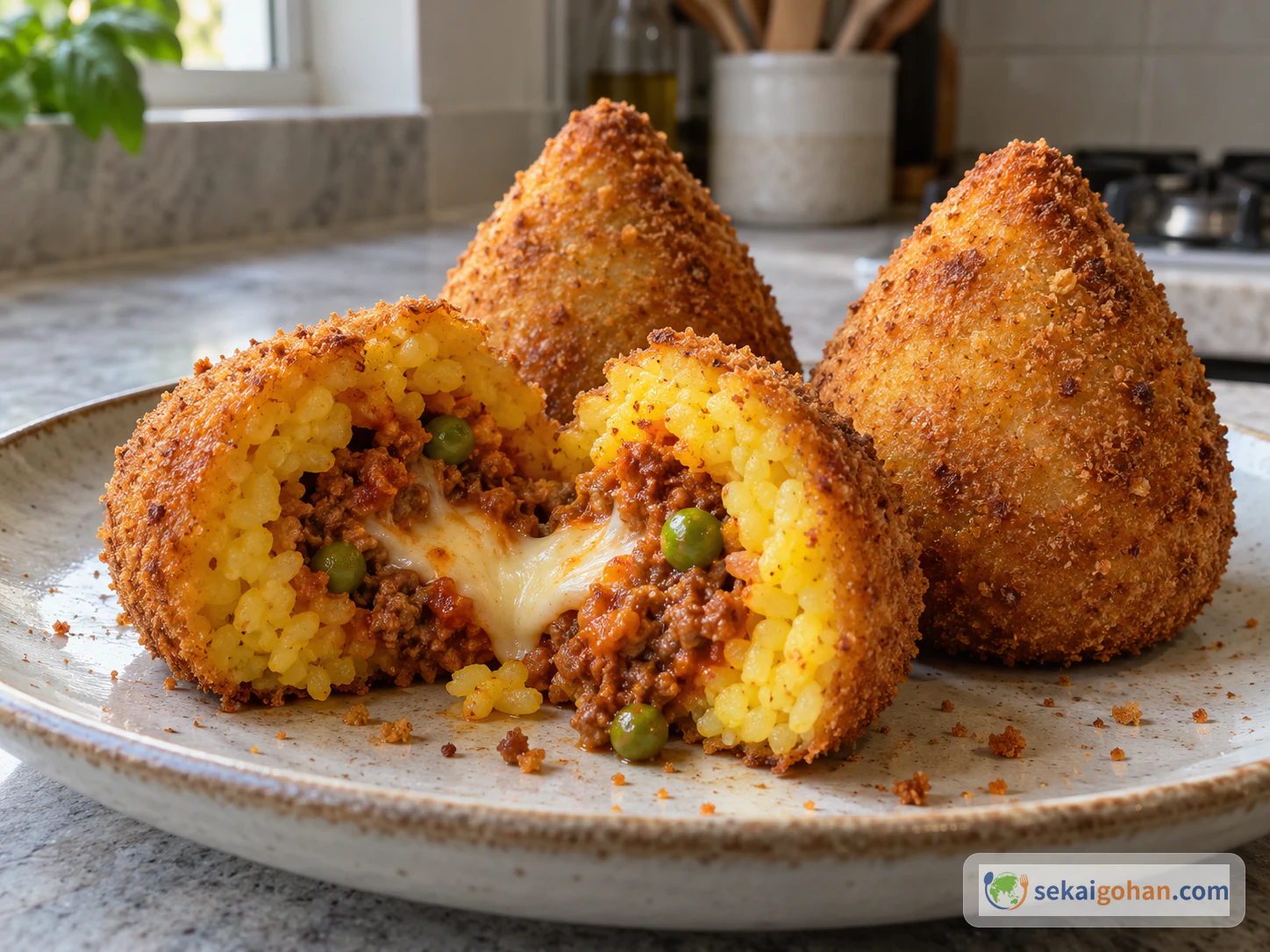
Lift the arancini onto a wire rack set over a tray and let them rest for a short while. The cheese inside is molten and the filling stays very hot, so let them settle before biting in. Cut one open to see the result: compact yellow rice, ragù and peas, and the melted cheese in the center.
Arancini need no side dish. If you want something alongside, a simple leaf salad or something with a little acidity is an easy home pairing.