Ingredients and steps on one page. Print it, or choose “Save as PDF” in the print dialog.
Sekai Gohan
Neapolitan Pizza at Home: Dough and Baking in a Home Oven
Ingredients
Dough
| Ingredient | Amount | Substitutes & notes |
|---|---|---|
| Bread flour or type 00 pizza flour | 600 g | Same amount if using 00 flour. Use one kind the first time |
| Water | 375 g | 20–25°C (68–77°F). On hot days use cold water to slow fermentation |
| Salt | 20 g | Fine sea salt. Dissolve in the water before adding the flour |
| Instant dry yeast | 1 g | Ideally weighed to 0.1 g. A scant 1/4 tsp as a guide |
| Flour for dusting | up to 20 g | Use bread flour thinly. Too much makes the bottom floury |
Toppings
| Ingredient | Amount | Substitutes & notes |
|---|---|---|
| Canned whole tomatoes | 1 can (14 oz / 400 g) | Crush by hand, drain the excess liquid and use about 10.5 oz (300 g) |
| Mozzarella or fior di latte | 5.5 oz (160 g) | Divide into 2.75 oz (80 g) portions and blot with paper towels |
| Basil | 8 leaves | 4 each for the 2 Margherita. You can split them between before and after baking |
| Garlic | 1 clove | Thinly sliced, half for each of the 2 Marinara |
| Dried oregano | 2 g | 1 g each for the 2 Marinara. Rub whole oregano between your fingers to release its aroma |
| Extra-virgin olive oil | 1.5 tbsp (20 ml) | About 1 tsp drizzled over each pizza |
| Salt (for the tomatoes) | 5 g | Mix into the crushed tomatoes; taste and use it all |
Steps
1Add the flour to the salt water and bring it together
10 min
Dissolve 20 g salt in 13 oz (375 g) water, and put about 1 lb (500 g) of the 1.25 lb (600 g) bread flour or 00 flour into the bowl. Pour the water in while stirring with your fingertips or a wooden spoon, and add 1 g dry yeast while some dry flour still remains. Add the rest of the flour little by little and bring it together for 8–10 minutes, until no dry flour remains at the bottom of the bowl. No heat is needed. The dough's surface should be rough and slightly sticky on your fingers; the key is not to add more flour and stiffen it here.
2Knead to build elasticity
15 min
Turn it onto the work surface and, for 10–12 minutes, push it away with the heel of your hand and fold it back toward you. There's no need to slap it down. It's done when the surface is thin, taut and smooth, a fingerprint springs back slowly, and a piece stretched between your fingers doesn't tear right away. If the dough spreads out on the surface, rest it for 5 minutes and knead again for 2–3 minutes. If the dough warms up on a hot day, return it to the bowl to cool for 10 minutes so fermentation doesn't rush.
3Grow small bubbles in the first rise
2 hours
Shape it into a taut ball, place in a lightly oiled bowl and cover with a lid or plastic wrap. Leave at 20–25°C (68–77°F) for 2 hours, and move on when it has grown to 1.3–1.5 times its volume and small bubbles are visible on the surface. If you wait until it doubles, gas escapes when you divide it and the rims puff less. On days when the room is above 28°C (82°F), check once at 90 minutes, and if it's still stiff, extend 15 minutes at a time.
4Divide into four and shape into balls
15 min
Turn the risen dough onto the surface and divide it into four with a bench scraper; each piece is about 249 g. Fold the cut edges underneath and rotate the dough with your palm while pulling it lightly against the surface to make a taut ball. Place the four balls seam side down, spaced apart, in a lightly oiled lidded container. Leave at 20–25°C (68–77°F) for 4–6 hours, until they've grown to about 1.5 times their volume and spring back slowly when you press the side with a finger. In a cramped container the balls join together, so leave enough space to take them out easily just before baking.
5Press the center and leave the rim
5 min for 1 pizza
Take just one ball that has finished its second rise onto the dusting flour and press it outward from the center with your fingertips. Aim for a smooth surface, a center 2–4 mm thick, and an outer 1–2 cm left mostly untouched. Spread it to 25–28 cm across. Don't use a rolling pin, which presses the air out of the rim. If the dough springs back, rest it for 5 minutes and start again rather than forcing it.
6Top lightly with tomato and toppings
3 min for 1 pizza
Mix 5 g salt into the crushed whole tomatoes, and spread 2.75 oz (80 g) per Marinara or 2.5 oz (70 g) per Margherita in a spiral from the center. The tomato sauce should spread smoothly and thinly; coarse pieces can remain, but the juice shouldn't run onto the plate. On each of the 2 Marinara, place 1/2 clove sliced garlic, 1 g oregano and 1 tsp (5 ml) oil. On each of the 2 Margherita, place 2.75 oz (80 g) blotted mozzarella, 4 basil leaves and 1 tsp (5 ml) oil. Keep toppings 1 inch (2 cm) in from the edge. No heat is needed; once topped, get it into the oven within 1–2 minutes. The longer it sits on the peel, the more the tomato moisture makes the dough stick.
7Bake at the highest temperature
6–12 min per pizza (depending on your oven's maximum temperature)
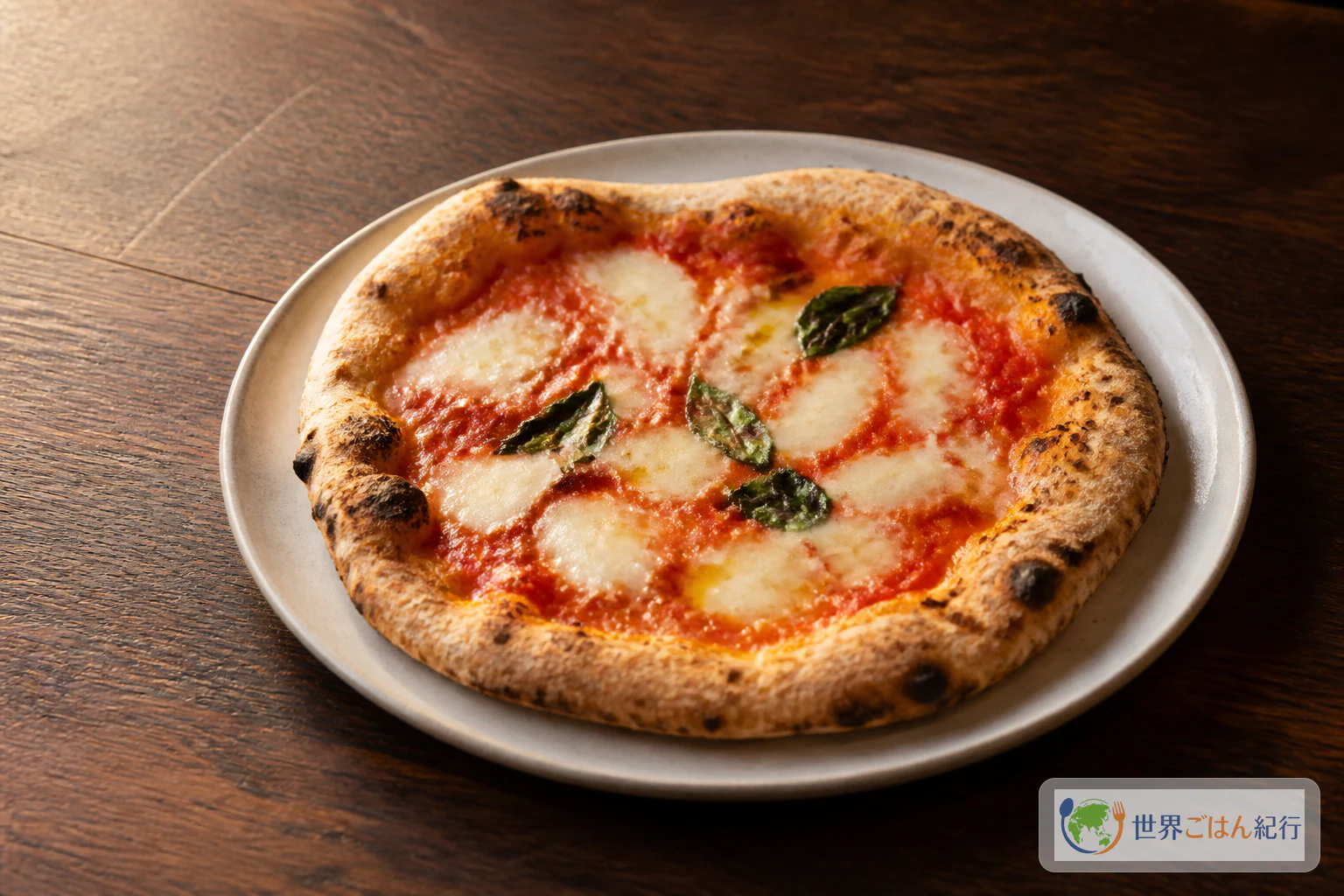
Put a stone or steel on the upper rack and preheat the oven at its highest temperature for 45 minutes. Slide the dough onto the preheated surface and bake at 250–275°C (480–525°F) for 6–8 minutes. If your oven's maximum is below 250°C, allow 8–12 minutes and turn the pizza once partway through. Take it out when the rim has puffed up well, the bottom is lightly browned, and the surface of the mozzarella has melted with small dots of oil. If the top heat is weak and only the center dries out first, switch to the broiler for just the last minute. You won't get the same result as a 485°C wood oven in 60–90 seconds, so don't extend the time and end up with only a burnt rim. Transfer to a plate, leave for about 30 seconds, then cut into 6–8 slices with a pizza cutter.