Ingredients and steps on one page. Print it, or choose “Save as PDF” in the print dialog.
Sekai Gohan
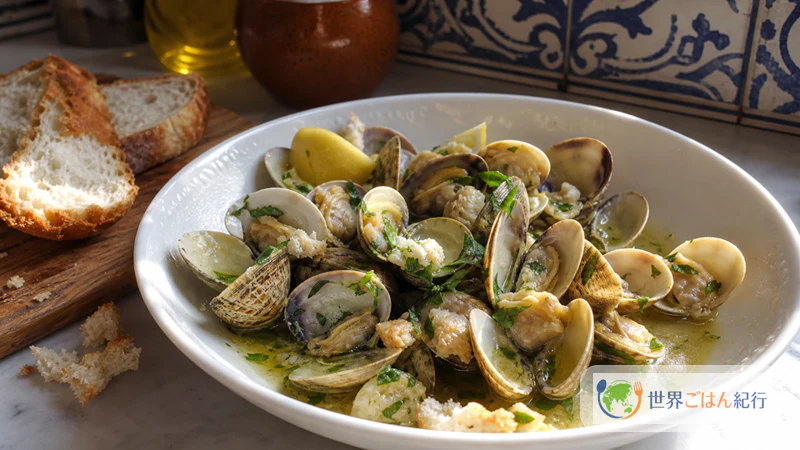
Amêijoas à Bulhão Pato: Portuguese Clams with Garlic and Coriander
Ingredients
| Ingredient | Amount | Substitutes & notes |
|---|---|---|
| Clams in the shell | 1.75 lb (800g) | Even if sold pre-purged, rest them in salted water for 20–30 minutes |
| Water for purging | 2 cups (500ml) | Use a shallow container so the clams do not pile up |
| Salt for purging | 15g | About 3% of the water. As salty as seawater |
| Extra-virgin olive oil | 4 tbsp | Use plenty so the garlic does not scorch |
| Garlic | 3 cloves | Sliced 0.125 inch (2mm) thick. Minced garlic burns easily |
| Coriander (cilantro) | 25g | Split into 10g stems and 15g leaves. If you dislike it, use flat-leaf parsley |
| Dry white wine | ½ cup (100ml) | Cooks off the raw alcohol smell. Without wine, use ¼ cup (80ml) water and 1 tsp white wine vinegar |
| Lemon | 1/2 | Cut into wedges for finishing and the table |
| Coarsely ground black pepper | 1/4 tsp | Add no salt. Judge by the saltiness of the clams |
| Baguette or country loaf | 1/2 loaf | For scooping the broth. A firmer bread suits it better than sandwich bread |
Steps
1Sort the clams and purge the sand
30 min to 2 hours. No heat is used.
Wash the clams by rubbing the shells together, and remove any with cracked shells, an off smell, or that will not close when touched. In a shallow container, dissolve 15g salt in 2 cups (500ml) water and spread the clams out so they do not overlap. Cover with a dark cloth and leave in the refrigerator or a cool place for 30 minutes to 2 hours. When the sand has come out, pour off the water and rinse the clams once more under running water just before cooking.
2Prep the aromatics
7 min. No heat is used.
Peel the garlic and slice it 0.125 inch (2mm) thick. Separate the coriander stems from the leaves, chop the stems 0.25 inch (5mm) wide and roughly chop the leaves. Cut the lemon into 4 wedges. Put ½ cup (100ml) white wine, or ¼ cup (80ml) water and 1 tsp white wine vinegar, in a small bowl so you are not scrambling at the pan. Chop the leaves too fine and they blacken easily, so leave them large enough to scatter at the end.
3Warm the garlic over low heat
3 min. Low heat, just small bubbles forming in the oil.
Put 4 tbsp olive oil and the garlic in a wide skillet over low heat. Warm for about 2 minutes until small bubbles appear around the edges of the garlic and a sweet aroma rises. Stop while the color is still white to pale cream; do not let it turn golden. Add the coriander stems and stir for only 20 seconds to pass their fragrance to the oil.
4Steam the clams with white wine
4 min. Medium heat, a level where it bubbles and the shells begin to open.
Add the drained clams all at once and pour the ½ cup (100ml) white wine around them. Cover immediately and raise the heat to medium. After about a minute and a half the pot starts to bubble and the shells begin to pop open one by one. Gently shake the pan back and forth to circulate the steam, without turning the clams over. When about 70% of the shells have opened, move on to the next step.
5Take out the opened clams and adjust the broth
2 min. Medium heat, the broth at a light boil.
Move the clams to a warm bowl with tongs, in the order they open. Leave the ones still closed in the pan for just 30 seconds more; any that still do not open are not eaten and are discarded. Bring the broth left in the pan to a boil over medium heat for 30 seconds to 1 minute, and when the bubbles turn fine and it has thickened a little, turn off the heat. Do not add salt here. The clams usually add enough.
6Finish with coriander and lemon
2 min. Heat off; let the residual heat blend in the aroma.
Return the clams to the pan and add the coriander leaves, roughly chopped about 0.5 inches (1cm) wide. Squeeze in 1/4 of the lemon, sprinkle with black pepper and toss just twice with big motions. It is enough when the broth coats the clams and the leaves stay a vivid green. If it needs more acidity you can add it at the table, so do not put too much lemon in the pan.
7Serve hot with bread
2 min. No heat is used.
Bring it to the table in a shallow dish or in the skillet itself, with the remaining lemon and the baguette. Spreading the clams in a shallow dish where the broth shows, rather than piling them in a heap, makes them easier to scoop with bread. Just before eating, spoon the broth from the bottom over the clams once, and the garlic and olive oil aroma comes back.