Ingredients and steps on one page. Print it, or choose “Save as PDF” in the print dialog.
Sekai Gohan
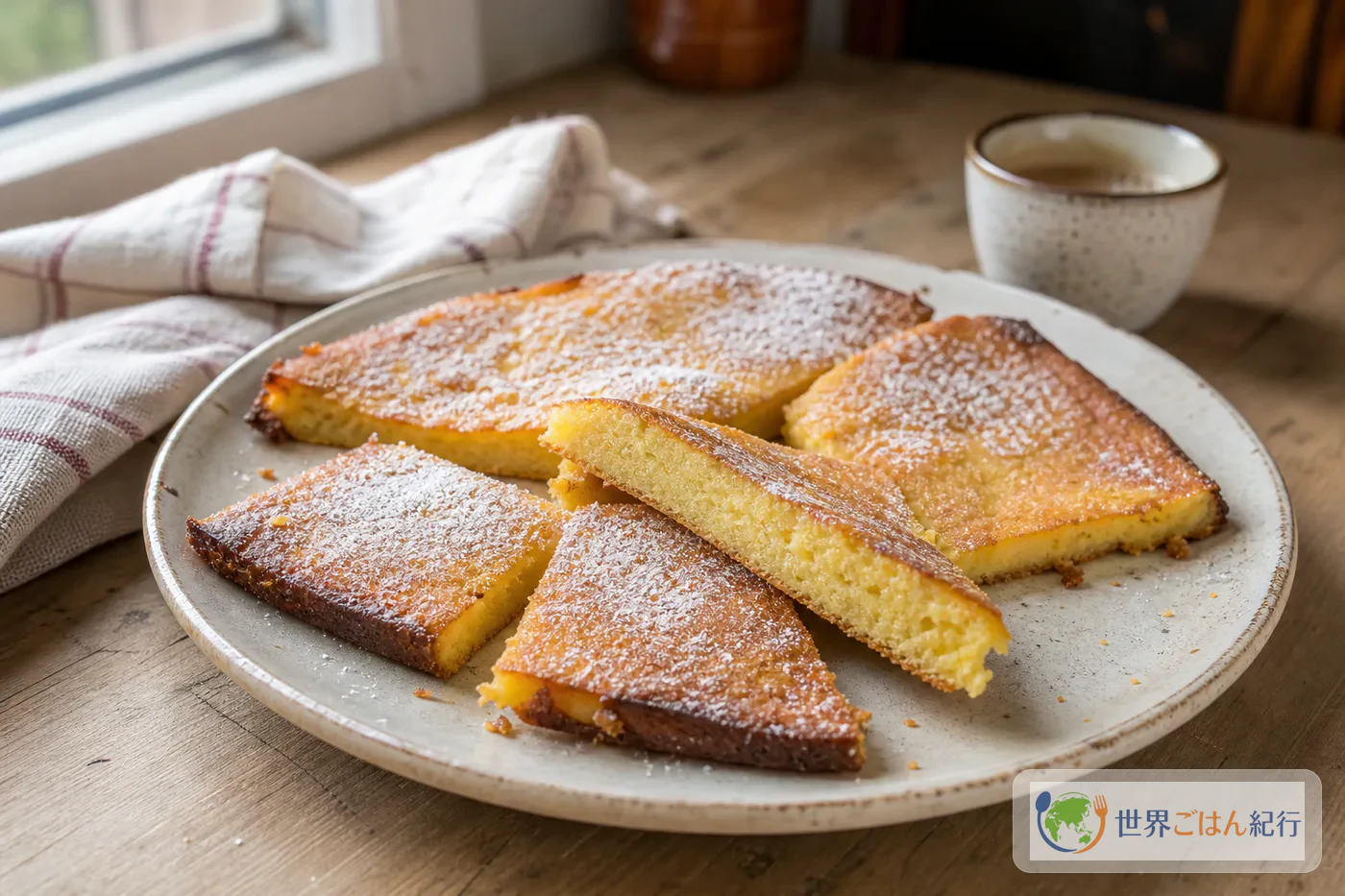
Zlevanka: Slovenia's Thin Baked Cornmeal Cake from Prekmurje
Ingredients
| Ingredient | Amount | Substitutes & notes |
|---|---|---|
| Fine cornmeal (corn flour) | 9 oz (250 g) | Finely ground corn. Cornstarch will not do |
| Milk | 2 cups (500 ml) | Whole, unflavored. Take it out of the refrigerator 15 minutes ahead |
| Heavy cream | 3 tbsp (45 ml) | About 35% fat. 1.5 oz (45 g) plain unsweetened yogurt also works |
| Egg | 1, about 2 oz (55 g) | Medium |
| Granulated sugar | 24 g | 2 tbsp. For less sweetness, reduce to 16 g |
| Rice bran oil | 3 tbsp (45 ml) | 2 tbsp (30 ml) for the batter, 1 tbsp (15 ml) for the pan. Canola oil also works |
| Salt | 2 g | 1/3 tsp |
| Powdered sugar | 16 g | For finishing. Use right before eating |
Steps
1Warm the pan and the oven
10 min
Heat: preheat the oven to 400°F (200°C), and warm the skillet with 1 tbsp (15 ml) oil in it for 5 minutes.
Put 1 tbsp (15 ml) rice bran oil in an oven-safe 10 inches (26 cm) skillet and spread it thinly over the bottom. Warm it in a 400°F (200°C) oven for 5 minutes, and it is ready when the oil moves freely and a uniform sheen shows on the pan. If smoke appears it is overheated, so take it out and wait 1 minute. The handle gets hot too, so use a dry, thick oven mitt.
2Make the pourable batter
8 min
Heat: none used. Use the milk at about 68°F (20°C).
Put 1 egg, 24 g sugar and 2 g salt in a bowl and whisk for 1 minute. Add 2 cups (500 ml) milk, 3 tbsp (45 ml) cream and 2 tbsp (30 ml) rice bran oil, and whisk 30 seconds at this point. Add 9 oz (250 g) corn flour in 3 portions, pressing lumps against the side of the bowl each time. When you lift the whisk, the batter should fall in a ribbon about 0.5 inches (1 cm) wide, not a thick band, and the marks on the surface should disappear in about 2 seconds. If the flour is coarse and the batter is heavy, add just 1 tbsp (15 ml) more milk.
3Pour into the hot pan all at once
2 min
Heat: do not use the stovetop. Pour into the pan taken out of the 400°F (200°C) oven.
Set the hot skillet on a heatproof stand and re-stir the batter 5 times from the bottom. Make sure no flour has settled and the batter flows smoothly again, then pour it in one go into the center of the pan. It spreads to a thickness of about 0.5 inches (1.5 cm), and fine oil bubbles appear at the edge. If you pour in several portions, only the first layer sets and the cross-section peels. If the batter pools to one side, hold the handle with both hands and tilt the pan slowly, just once, to level it.
4Lower the temperature and bake
35–40 min
Heat: 7 minutes at 400°F (200°C); when the surface has risen slightly, 15 to 20 minutes at 350°F (175°C), then turn off the heat and rest 10 minutes.
Return the skillet to the 400°F (200°C) oven right away. After about 7 minutes, when the edge has lifted and small bubble marks appear in the center, lower to 350°F (175°C) without opening the door. Bake 15 to 20 minutes from there, until the edge is golden and a gentle press on the center springs back slowly. The whole surface does not need to be dark brown. Turn off the oven, take out the pan and leave for 10 minutes. Run a thin spatula around the edge, cut into 8 pieces and, just before eating, dust thinly with 16 g powdered sugar.