Ingredients and steps on one page. Print it, or choose “Save as PDF” in the print dialog.
Sekai Gohan
Crema Catalana: Lemon-and-Cinnamon Custard with a Burnt-Sugar Crust
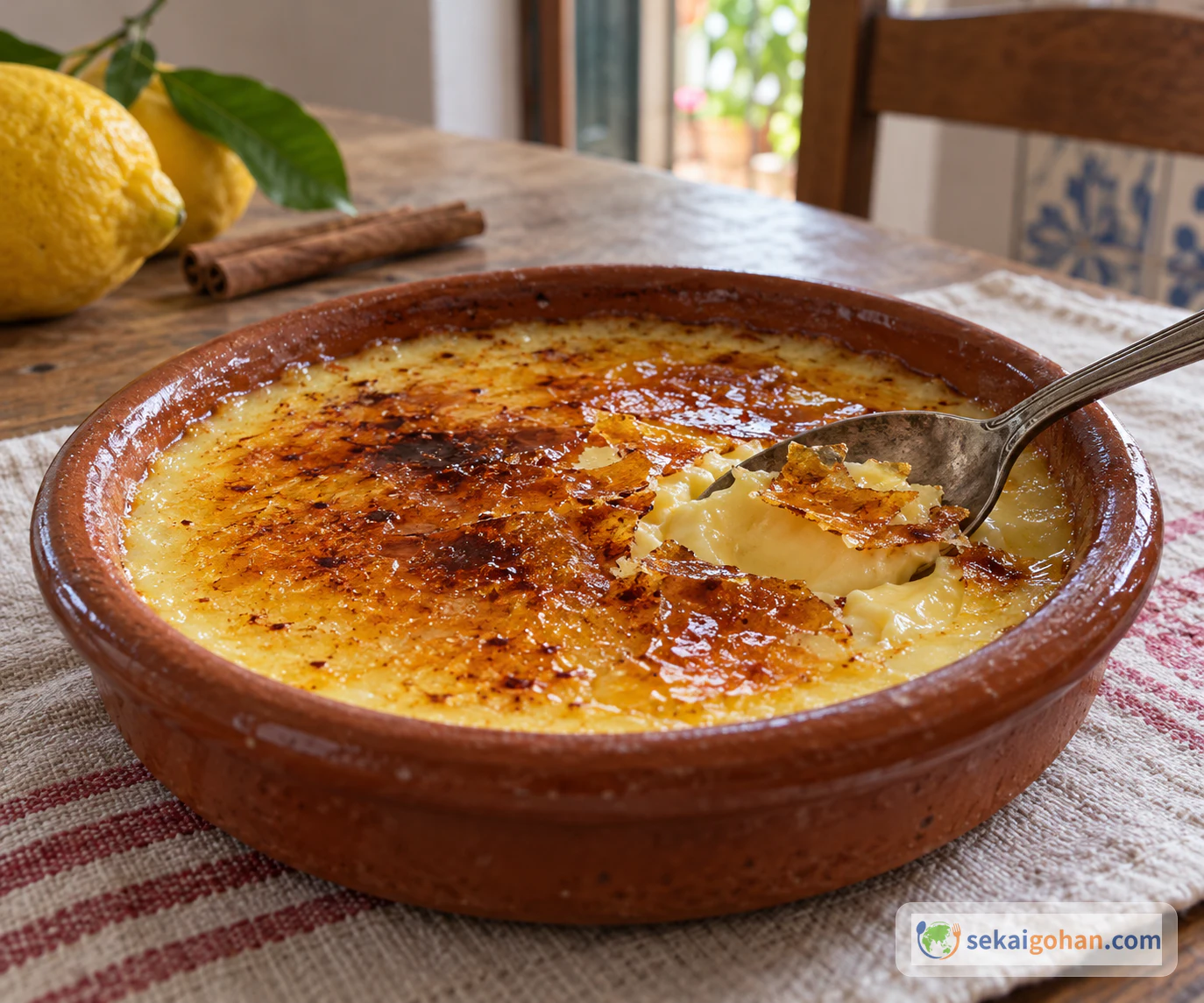
Ingredients
Custard
| Ingredient | Amount | Role |
|---|---|---|
| Milk (llet) | 2 cups (500 ml) | The base, giving a traditionally light texture. Reserve about 2 tbsp cold to dissolve the cornstarch |
| Egg yolks (rovells d'ou) | 4 | Richness and setting. Whites are not used |
| Granulated sugar (sucre) | 3.5 oz (100 g) | All of it goes into the milk that is being infused |
| Cornstarch / Maizena (midó de blat de moro) | 20 g | Thickens the custard as it cooks |
| Lemon peel (pell de llimona) | Peel of 1/2 lemon, yellow part only | Aroma for the milk |
| Cinnamon stick (branca de canyella) | 1/2 stick | Aroma for the milk |
Topping
| Ingredient | Amount | Role |
|---|---|---|
| Granulated sugar | About 1 tsp per dish | Separate from the 3.5 oz (100 g) above. Just enough to cover the surface in a thin, even layer for burning |
Steps
1Infuse the milk with lemon and cinnamon
Dissolve the 20 g cornstarch in about 2 tbsp of the cold milk and set it aside. Pour the rest of the milk into a saucepan and add all 3.5 oz (100 g) sugar, the lemon peel and the cinnamon stick. Heat it, and as soon as it begins to boil, take it off the heat; don't let it keep boiling. Leave it off the heat for about 5 minutes to let the aroma pass into the milk, then lift out the peel and the cinnamon stick.
2Mix the yolks with the cornstarch slurry
In a bowl, combine the 4 egg yolks with the cornstarch you dissolved in cold milk, and whisk until smooth and even. There is no need to whip in air. Do not add any more sugar here; all of it is already in the milk. Dissolving the starch in cold milk first helps prevent lumps.
3Temper the yolks with the warm milk and strain
Pour the warm infused milk into the yolk mixture a little at a time, whisking after each addition. Bringing the yolks up to temperature gradually, instead of all at once, helps keep them from turning grainy. When all the milk is in, pour the mixture through a fine-mesh strainer back into the saucepan.
4Cook over low heat, stirring constantly
Set the pan over low heat and stir constantly, scraping the bottom and corners. Take the pan off the heat when the custard is steaming, bubbles just start to break through the surface, the whole mixture has thickened, and it coats the spoon thinly enough that a line drawn through it holds for a moment. Remove it as soon as it starts to boil; don't keep boiling it. The custard needs this cooking and should not be served uncooked.
5Divide among dishes and chill
Pour the custard evenly into the 4 shallow dishes. Press plastic wrap directly onto each surface to stop a skin from forming. Once the custard has cooled down, put it in the refrigerator and chill it thoroughly for at least 2 hours. Check that it is cold and set before serving.
6Spread a thin layer of sugar just before serving
Right before serving, take the dishes out of the refrigerator. If there are droplets of water on the surface, blot them away lightly. Sprinkle about 1 tsp sugar over each dish and spread it thin and even. A thick layer is hard to caramelize evenly and can turn into a hard lump.
7Burn the sugar to an amber crust
Keep the kitchen torch moving over the sugar until it turns amber. Don't hold the flame on one spot and don't overheat the dish; follow the safety instructions for your torch. Let the dishes sit for a few minutes so the crust hardens before eating.
Without a torch, you can use an oven broiler: preheat it well, follow the instructions for your heatproof dishes, and caramelize the sugar quickly. The custard warms up more easily this way, so the result is not quite the same.