Ingredients and steps on one page. Print it, or choose “Save as PDF” in the print dialog.
Sekai Gohan
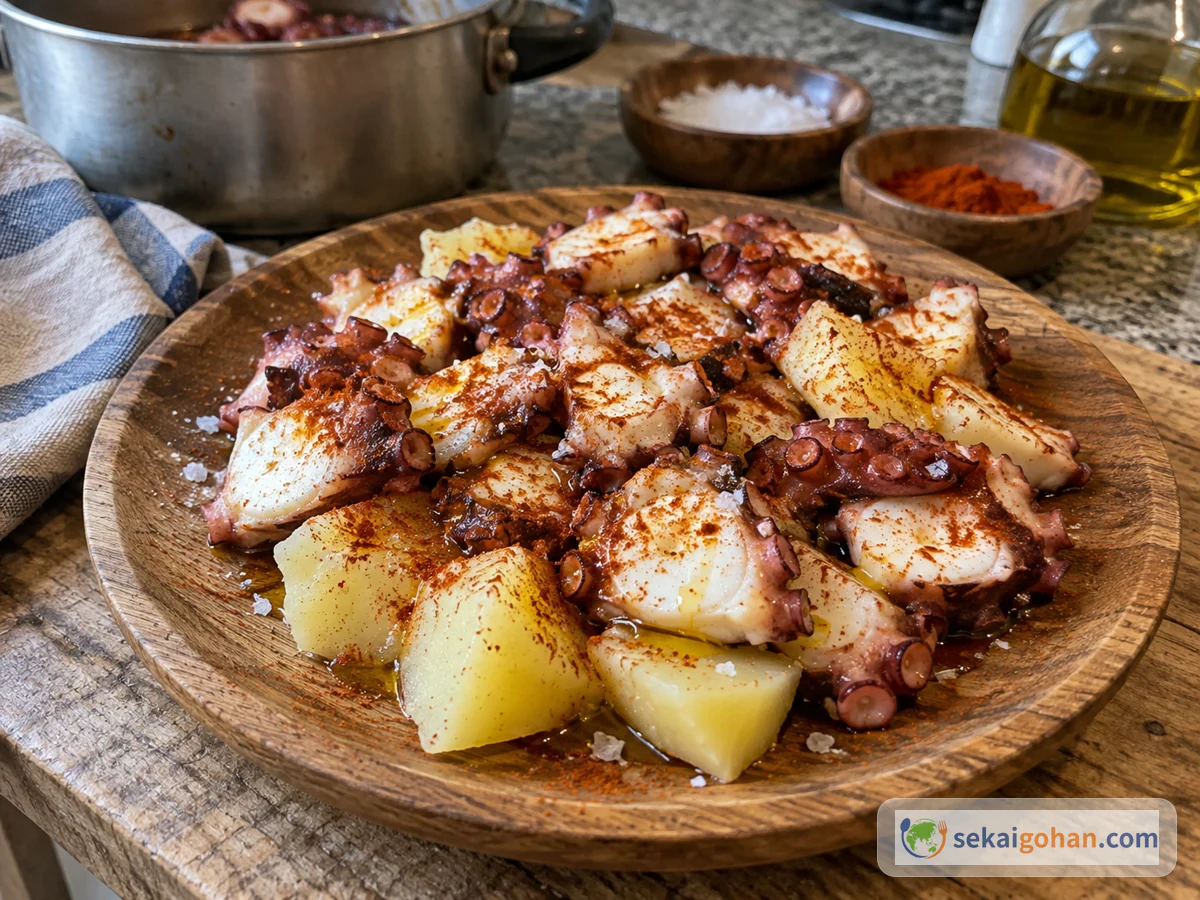
Pulpo a la Gallega (Pulpo a Feira): Galicia's Market-Day Boiled Octopus
Ingredients
Octopus and potatoes
| Ingredient | Amount | Substitutes & notes |
|---|---|---|
| Raw octopus (frozen, 1 whole) | 4.5 lb (2 kg) | Cleaned, with the innards and beak removed. For 3.25 lb (1.5 kg), shorten the simmer slightly |
| Potatoes | 2.25 lb (1 kg) | Peeled and cut into 4–5 cm chunks. A floury, all-purpose variety works |
| Water | 6.25 quarts (6 L) | Enough to cover the octopus. Adjust to the size of your pot |
Finishing
| Ingredient | Amount | Substitutes & notes |
|---|---|---|
| Coarse salt | 1 tsp | Large-grained sea salt. Do not add it to the cooking water |
| Paprika powder (sweet) | 2 tsp | Spanish pimentón is ideal. Smoked paprika also works |
| Paprika powder (hot) | 1/2 tsp | Leave it out if you dislike heat and use only sweet |
| Extra-virgin olive oil | 4 tbsp | A generous pour is the local way |
Steps
1Thaw the octopus in the refrigerator
The night before you eat, put the frozen raw octopus in a large bowl or tray and move it to the refrigerator to thaw overnight (about 12 hours). The octopus gives off a lot of liquid as it thaws, so use a deep container. If you press a tentacle with your finger and it is soft all the way through, it has thawed.
2Bring unsalted water to a boil
20 min
Put 6.25 quarts (6 L) of water in a large, tall pot and heat over high heat for about 20 minutes, until it reaches a full rolling boil with large bubbles rising vigorously from the bottom. You will salt the octopus later, so do not add salt to the cooking water. A copper pot is ideal, but at home any material works as long as the pot is deep enough to submerge the octopus.
3Dip the octopus three times
1 min
When the water is at a rolling boil, hold the octopus by the head and lower the tentacles into the water for 2–3 seconds, then lift them out right away. Repeat three times, about 1 minute in all. In Galicia this pre-boil is called "scaring the octopus" (asustar el pulpo). It is done when the tips curl up, the surface changes color to a reddish tone, and the skin is taut. The skin stays on better and the flesh tightens evenly. Because the water splashes, use tongs or long cooking chopsticks and keep your arm from reaching directly over the pot.
4Simmer for 30 minutes from the return to a boil
After the third dip, leave the octopus submerged in the pot. Start timing from when the water returns to a boil, and cook a 4.5 lb (2 kg) octopus for about 30 minutes. Keep the heat at medium to medium-high, so the surface of the water moves in gentle bubbles. After 20 minutes, push a bamboo skewer into the base of the thickest tentacle. When it meets slight resistance, like when you pierce a boiled potato, it is ready. If it is still firm, add 5 minutes at a time.
5Rest in the water for 5 minutes
Turn off the heat and leave the octopus in the water for about 5 minutes. Then lift it out with tongs onto a tray. Do not throw out the cooking water, because you will use it for the potatoes. The removed octopus should give under your finger on the thick tentacle, springy but soft. Cover it with a cloth on the tray so it does not dry out before plating.
6Boil the potatoes in the same water
15 min
Bring the octopus cooking water back to a boil, add 2.25 lb (1 kg) of potatoes cut into 4–5 cm chunks, and cook over medium heat for about 15 minutes. In Galicia these potatoes are called cachelos, and cooking them in water that has taken on the octopus flavor is the standard way. When a bamboo skewer slides in easily, drain them and set them on a tray. Timing varies with the size of the potatoes, so judge by how the skewer goes in.
7Snip the tentacles into rounds with scissors
3 min
With kitchen scissors, cut the tentacles into rounds 0.5 inches (1 cm) thick. Chop the head small. A Galician pulpeiro also cuts with scissors, not a knife. You can cut right over the plate without a cutting board, so you can plate quickly while it is warm. The tentacle is hot, so hold it with tongs or a cloth as you cut.
8Salt, paprika, then olive oil
2 min
Moisten a wooden plate lightly with the cooking water, lay down the potatoes, and top with the octopus. Sprinkle evenly with 1 tsp coarse salt, dust with the sweet and hot paprika mixed together through a tea strainer, and finally pour 4 tbsp olive oil over the top. Keep to the order of salt, paprika, oil: the salt reaches the flesh first, and the paprika stays put instead of washing away in the oil. Eat it while it is steaming, spearing pieces with toothpicks.