Ingredients and steps on one page. Print it, or choose “Save as PDF” in the print dialog.
Sekai Gohan
Fish and Chips Recipe: Light Batter and Double-Fried Chips for a British Table
Ingredients
Fish and chips
| Ingredient | Amount | Substitutes and notes |
|---|---|---|
| Cod or haddock fillets | 4 pieces (1.25 lb (600g) in total) | Cod, hoki, hake, or pollock also work. Aim for 5.5 oz (150g) per piece, 2 to 3 cm thick |
| Potatoes | 2.25 lb (1kg) | A floury variety that does not break down easily. Cut 0.5 inches (1.5 cm) thick |
| Frying oil | 1.5 quarts (1.5L) | Rapeseed, sunflower, and the like. Keep it under half the height of the pot |
| All-purpose flour | 6.5 oz (180g) | Divided into 5.5 oz (150g) for the batter and 1 oz (30g) for dredging the fish |
| Potato starch or cornstarch | 1.5 oz (40g) | Adds lightness to the batter. For rice flour, start from 1 oz (30g) and adjust |
| Baking powder | 8g | Omitting it weakens the rise, but it can still be made |
| Cold sparkling water | 1¼ cups (300ml) | Unsweetened. Dry beer, 1 cups (250ml), also works |
| Salt | 8g | Roughly divided as 5g for the batter, and 3g for the potatoes and finishing |
| White pepper | a little | Black pepper also works. Season the fish lightly |
Accompaniments
| Ingredient | Amount | Substitutes and notes |
|---|---|---|
| Frozen green peas | 10.5 oz (300g) | If using dried marrowfat peas, soak overnight first |
| Butter | 15g | Olive oil also works, but the round richness of the peas is weaker |
| Lemon | 1 | Cut into wedges. Serve a little even if you use vinegar |
| Malt vinegar | 2 tbsp (30ml) | If you cannot get it, white wine vinegar. The aroma is not the same |
| Mayonnaise | 4 oz (120g) | For tartar sauce. Store-bought is fine |
| Pickles | 1.5 oz (40g) | Unsweetened cucumber type, chopped |
| Capers | 10g | If you have none, increase the pickles a little |
| Onion | 20g | For the tartar sauce. Soak in water to remove the sharpness |
Steps
1Cut the potatoes and soak in water
15 min
Peel the potatoes and cut into sticks 6 to 8 cm long and 0.5 inches (1.5 cm) wide and thick. Matching the cut ends keeps only the thin ones from browning first. Soak in plenty of cold water for 10 minutes, and when the starch has dissolved from the surface and the water turns cloudy white, change the water and rinse twice. Lift out when the water is almost clear.
2Parboil the potatoes and dry them
40 min
Put the potatoes in a pot with water to cover and 2g salt and set over medium heat. Once boiling, lower the heat and boil 8 to 10 minutes at 90 to 95 degrees C, with small bubbles continuing. Stop just before a skewer would go through the center, when a corner pressed with a finger seems about to crumble but still holds its shape. Lift gently into a colander, let steam escape for 10 minutes, then spread in a single layer on a rack or tray and chill in the refrigerator for at least 20 minutes.
If water droplets stay on the surface, the oil spatters and the chips turn soft. Don't just blot with kitchen paper; give them time to cool and dry the surface. If many broke during parboiling, you overcooked them, so next time use a heat that doesn't reach a full boil.
3Prepare the batter and the accompaniments
15 min
In a bowl mix 5.5 oz (150g) all-purpose flour, 1.5 oz (40g) potato starch, 8g baking powder, 5g salt, and white pepper. Pour in 1¼ cups (300ml) cold sparkling water all at once and mix with a whisk only 10 to 12 times, until no flour shows. A good guide is a consistency that leaves a few lumps and, when dropped from a spoon, leaves a trail for about 2 seconds. Overmixing develops gluten and makes it heavy, so put the bowl itself in the refrigerator.
Cut the fish into pieces 2 to 3 cm thick, about 5.5 oz (150g) each, and press the surface dry with paper. Chop the pickles, capers, and onion and mix into the mayonnaise for tartar sauce. Boil the frozen green peas in boiling water for 2 minutes, drain, and crush coarsely with the butter and 1g salt. About half the peas left whole is a good state for taking up the fish's batter.
4Fry the chips the first time
8–10 min
Put oil in a deep pot and heat to 150 degrees C. If you have no thermometer, a guide is that a little batter dropped in does not sink to the bottom and slowly sends up bubbles. Add the potatoes a quarter at a time and fry for 5 to 6 minutes, adjusting the heat so the oil does not fall below 140 degrees C. Lift out when the surface is whitish and dry, a corner pressed with a finger dents slightly, and there is almost no color.
Lift onto a rack and drain. Stacked on kitchen paper they trap steam, so leave them in a single layer. If too much goes into the pot at once the temperature drops and they absorb oil and turn heavy.
5Batter and fry the fish
20–24 min
Bring the oil back to 180 degrees C. Dredge the surface of the fish thinly with 1 oz (30g) all-purpose flour, shake off the excess, and dip into the cold batter. If the batter hangs thick and dripping, it will crack in the oil, so hold it at the rim of the bowl for 1 second until only a thin film remains. Bring a long edge of the fish close to the oil first, then slowly lower in the whole piece.
Fry one piece at a time, or up to two depending on the size of the pot. Don't touch it for the first minute after it goes in, and turn it once the outside of the batter has set. For 2 to 3 cm thick, a guide is 2 1/2 to 3 minutes per side, 5 to 6 minutes in total. Lift out when the batter is a deep gold, the center of the fish is no longer translucent, and the flesh separates into layers when pressed with a fork.
If the batter comes off right away, moisture is left on the fish. Lift it onto a rack and rest 1 minute, dredge again thinly with flour, and dip into the batter again. If the oil has dropped to 165 degrees C, bring it back to 180 degrees C before adding the next fish.
6Fry the chips the second time
6–8 min
After lifting the fish onto a rack, raise the oil to 185 degrees C. Add the first-fried chips in 2 batches and fry for 2 to 3 minutes. Take them out when the surface is golden brown and they have a firmness that sends a slight vibration through when lifted with chopsticks. Sprinkle 1g salt on them fresh from the oil and drain on a rack.
If the chips are still white and soft when a corner is pressed, add 30 seconds at a time. Conversely, if only the color suddenly darkens, the oil has exceeded 190 degrees C, so lower the heat before continuing. After frying fish, bits of batter float in the oil, so skim out burnt pieces with a strainer before adding the chips to avoid bitterness transferring.
7Serve at once with vinegar and sauce
5 min
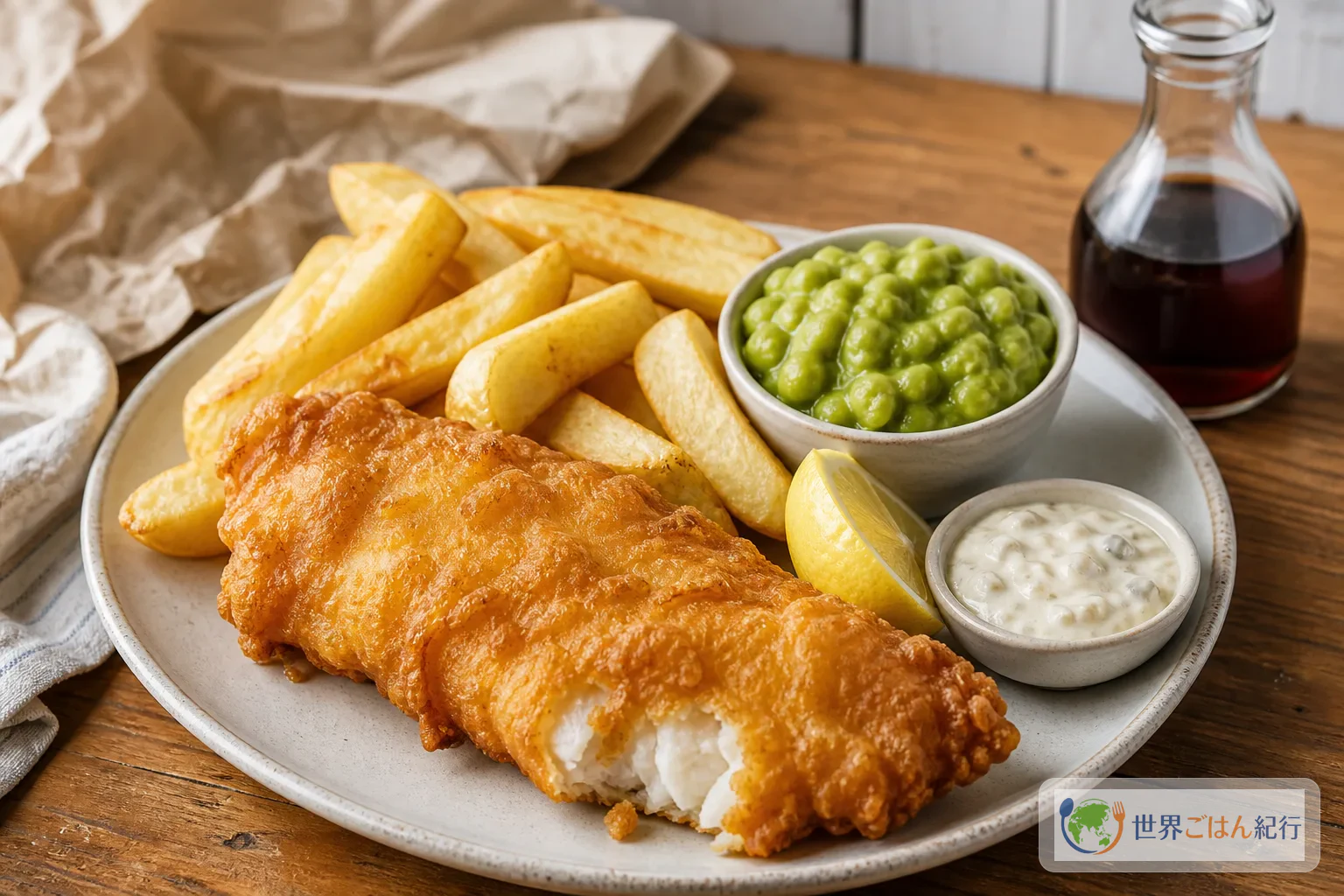
No heat in this step; with the heat off, plate the chips and place the fish without stacking. Add mushy peas, tartar sauce, and lemon, and sprinkle malt vinegar or white wine vinegar in small amounts just before eating. Pouring the vinegar over everything first lets the batter take up steam and soften, so it is fine to serve it in a small dish at the edge of the plate.
The batter on the fish is lightest right after frying, and the chips change in surface firmness within about 5 minutes. If you finish plating first and keep the sauce and vinegar at hand before starting the last fry, you can bring it to the table hot.