Ingredients and steps on one page. Print it, or choose “Save as PDF” in the print dialog.
Sekai Gohan
Mehallabiyya: Iranian Home-Style Rosewater Milk Pudding
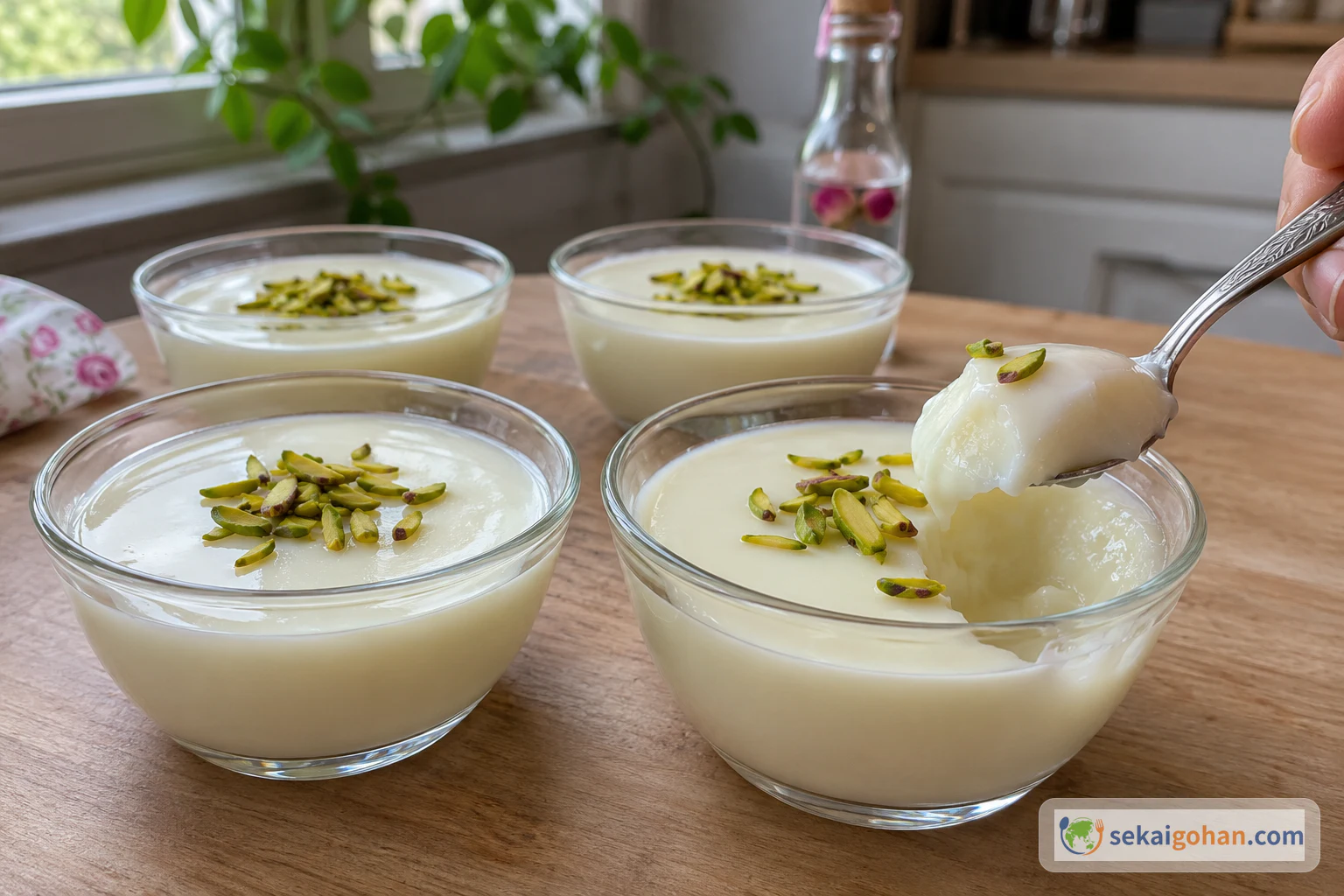
Ingredients
| Ingredient | Amount | Role |
|---|---|---|
| Whole milk (shir) | 4 cups | The body of the pudding |
| Cornstarch (nashasteh-ye zorrat) | 4 tbsp | Thickens the milk and sets it as it cools |
| Sugar (shekar) | ½ cup | Sweetness |
| Rosewater (golab), food-grade | 2 tbsp | The fragrance |
| Banana (moz), optional | 1, thinly sliced | A soft layer at the bottom of each glass |
| Slivered pistachios (khelal-e pesteh), optional | as needed | Green garnish on the set surface |
Steps
1Whisk the cornstarch into cold milk
Pour the cold milk into the saucepan with the heat off. Add the cornstarch and whisk until every lump has dissolved, working the whisk into the corners of the pan where powder hides. Cold milk matters here, because starch dropped into warm milk swells into beads before it can spread. Keep whisking until the milk is evenly white and the whisk comes out clean, with no specks clinging to the wires.
Dissolve completely before the heatLumps form in the first seconds of heating and do not whisk out afterwards. Spend the extra time here, scraping the bottom once to catch any starch that has settled.
2Stir in the sugar
Add the sugar to the milk, still off the heat. Stir with a spoon until it has completely dissolved. Drag the spoon across the bottom of the pan to feel for grains. Move on when the milk is smooth and opaque and nothing grits under the spoon.
3Set over low heat and keep stirring
Put the pan over low heat and switch to the silicone spatula. Stir constantly, scraping the bottom and corners in long strokes, because cornstarch catches and scorches where it touches the hot metal. The mixture stays thin and pourable for the first few minutes while it warms and begins to steam. You are on track when the spatula glides freely and no film builds up on the bottom of the pan.
4Cook until it falls in a heavy ribbon
After about 4 to 5 minutes the milk begins to thicken, and you feel the drag on the spatula change. Keep stirring without pause. Some cooks take the pan off the heat the moment it thickens; others keep going until slow bubbles break the surface. Stop when the pudding falls from a lifted spatula in a thick ribbon that leaves a trail on the surface, the raw starch smell has gone, and the texture is a little firmer than fereni.
5Take it off the heat and add the rosewater
Lift the pan off the burner onto a trivet. Pour in the rosewater and stir quickly with the spatula until it disappears into the pudding. Adding it off the heat keeps the scent from cooking away. The pudding is ready to pour when the steam smells clearly of roses and the surface looks even, with no thin streaks of liquid.
Rosewater goes in lastThe fragrance is the most fragile part of the dish. Have the 2 tbsp measured in advance so it goes into the pan the second the pan comes off the flame.
6Pour into the glasses
If you are using banana, lay the thin slices over the bottom of some or all of the glasses. Pour the hot pudding slowly down the inside wall of each glass rather than straight onto the fruit, so the slices stay where you put them. Fill the rest of the glasses the same way. Each glass is done when the surface has settled level and the banana layer still sits flat on the bottom.
7Garnish once the surface firms, then chill
Set the glasses on a shallow tray and let them stand only until the surface firms into a matte skin. Then scatter the pistachios, which now stay on top instead of sinking. Carry the tray straight to the refrigerator and chill for a few hours. The pudding is ready when it is cold all the way through and holds its shape on a spoon with a soft wobble.