Ingredients and steps on one page. Print it, or choose “Save as PDF” in the print dialog.
Sekai Gohan
Tahdig: How to Make Persian Crispy Rice from the Bottom of the Pot
Ingredients
Rice and pot bottom
| Ingredient | Amount | Role and substitutes |
|---|---|---|
| Basmati rice | 14 oz (390 g) | For 4 servings. Other long-grain aromatic rice such as jasmine can substitute. Short-grain rice needs the adjustments described below |
| Water for soaking | 1.5 quarts (1.5 L) | Enough to cover the rice well |
| Salt for soaking | 2 tsp | Seasons the rice. Discard the water before boiling |
| Water for boiling | 2.75 quarts (2.5 L) or more | Deep enough for the rice to swim |
| Salt for boiling | 1 tbsp | Season the water the way you would for pasta |
| Neutral oil | 3 tbsp (45 ml) | Spread evenly over the bottom of the pot. Rice bran oil or light sesame oil also works |
| Unsalted butter | 20 g | Adds aroma while steaming. You can make it with oil alone |
Saffron and the base layer of rice
| Ingredient | Amount | Role and substitutes |
|---|---|---|
| Saffron | about 0.1 g | A pinch. Bloom the threads in a little hot water |
| Hot water | 2 tbsp (30 ml) | For the saffron liquid |
| Plain yogurt | 1.5 oz (45 g) | The base of the crust. To avoid dairy, omit it and add 2 tsp (10 ml) more oil |
| Salt | a little, to finish | Adjust to the saltiness of the boiling water |
Steps
1Wash off the surface starch
Put 14 oz (390 g) of basmati rice in a bowl, add water, stir gently, and pour off the cloudy water. Repeat 4 to 5 times, until the water goes from milky to lightly translucent. Rubbing hard breaks the grains, which makes them sticky in the pot later, so just roll them gently with your fingertips.
Add 1.5 quarts (1.5 L) of water, enough to cover the rice, and 2 tsp of salt, and leave for 30 minutes. Soaked rice has swollen, whiter centers than when dry, and when you snap a grain with your fingers only the surface is slightly soft. You can stretch the soak to 2 hours, but for a first attempt do not soak too long, so the parboiling time stays easy to judge.
2Make the saffron liquid
Put 0.1 g of saffron in a mortar or small dish and loosen it gently with your fingertips. Pour in 2 tbsp (30 ml) of hot water and leave for at least 10 minutes. It is ready when the liquid turns a reddish gold. Rather than using a lot of threads to push the yellow, scatter a small amount over the rice, which keeps the contrast between the white of the chelow and the aroma.
A mortar is worth buying if you will keep using saffron and whole spices. If you are only trying this once, press the saffron lightly with the back of a spoon and let it open slowly in the hot water; no special tool is needed.
3Pull it from plenty of water early
Bring 2.75 quarts (2.5 L) or more of water to a boil in a pot and dissolve 1 tbsp of salt in it. Drain the soaked rice, add it to the water once the boil returns, and cook at a strong medium heat for 5 to 7 minutes. Pot size, water temperature, and soaking time all make a difference, so after 6 minutes take out one grain and bite it.
It is time to lift it when the outside is soft and a small firmness remains at the center. If the center is already soft, the rice will fall apart when steamed; if the center is chalky and hard, add 30 seconds at a time. Drain into a fine-mesh strainer, run cold water over it for about 30 seconds to rinse off the extra surface starch, and drain thoroughly.
4Yogurt rice on the bottom, white rice on top
Add 3 tbsp of neutral oil to a dry pot and warm it over medium heat. In a separate bowl, mix about 7 oz (200 g) of the parboiled rice with 1.5 oz (45 g) of yogurt, half of the saffron liquid, and a little salt. Turn it from the bottom with a spatula so you do not crush the rice.
When the oil moves loosely, lower the heat and spread the yogurt rice thinly over the bottom of the pot. Mound the remaining white rice high in the center without pressing it down, and poke 6 to 8 holes in the surface of the mound. The holes become channels for steam and keep the rice on top from turning watery.
5Check the sound and color, then release the crust
Pull the mound slightly away from the sides so heat can travel in from the rim of the pot. Wrap the lid in a clean, thick kitchen towel, make sure the ends do not hang toward the flame, and set it back on the pot. Heat at medium for 6 to 8 minutes, and when you hear a small sizzle from the bottom, drop to low.
Steam for 30 to 35 minutes more. Stirring midway breaks the crust at the bottom and makes the rice on top sticky, so lift the lid as few times as possible. Before turning off the heat, dot 20 g of unsalted butter into the holes in the rice and drizzle the remaining saffron liquid over a little at a time. After turning off the heat, rest for 5 minutes with the lid on.
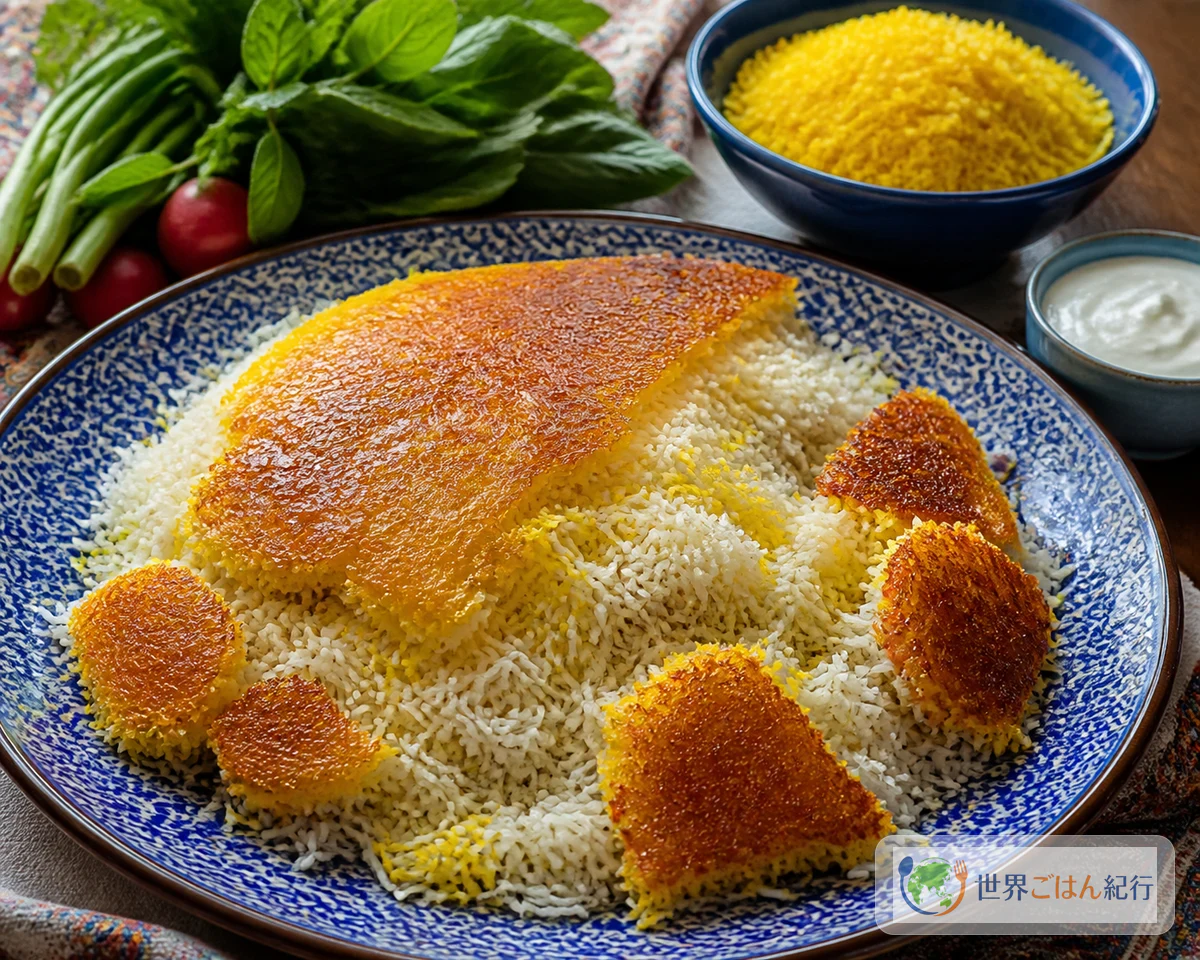
Set the pot on a damp towel for 2 to 4 minutes to cool the bottom slightly, and run a wooden spatula once around the edge of the crust. Either put a large plate over the pot and flip it, or plate the rice first, break the crust, and arrange it on top. It has worked if the crust is golden to deep amber, sounds hard when pressed, and is dry inside.