Ingredients and steps on one page. Print it, or choose “Save as PDF” in the print dialog.
Sekai Gohan
Manakish: Lebanese Za'atar Flatbread for Breakfast
Ingredients
Dough
| Ingredient | Amount | Role & substitutes |
|---|---|---|
| Bread flour | 1 lb (450 g) | Resists tearing when rolled thin. If using only all-purpose flour, reduce water by 10–20 ml |
| Lukewarm water | ¾ cup (180 ml) | 35–38°C. Water that is too hot weakens the yeast |
| Instant dry yeast | 5 g | About 1 1/2 tsp. Check the storage condition after opening |
| Sugar | 4 g | Helps get the yeast fermenting. Can be omitted |
| Salt | 8 g | Tightens the flavor of the dough |
| Olive oil | 2 tbsp (30 ml) | Makes the dough easier to roll and keeps the baked bread from turning hard |
Za'atar topping
| Ingredient | Amount | Substitutes & notes |
|---|---|---|
| Za'atar | 2 oz (60 g) | Store-bought. If it contains salt, no extra salt is needed |
| Olive oil | ¼ cup (60 ml) | Mix with the za'atar into a slowly flowing paste |
Steps
1Dissolve the yeast in lukewarm water
Mix 4 g sugar and 5 g dry yeast into ¾ cup (180 ml) lukewarm water and leave it for 8–10 minutes. If fine bubbles spread over the surface, it is ready to use. Avoid water that feels hot when you put a finger in. If it is hotter than 113°F (45°C), the yeast's power drops and the dough is slow to rise. If no bubbles appear, check the room temperature. If nothing changes after another 10 minutes, replace the yeast.
2Combine the flour and knead until the surface is smooth
Put 1 lb (450 g) bread flour and 8 g salt in a bowl and add the yeast liquid and 2 tbsp (30 ml) olive oil. When no dry flour is left, turn it out onto the counter and knead by hand for 8–10 minutes. It will be a bit sticky at first, but knead until the surface comes together and a pressed dent springs back slowly. Adding flour continuously makes the baked bread hard, so when dough sticks to your hands, oil them lightly instead. Only if the dough is cracking from lack of water, add 1 tsp (5 ml) of water at a time.
3Let the dough rise to nearly double
Put the dough in a lightly oiled bowl and cover with a dry cloth or plastic wrap. Leave for 60–90 minutes at about 25–28°C. Don't go by time alone; check that the volume is about 1.8–2 times larger and that a pressed dent springs back slowly. At a room temperature of around 68°F (20°C) it will take more than 90 minutes. Keep it away from a heater's draft, which dries only the surface. If you need extra warmth, set a container of hot water nearby.
4Divide into 6, rest, then roll thin
Press the risen dough lightly to release the gas and divide it into 6. Each piece is about 4.5 oz (125 g). Round them and rest for 10 minutes, then roll to 8 inches (20 cm) across with a minimum of dusting flour. Leave the center 3–5 mm thick and the rim slightly thicker, so the rim bakes while holding the topping. You don't need to leave air in and make it thick like pizza. If the dough shrinks back, rest it for 5 minutes before rolling harder. When rolled, the surface should be dry but not floury, and the center should not look translucent when lifted. During this time preheat the oven to 475°F (250°C), or 450°F (230°C) if the maximum of your model is 450°F (230°C), and keep the baking sheet hot for 30 minutes.
5Spread the za'atar and make shallow dimples with your fingers
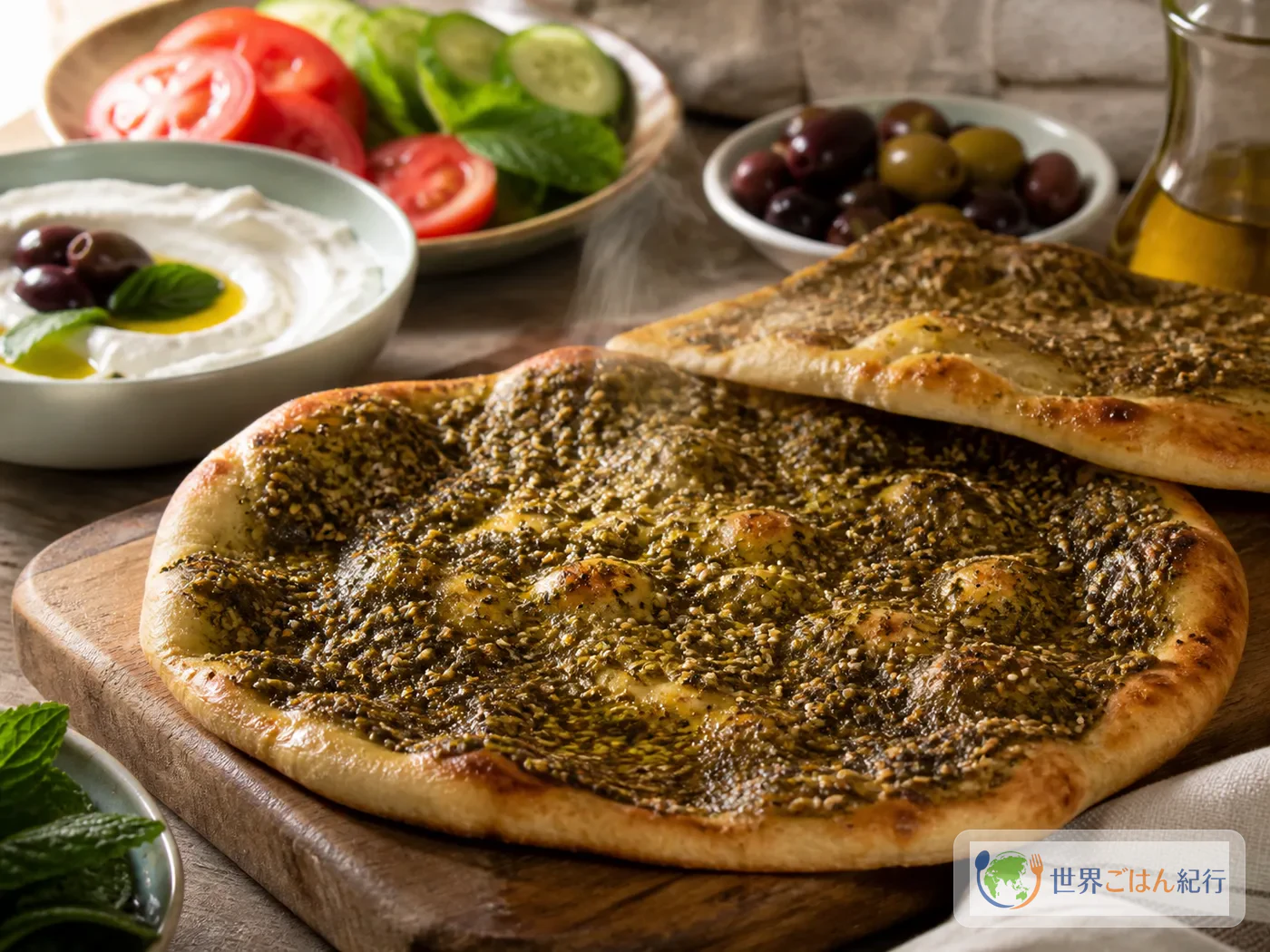
Mix 2 oz (60 g) za'atar and ¼ cup (60 ml) olive oil for about 2 minutes, until the herbs are evenly mixed into a smooth paste. Even after the powder absorbs oil, it should flow slowly when you tilt the spoon. Spread a little over 1 tbsp on each piece of dough from the center to the edge, leaving the outer 0.25 inch (5 mm) bare. If you spread it so thick that oil pools, the center doesn't bake, and only the herbs scorch first. Press the surface lightly with the tips of three fingers to make shallow dimples here and there. Don't poke holes. If your fingers are about to go through the dough, ease off.
6Bake briefly on the hot sheet
Move the dough, parchment and all, onto the preheated baking sheet and bake at 475°F (250°C) for 6–8 minutes. If the maximum of your home oven is 450°F (230°C), aim for 8–10 minutes. It is done when the edge has a light color, small puffs form on the surface, and the center is not damp when you lift the underside. If it stays pale while the time stretches, lengthen the sheet's preheating from the next piece. The edge should color before the za'atar turns black. If the surface scorches first, thin the paste rather than lowering the temperature.
7Rest for 2–3 minutes and fold with the vegetables
Move the baked bread to a rack and rest it for just 2–3 minutes. If you stack it immediately, steam softens the bottom. Cut into four and serve with labneh and vegetables, or fold in half and tuck in mint and olives. When the heat has dropped a little, the green of the herb, the sourness of the sumac and the bitterness of the olive oil come together without separating. Place the fresh bread in the center of the table and eat while you bake the next piece.