Ingredients and steps on one page. Print it, or choose “Save as PDF” in the print dialog.
Sekai Gohan
Cochinita Pibil: Yucatán Achiote Pork Braised in Banana Leaves
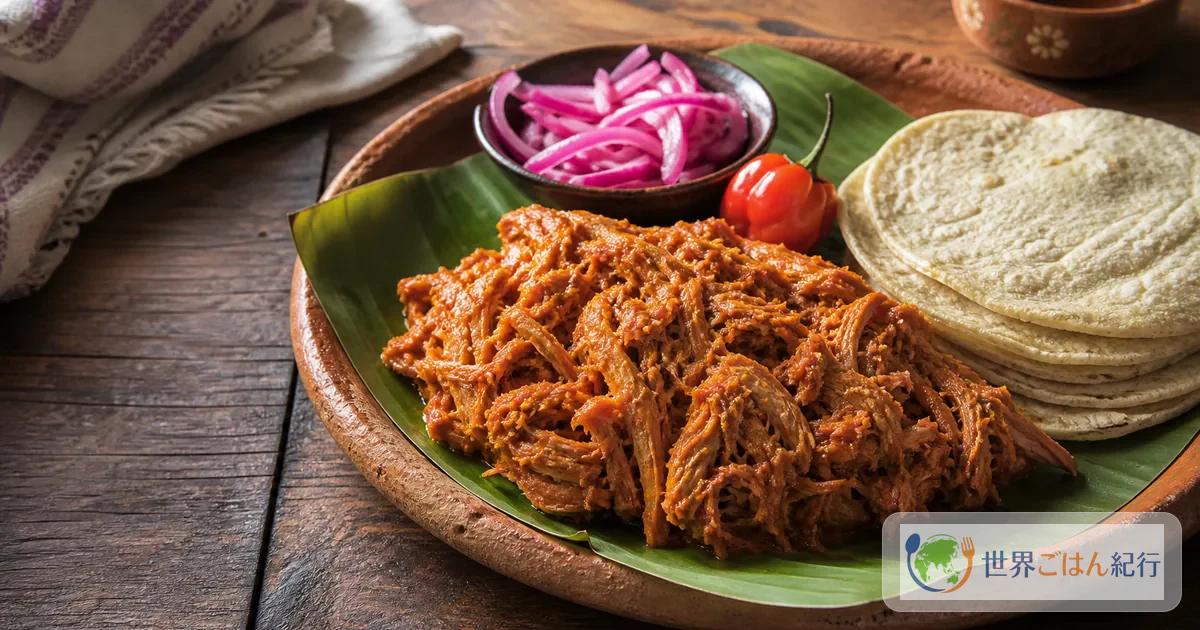
Ingredients
Meat and achiote marinade
| Ingredient | Amount | Role & substitutes |
|---|---|---|
| Pork shoulder (Boston butt) or pork shoulder roast, in one piece | 1 kg | A piece with fat under 1 cm thick. Leg alone tends to dry out. About 2.2 lb |
| Annatto seeds | 20 g | The seeds used for achiote. 60 g store-bought achiote paste also works |
| Orange juice | 120 ml | Use sweet oranges. About 1/2 cup |
| Lime juice | 45 ml | 30 ml lemon juice also works |
| Rice vinegar or apple cider vinegar | 15 ml | Makes up for the sharpness of sour orange |
| Garlic | 4 cloves, 20 g | Crushed |
| Ground cumin | 1 tsp | The base of the aroma |
| Ground allspice | 1/2 tsp | Notes reminiscent of cinnamon and clove |
| Dried oregano | 1 tsp | Regular dried oregano if you can't find Mexican oregano |
| Black pepper | 1/2 tsp | Coarsely ground |
| Cinnamon | 1 cm piece | Optional |
| Salt | 12 g | About 1.2% of the meat's weight |
| Water | 100 ml | Goes in the bottom of the pot for steam |
Wrapping and finishing
| Ingredient | Amount | Role & substitutes |
|---|---|---|
| Banana leaves | 2 sheets, 12 inches (30 cm) square | Thaw frozen leaves and wipe dry. Without them, 1 sheet of parchment paper plus foil. About 12 inches square |
| Red onion | 1, 6.5 oz (180 g) | Thinly sliced |
| Vinegar | ¼ cup (60 ml) | Rice vinegar or white wine vinegar |
| Water | ¼ cup (60 ml) | Softens the vinegar's edge |
| Salt | 3 g | For the red onion |
| Sugar | 4 g | Rounds out the acidity. Optional |
| Habanero | 1/2 | Only if you want heat. Sliced into rings |
| Corn tortillas | 12 | 3 per person. Flour tortillas also work |
| Cilantro | 10 g | For garnish. Leave it out if you don't like it |
Steps
1Make the sour orange substitute
5 min, no heat
Halve and squeeze the limes and measure the juice. In a bowl, combine ½ cup (120 ml) orange juice, 3 tbsp (45 ml) lime juice and 1 tbsp (15 ml) vinegar. Taste just the acidity first: you're looking for sweetness up front with a tightening at the back of the tongue. It's ready when the liquid is evenly mixed and the vinegar doesn't sink to the bottom. Orange juice alone, which is sweet, won't cut through the fat of the cooked meat. If you can get sour orange, replace the total ¾ cup (180 ml) with its juice.
2Crush the annatto and spices
8 min, low heat
Warm a skillet over low heat for 30 seconds and add 20 g annatto seeds. Shake the pan so the seeds don't jump, toast them dry for just 1 minute, and turn off the heat when the reddish brown deepens slightly. Heating them until black makes them bitter, so stop before they start to smell toasted.
Put the annatto, cumin, allspice, oregano, black pepper, cinnamon and garlic in a mortar and grind to a coarse paste with no large pieces left. It doesn't need to be a fine powder. Add some of the orange juice; once it becomes a red-orange sauce that drips slowly off a spoon, move on.
3Marinate the pork shoulder
15 min + 4–12 hours resting in the fridge
Pat the surface of the 1 kg pork shoulder dry with paper towels and cut it into roughly 4 cm (1 1/2 inch) cubes. You can leave it as one large piece, but in a home pot, 4 cm cubes let the flavor reach the center and make it easier to check doneness. Rub 12 g salt all over, then add the paste, the remaining citrus liquid and massage them in.
Put it in a storage container or a heavy zip-top bag and refrigerate for at least 4 hours, ideally overnight. It's ready when the surface of the meat is evenly red-orange and the liquid hasn't separated to the bottom. Even if you're short on time, don't stop at 30 minutes; allow 4 hours. Trying to tenderize the meat with acid alone tends to tighten the surface; the point of the wait is to move the aroma and salt into the meat.
4Wrap in banana leaves and place in the pot
10 min, low heat
Rinse the banana leaves and wipe them with paper towels. Prepare 2 leaves 1 inch (2 to 3 cm) larger than the bottom of the pot and lay them so they overlap in the center. Set a dry skillet over low heat and warm the leaves one at a time for about 10 seconds, keeping them moving. They're ready when the surface shines evenly and they give off a green aroma. Take them out before any scorched spots appear.
Lay the leaves in the pot in a cross, and place the marinated meat and its liquid in the center. Add ½ cup (100 ml) water to the bottom of the pot, fold the leaves over the meat and cover with the lid. Without leaves, wrap the meat in parchment paper, seal it with foil over the top and place it in a lidded pot. A layer of parchment between the meat and the foil makes the acidic liquid easier to handle than foil touching the meat directly.
5Let the meat fall apart in a 350°F (170°C) oven
3 hours 30 min, checking just once along the way
Cover the pot and put it in an oven preheated to 170°C (340°F). After 3 hours, take the pot out and check the meat through a gap in the leaves. It's done when a fork slides in without resistance and the fibers split naturally when you push them sideways. If it still feels springy, put the lid back on and continue in 20-minute increments.
For food safety, the minimum for whole cuts of pork is 63°C (145°F) in the center, followed by a 3-minute rest. But this dish needs to go further: to make it tender enough to pile onto tortillas, let the center climb to around 90°C to 95°C (195°F to 205°F) so the connective tissue breaks down. If you use a thermometer, check how the fork goes in as well as the number. For leftovers and cooling, see leftovers and food safety.
6Shred the meat and return the juices
20 min, low heat
Take the pot out and let it rest, covered, for 15 minutes. Move the meat to a bowl, and once it has cooled slightly, shred it along the grain with two forks. Transfer the red-orange liquid left in the pot to a small saucepan and warm it over low heat for just 5 minutes to reduce it slightly. Return the meat and let it soak up the juices.
The goal is not to evaporate the juices completely. When you lift the meat with tongs, a thin stream should drip off, and about 2 to 3 tbsp of juice should remain at the bottom of the bowl; that's the consistency that keeps it from drying out on a tortilla. If the acidity is sharp, thin the juices with water 1 tbsp at a time; if the salt is weak, add a pinch at a time.
7Put the red onion in a tangy pickling liquid
15 min, no heat
Thinly slice the red onion and place it in a clean storage container. Mix ¼ cup (60 ml) vinegar, ¼ cup (60 ml) water, 3 g salt and 4 g sugar and pour it over; if using habanero, add half of the rings. After 15 minutes the purple-red color turns vivid from the outside in, the surface becomes slightly translucent and the onion's bite fades.
This is not a sauce to mix into the meat but an accompaniment to cut the fat at the table. If anyone doesn't like heat, put the habanero on a separate plate. There's no need to blanch the onion, but keep it apart from tools that touched raw meat and refrigerate it once pickled.
8Fill the tortillas and set the flavor
5 min, low heat
Warm the corn tortillas in a dry skillet for 20 seconds per side, until the surface isn't dry and they fold without cracking, then wrap them in a kitchen towel. Put about 2 tbsp of meat in the center of each, in a mound about 2 cm (3/4 inch) high, and add red onion, cilantro and habanero. Taste the first bite with meat only, then add onion.
The sweet fat and achiote aroma come first from the meat, the acidity rises when you add onion, and a little habanero widens the depth of the aroma. Rather than piling everything on from the start, you can find out for yourself which element is missing. If you've added heat and it still lacks acidity, add more onion, not more habanero.