Ingredients and steps on one page. Print it, or choose “Save as PDF” in the print dialog.
Sekai Gohan
Menudo Rojo: Mexican Red Chile Tripe and Hominy Soup
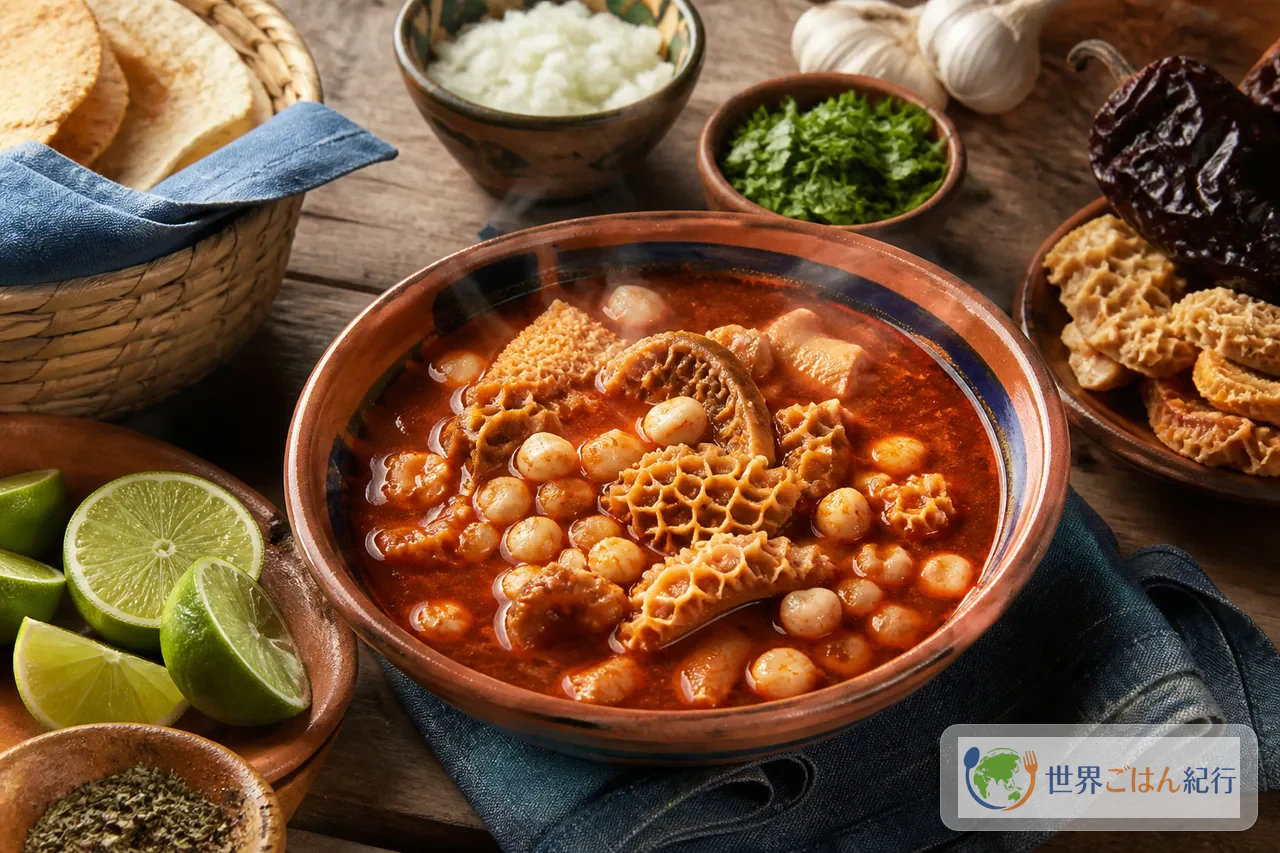
Ingredients
Tripe and simmering broth
| Ingredient | Amount | Substitutes & notes |
|---|---|---|
| Cleaned honeycomb tripe | 500 g | Beef reticulum (honeycomb stomach). Choose tripe sold for cooking over uncleaned (about 1.1 lb) |
| Beef shank | 250 g | Bone-in shank or beef tendon also works. Gives the broth more body than tripe alone (about 9 oz) |
| Onion | 1/2 (about 100 g) | Cut into wedges. The rest is used for serving |
| Garlic | 3 cloves | Crush before adding |
| Water | 2 L | Enough to keep the tripe submerged. Top up with boiling water if it drops (about 8 1/2 cups) |
| Bay leaf | 1 | Can be omitted |
| Dried oregano | 1 tsp (about 1 g) | Mexican oregano is ideal. Start with less if yours is strongly aromatic |
| Salt | 1 tsp, to start | Adjust separately in the chile sauce and at the end |
Red chile sauce and hominy
| Ingredient | Amount | Substitutes & notes |
|---|---|---|
| Dried guajillo chiles | 4 (about 20 g) | Remove stems, seeds and thick veins. The base for red color and gentle tartness |
| Dried ancho chiles | 2 (about 20 g) | Add sweetness and deep color. If unavailable, use 2 more guajillos |
| Dried chile de árbol | 1 | For heat. Omit for a milder pot |
| Ground cumin | 1 tsp | Too much pushes it toward curry, so start with this amount |
| Black pepper | 1/2 tsp | Coarsely ground is fine |
| Garlic | 1 clove | For the chile sauce |
| Hot water for soaking | 400 ml | Enough to fully cover the chiles (about 1 2/3 cups) |
| Broth or water | 250 ml | Liquid for blending (about 1 cup) |
| Vegetable oil | 1 tbsp | For frying the strained sauce |
| Canned white hominy | 1 can (425 g net) | Drain and rinse lightly. If using dried, soak and precook it separately (a standard 15 oz can) |
For the table
| Ingredient | Amount | Substitutes & notes |
|---|---|---|
| White onion | 1/2 | Finely chopped. If sharp, soak in water for 5 minutes and drain |
| Limes | 2 | Lemon works, but the aroma and tartness change |
| Cilantro | 1/2 bunch | Scallions give a milder green note |
| Dried oregano | 1/2 tsp | Rub between your fingers over the bowl to release the aroma |
| Ground chile de árbol | A little | Serve on the side; not everyone wants it hot |
| Corn tortillas or tostadas | For 4 | Add heft. Check the ingredient label of each product |
Steps
1Parboil the tripe
15 min
Cook over medium-high heat.
Cut 1 lb (500 g) honeycomb tripe into large pieces, about 2 inches (5 cm) square at the thick parts, and rinse briefly in a bowl. Drain off the surface water. Put the tripe in a pot, add plenty of water and bring to a boil over medium-high heat. Once boiling, keep it going for 5 minutes, until white foam gathers on the surface. Discard the water, tip the tripe into a colander and wash the pot.
If the drained tripe is white to pale gray and the surface isn't strongly slimy, move on. If the smell is strong, repeat the same parboil just once more. Avoid soaking it repeatedly or trying to remove the smell with vinegar or cleaning agents; that makes it harder to judge the state of the tripe.
2Simmer the tripe and beef shank
2 hr to 2 hr 20 min
Start over medium heat, then lower to low once it boils.
Put the tripe, beef shank, onion, crushed garlic, bay leaf, dried oregano and 2 quarts (2 L) water in the clean pot. Bring to a boil over medium heat, and for 15 minutes after it boils leave the lid off and skim the foam that gathers on the surface with a ladle. When the foam subsides, turn the heat to low, set the lid slightly ajar and keep the surface just trembling. At this stage the broth is thin and light, concentrated enough to ladle the solids from.
After 1 hour 30 minutes, test the thickest part of the tripe with a chopstick or skewer. If the skewer goes in easily and the tripe holds together when lifted, you're on track. If it's still tough, add 100 ml (about 1/2 cup) boiling water, replace the lid and extend in 10-minute increments. A hard boil reduces the liquid but tightens the surface of the tripe, so never let the whole pot churn.
3Toast and soak the dried chiles
30 min
Medium-low heat while toasting; no heat while soaking.
Remove the stems, seeds and thick veins from the guajillo, ancho and chile de árbol. Spread the guajillos and anchos in a dry skillet and warm over medium-low heat for 20 to 30 seconds per side. Chile de árbol is thin, so about 10 seconds is enough. As soon as they smell sweet, like dried fruit, and the skins turn slightly brighter, take them out.
If black spots spread, the chile is burned; don't put that one in the sauce. Move the toasted chiles to a bowl, pour over 400 ml water at about 80°C (176°F), weigh down with a plate and leave for 20 minutes. They're done when the skins are soft enough to bend with your fingers. Taste a little of the soaking liquid; if it's bitter, don't use it in the sauce and use water or simmering broth instead.
4Blend and strain the red sauce
10 min
No heat.
Drain the soaked chiles and put them in a blender. Add 1 clove garlic, the cumin, black pepper and 1 cup (250 ml) broth or water, and blend for 60 to 90 seconds, until you can barely see any flecks of skin. Press a little with the back of a spoon; if the red liquid isn't gritty, it's ready.
Set a fine-mesh strainer over a bowl and pour in the sauce. Press with the back of a ladle and strain out the bits of skin. If the sauce won't move, add broth 1 tbsp at a time and blend again. When you have 200 ml to 1 cup (250 ml) of strained sauce that's an even reddish brown, it's ready for the pot.
5Fry the chile sauce
8 min
Cook over medium-low heat.
Heat 1 tbsp vegetable oil in a skillet or small saucepan over medium-low heat. Add the strained chile sauce a little at a time, stirring from the bottom so the oil doesn't spatter. For the first 2 minutes fine bubbles rise; after 3 minutes red oil floats to the surface. Cook about 5 minutes in total, until a line drawn with a spoon leaves a trail for just a moment. It's done when red oil floats on top and the reduced trail doesn't close right away.
If the sauce looks like it's about to stick, lower the heat and add 1 tbsp of the simmering broth. If the bottom turns brown, don't scrape it; transfer only the sauce above it to another pan. The bitterness of burned chile is hard to mask with sugar, so the best fix is to keep the black bits out of the pot.
6Add the hominy and red sauce
30 min
Simmer gently over low heat.
Lift the tripe and beef shank out of the broth. If there's a lot of fat on the surface, skim some off with a ladle, but there's no need to remove it all. Add the fried chile sauce to the pot and stir until the broth turns deep red.
Add the drained, lightly rinsed hominy and return the tripe and beef shank. Simmer over low heat for 25 to 30 minutes with the lid slightly ajar. When the hominy kernels have plumped and a thin layer of red broth clings to the surface, it's cooked. Finally taste for salt, adding 1/4 tsp at a time if needed.
If the broth is watery, remove the lid and extend by 10 minutes, taking care not to break up the solids. If it's too salty or hot, add boiling water ½ cup (100 ml) at a time and heat for 3 minutes. Diluting with plain water again and again also weakens the aroma, so don't add much at once.
7Cut the tripe and return it to the pot
10 min
Off the heat at first, then low heat only at the end.
Take the tripe out onto a cutting board and cut into about 3/4 to 1 inch (1.5 to 2 cm) squares. Pull the beef shank apart along the grain into bite-size pieces. Return the cut tripe and shank to the pot and warm over low heat for 5 minutes.
It's done when the tripe holds together on a spoon and gives way with a soft spring when you bite it. If it's so soft the surface is falling apart, it's still fine to eat, but the honeycomb texture will be weaker. If it's still tough, return just the tripe to the broth, cover and extend in 10-minute increments.
8Set out the garnishes
5 min
Keep the soup hot over low heat.
Finely chop the white onion to 2 mm to 0.125 inch (2–3 mm), cut the limes into 4–6 wedges each, and tear the cilantro into small pieces. Ladle the menudo into bowls and top the center with a little onion, cilantro and dried oregano. Put the limes and ground chile de árbol on a separate plate so everyone can add tartness and heat.
When red broth, white hominy, green herbs and tart lime come through one after another in a single bite, the bowl is ready. Serve the corn tortillas or tostadas as a contrast in texture rather than soaking them through. Squeezing lime into the pot from the start makes the whole thing sour, so add it a little at a time at the table.