Ingredients and steps on one page. Print it, or choose “Save as PDF” in the print dialog.
Sekai Gohan
Panuchos: Yucatán Fried Tortillas Stuffed with Black Beans
Ingredients
Black bean paste
| Ingredient | Amount | Substitutes & notes |
|---|---|---|
| Cooked black beans | 10.5 oz (300 g) | Canned beans: drain first. If using dried, soak and simmer until tender |
| White onion | 1.5 oz (40 g) | Finely chopped. Red onion works, but keep it separate from the pickled onion on top |
| Garlic | 1/2 clove (about 3 g) | Omitting it lets the sweetness of the beans come forward |
| Water or bean cooking liquid | ¼ cup (80 ml) | To adjust the thickness of the paste. Do not add it all at once |
| Salt | 3 g | Adjust after checking the salt in the canned beans |
| Canola oil or lard | 1 tbsp (15 ml) | For frying the beans. Lard gives a stronger aroma |
Tortilla dough
| Ingredient | Amount | Substitutes & notes |
|---|---|---|
| Masa harina | 8.5 oz (240 g) | Do not substitute masarepa, cornstarch, or wheat flour |
| Warm water | about 1¼ cups (320 ml) | Adjust by 10 ml at a time depending on how dry the flour is |
| Salt | 3 g | For the dough. Too much hides the flavor of the beans and toppings |
Achiote chicken
| Ingredient | Amount | Substitutes & notes |
|---|---|---|
| Boneless, skinless chicken thighs | 12.5 oz (350 g) | Turkey works in the same amount if you can find it |
| Achiote paste (annatto) | 1 oz (30 g) | Reduce the salt depending on the product. Seeds or powder change the flavor |
| Orange juice | ¼ cup (60 ml) | Stands in for Yucatán's sour orange |
| Lime juice | 1.5 tbsp (20 ml) | Do not use lemon alone; keep the round orange aroma |
| Garlic | 1 clove (about 6 g) | Grated |
| Ground cumin | 2 g | A little under 1 tsp. Do not overdo the aroma |
| Dried oregano | 1 g | 1/2 tsp. The achiote still carries the dish if you omit it |
| Salt | 4 g | Adjust for the saltiness of the paste |
Pickled red onion and toppings
| Ingredient | Amount | Substitutes & notes |
|---|---|---|
| Red onion | 4 oz (120 g) | Thinly sliced |
| White wine vinegar | ¼ cup (80 ml) | Rice vinegar works but is milder |
| Water | 2.5 tbsp (40 ml) | Softens the edge of the vinegar |
| Salt | 2 g | For the pickle |
| Habanero | up to 1/2 | Omit if you dislike heat and serve as a sauce on the side |
| Lettuce | 2.75 oz (80 g) | Shredded |
| Tomato | 1 (about 5.5 oz (150 g)) | Diced. Remove some seeds if it is very juicy |
| Cucumber | 1/2 (about 2 oz (60 g)) | Sliced. One garnish option |
| Avocado | 1 | Cut just before eating |
| Cilantro | 10 g | Optional if you dislike it |
Frying oil
| Ingredient | Amount | Substitutes & notes |
|---|---|---|
| Frying oil | about 1¼ cups (300 ml) | 0.375 inch (8 mm) deep in the skillet. A mild oil such as canola |
Steps
1Marinate the chicken in achiote and citrus, then cook it
15 min marinating, 15–18 min cooking
Mix 1 oz (30 g) achiote paste, ¼ cup (60 ml) orange juice, 1.5 tbsp (20 ml) lime juice, the garlic, cumin, oregano, and salt. Cut 12.5 oz (350 g) chicken thighs into bite-size pieces, work in the marinade, and leave for 15 minutes. If the paste is very salty, reduce the added salt.
Heat a heavy skillet over medium heat, add the chicken with its marinade and 3.5 tbsp (50 ml) water, and bring to a boil. Then lower to medium-low, cover, and simmer for 12–15 minutes. Turn off the heat when the center reaches at least 165°F (74°C), the cut surface has no red, and the liquid has gone from thin to slightly thickened and red-orange. Rest for 5 minutes, shred along the grain, and return only 1–2 tbsp of the liquid. If there is a lot of liquid, keep it apart from the meat. Shredded chicken with a little red-orange liquid left makes a topping that is not overpowered by the weight of the dough.
2Mash the beans into a paste that does not run
about 15 min
Cook 1.5 oz (40 g) onion and the garlic in 1 tbsp (15 ml) oil for 2–3 minutes over medium heat. When fragrant, add 10.5 oz (300 g) black beans, ¼ cup (80 ml) water or cooking liquid, and the salt. Simmer on low heat, just bubbling, for 8 minutes, then mash or pulse coarsely. Do not make it a liquid; aim for a thickness where the spatula leaves a trail that lasts 2 seconds.
Return to a small pot or skillet and cook over low heat for 3–5 minutes to evaporate moisture. It stiffens further as it cools, so do not dry it to a powder while hot. If too loose, cook 2 minutes more on low; if too stiff, add water 1 tsp at a time. Do not cover up the problem with extra oil. The target is a paste that holds the spatula trail but cannot be piped.
Tip: make the final adjustment before the paste coolsWhile hot it should be slightly soft, slowly dropping off a lifted spatula. Once it cools and stays put even with the spoon held upside down, it will not spread inside the tortilla. If it dries and cracks, add 1 tsp water; if it is loose and drips, cook 2 minutes on low.
3Pickle the red onion and drain the toppings
5 min slicing, 30 min pickling
Slice 4 oz (120 g) red onion thinly and pour just-off-the-boil water over it to take a little of the sharpness out. Combine ¼ cup (80 ml) white wine vinegar, 2.5 tbsp (40 ml) water, 2 g salt, and habanero if you like, and add the onion. Wait for 30 minutes until the red-violet shows through: the outside turns translucent and the color brightens. Stir the brine well so the salt dissolves, and loosen the onion by hand so it is coated. It is ready when it is soft, smooth, and bends slightly when pinched.
Shred the lettuce, dice the tomato, slice the cucumber, and cut the avocado last. Press excess moisture from the vegetables with paper towels. Do not mix the pickle into the meat; add it at the end. For anyone who wants to separate the heat, set aside a container without habanero first.
4Knead the masa harina and griddle thin tortillas
5 min kneading, 10 min resting, about 15 min cooking
To 8.5 oz (240 g) masa harina and 3 g salt, add the warm water starting at 1¼ cups (300 ml), until the dough is about as firm as an earlobe and free of cracks. Knead for 5 minutes, rest for 10, and divide into 8 pieces of about 2.5 oz (70 g) each. Press between sturdy storage bags or in a tortilla press to 4 inches (10 cm) across and 0.125 inch (3 mm) thick.
Heat an ungreased heavy skillet over medium to medium-high heat. Cook 45 seconds on one side, flip for 45 seconds, then flip again for 15–30 seconds. The signs are a dry surface, edges that lift, and small bubbles in the center followed by a light puff. Do not miss the moment when a bubble forms in the center and the thin layer lifts; if it threatens to scorch, lower the heat a little. If it does not puff, check for dry dough, uneven thickness, or a skillet that is too cool. Knead in a few drops of water and test with one tortilla.
Tip: puffing is the signal to shapeCooking the whole surface hard makes the thin top layer prone to cracking. Take the tortilla off once the surface is dry and the center has puffed. Cover cooked tortillas with a dry cloth to keep them moist. Even if the puff is small, a shallow cut just inside the edge that leaves the bottom layer intact lets you stuff the beans.
5Open the thin top layer and stuff with black beans
about 12 min
Cool a cooked tortilla for just 1 minute, make a short cut 0.25 inch (5 mm) in from the edge, and open only the thin surface layer. The trick is to open the top layer and leave the bottom layer; do not cut through the lower dough. Spread about 20 g black bean paste thinly in the center of each, close the layer, and press the edge lightly. A cooked tortilla is ready to cut when it has taken a pale color over medium heat and feels slightly dry and taut to the touch. Let it cool until just warm; if the layer does not tear and no beans escape at the edge, move on.
If one tears, patch it from the outside with a rice-grain-size piece of masa kneaded with water, and do not add more beans. Too many beans leak into the oil, and too few hide what makes this dish what it is. Check the amount with the first one.
6Fry in oil at 170–175°C (up to 350°F)
3–4 min each
Pour 0.375 inch (8 mm) of oil into a skillet and hold it at 170–175°C. If you have no thermometer, a steady stream of fine bubbles around the tip of a dry wooden spoon is a rough guide. Slide in 1–2 panuchos at a time, gently, and fry 1 minute 30 seconds to 2 minutes on one side, then 1 minute to 1 minute 30 seconds on the other.
Take them out at golden edges and no beans escaping at the seam. When the surface is an even golden color, the edge is firm, and the oil runs off in a thin stream as you lift one, stand it on a rack to drain. Below 325°F (165°C) they soak up oil and turn heavy; well above 350°F (180°C) only the surface scorches and the beans do not warm through. If one bursts, do not turn off the heat; keep your distance with tongs and take it out once the oil settles. Never throw water on it.
Tip: let the first one set your frying orderThe first panucho is a test run for bean quantity, seam, and frying time. If the surface darkens fast, lower the heat; if it soaks up oil without color, fry one at a time and let the oil recover. Do not stack the fried ones; stand them on a rack or paper towels so the surface does not steam.
7Stack the toppings and eat while warm
5 min plating
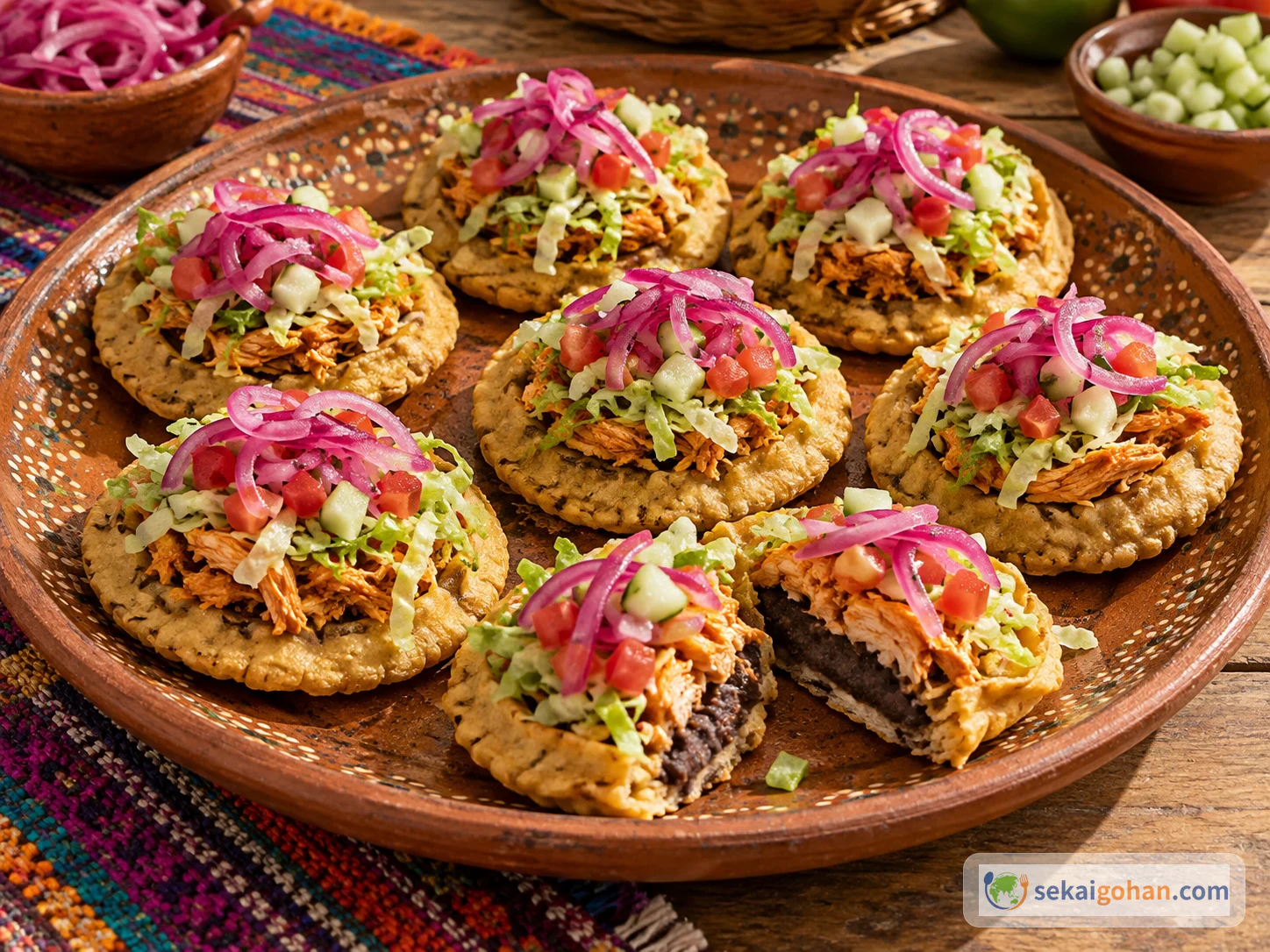
Onto each fried panucho, layer a little each of lettuce, shredded chicken, tomato, cucumber, avocado, and red onion, in that order. Do not overdo the red-orange chicken liquid; add about 1 tsp of the pickling liquid from the red onion. Serve habanero on the side so each person can set the heat. Freshly fried, they are golden, light, and crisp to hold, with warm, moist beans inside. Stack the toppings while warm and eat before the crust softens as it cools.
Hot dough, room-temperature vegetables, cold avocado. Layer these temperature differences and serve while the freshly fried crispness remains. Acidity and vegetables on fried dough is how it is eaten in Yucatán. Do not mix the toppings together on the plate, so everyone can vary the meat, acidity, and heat.