Ingredients and steps on one page. Print it, or choose “Save as PDF” in the print dialog.
Sekai Gohan
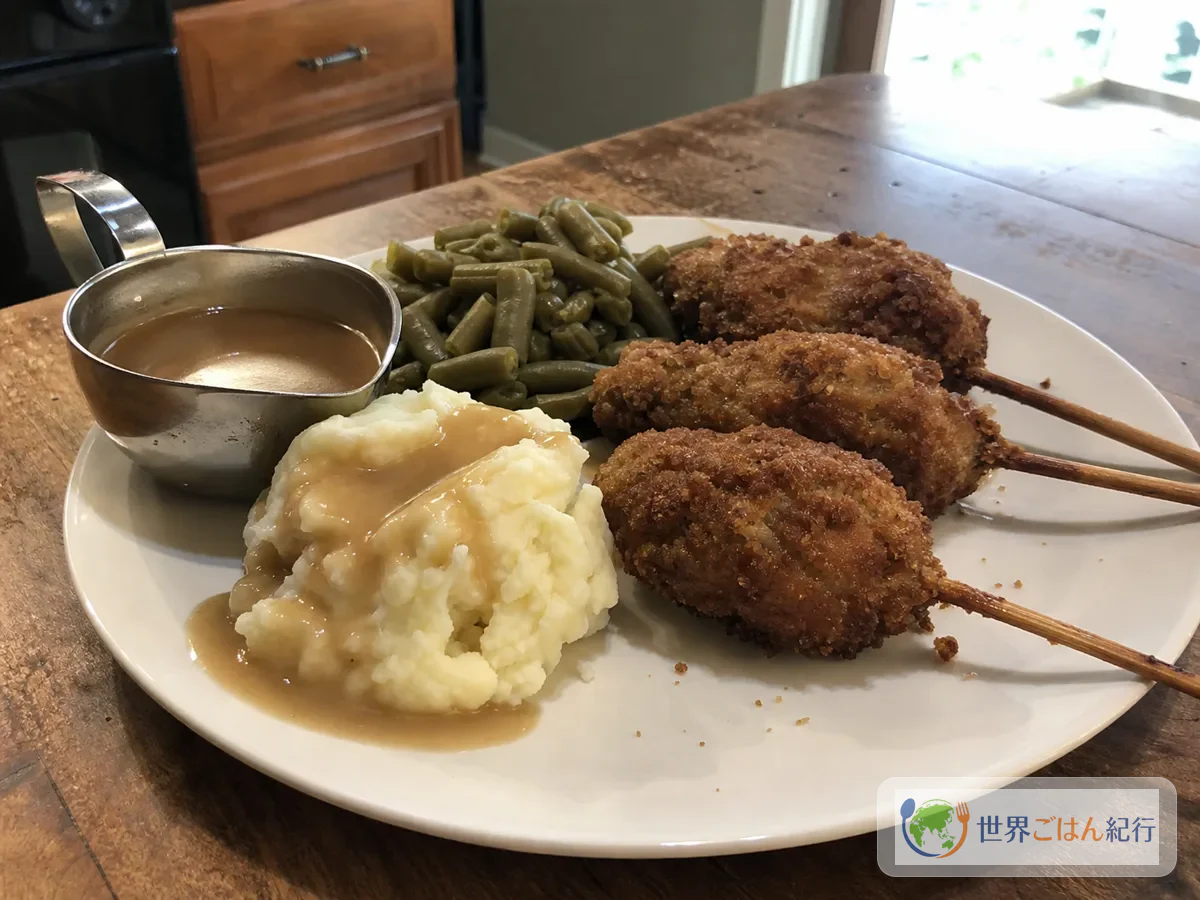
City Chicken: Breaded Pork on a Skewer, a Midwest Classic
Ingredients
Meat and seasoning
| Ingredient | Amount | Choosing and notes |
|---|---|---|
| Pork shoulder, block | 10.5 oz (300 g) | Do not leave thick fat; cut into 1 inches (2.5 cm) cubes |
| Pork leg, block | 10.5 oz (300 g) | Shoulder alone is fine too. Adding lean meat tightens the shape |
| Salt | 1 1/4 tsp | To season the meat |
| Black pepper | 1/2 tsp | Fine or coarse |
| Paprika | 1 tsp | For color and aroma. Smoked paprika is a little more American |
| Garlic powder | 1/2 tsp | 1/2 tsp grated fresh garlic also works |
Coating and frying oil
| Ingredient | Amount | Substitutes and notes |
|---|---|---|
| All-purpose flour | 2.5 oz (70 g) | Absorbs the moisture of the meat |
| Eggs | 2 | Beat well, breaking up clumps of white |
| Breadcrumbs | 4 oz (120 g) | Fine ones make an even coating; coarse ones make it crunchy |
| Milk | 2 tbsp | Thins the egg. Water is fine |
| Vegetable oil | 0.25 inch (5 mm) deep in the pan | For shallow-frying. Sesame oil is too fragrant |
Gravy and sides
| Ingredient | Amount | Role |
|---|---|---|
| Butter | 15 g | Richness for the gravy |
| All-purpose flour | 1 tbsp | Thickens the gravy |
| Chicken broth or water | 1 cups (250 ml) | If using water, add 1/2 tsp bouillon granules |
| Worcestershire sauce | 1 tsp | Boosts the meat aroma |
| Mashed potatoes | 4 servings | Receive the gravy |
| Green beans, pickles | as needed, of each | Cut the heaviness of the plate |
Steps
1Cut the pork into cubes
12 min
Heat/temperature: no heat
Trim excess fat and sinew from the pork, and cut it into roughly 1 inches (2.5 cm) cubes. Keep the sizes even, or the small pieces turn tough on the skewer. A little shoulder fat can stay, but remove any part that is only white fat, because the coating peels off there.
2Skewer and shape
8 min
Heat/temperature: no heat
Soak the bamboo skewers in water for 10 minutes and thread 3 to 4 pieces of meat onto each. The finished piece should be about 3 inches (7 cm) to 3 inches (8 cm) long and about 1 inch (3 cm) thick at the middle. Push the thicker part toward the center and make both ends a little narrower, and it takes on the shape of a chicken drumstick. If gaps between the pieces are too wide, the coating works into them and breaks apart, so pack them just enough to press lightly against each other.
3Dust with flour
6 min
Heat/temperature: no heat
Mix 2.5 oz (70 g) of flour with a little salt, a little pepper, and 1 tsp of paprika, until the flour is loose with no red lumps. Dust each skewer thinly all over and tap off any thick flour with a finger. Stopping where the red of the meat faintly shows through lets the egg cling evenly and keeps the coating from becoming a thick dumpling.
4Egg and breadcrumbs
10 min
Heat/temperature: no heat
Mix 2 eggs with 2 tbsp of milk into a smooth liquid in which no strands of white show. Dip the floured skewers, roll them in the breadcrumbs, press lightly by hand, and set them on a rack. Rest them for 5 minutes, until the crumbs are damp in patches and don't fall away in large pieces when you lift them gently; then the coating is less likely to come off during cooking.
5Brown in a skillet
10 min
Heat/temperature: medium heat, oil at about 170°C to 350°F (175°C)
Put about 0.25 inch (5 mm) of oil in a skillet and warm it over medium heat. When a breadcrumb dropped in bubbles right away, lay in the skewers. Cook 2 to 3 minutes per side, about 8 minutes in all, until golden all over. The goal here is not to cook through but to set the coating and build the toasty flavor.
6Cook through in the oven
18 min
Heat/temperature: 350°F (180°C)
Set the browned skewers on a rack and bake in an oven preheated to 350°F (180°C) for 12 to 15 minutes. Without a rack, put them directly on the baking sheet and turn them once midway. To keep the bottom of the coating from going damp, a rack is better.
7Check the core temperature and rest
6 min
Heat/temperature: residual heat; confirm 145°F (63°C) or higher at the center
Insert a thermometer into the center of the thickest skewer and confirm 145°F (63°C) or higher. If it is short, add 3 minutes at 350°F (180°C) at a time. Once confirmed, rest on the rack for 3 minutes. If you cut it right away, juices run out and the coating falls off more easily.
8Make the gravy
10 min
Heat/temperature: medium-low heat, just barely bubbling
Leave about 1 tbsp of oil in the skillet, and if the browned bits are black, wipe them out lightly. Add 15 g of butter and 1 tbsp of flour and cook over medium-low heat for 1 minute. Add 1 cups (250 ml) of chicken broth a little at a time, scrape the bottom with a wooden spoon, and simmer 3 to 4 minutes. Season with 1 tsp Worcestershire sauce and a little salt, and turn off the heat when the thickness leaves a thin coat on the spoon.