Ingredients and steps on one page. Print it, or choose “Save as PDF” in the print dialog.
Sekai Gohan
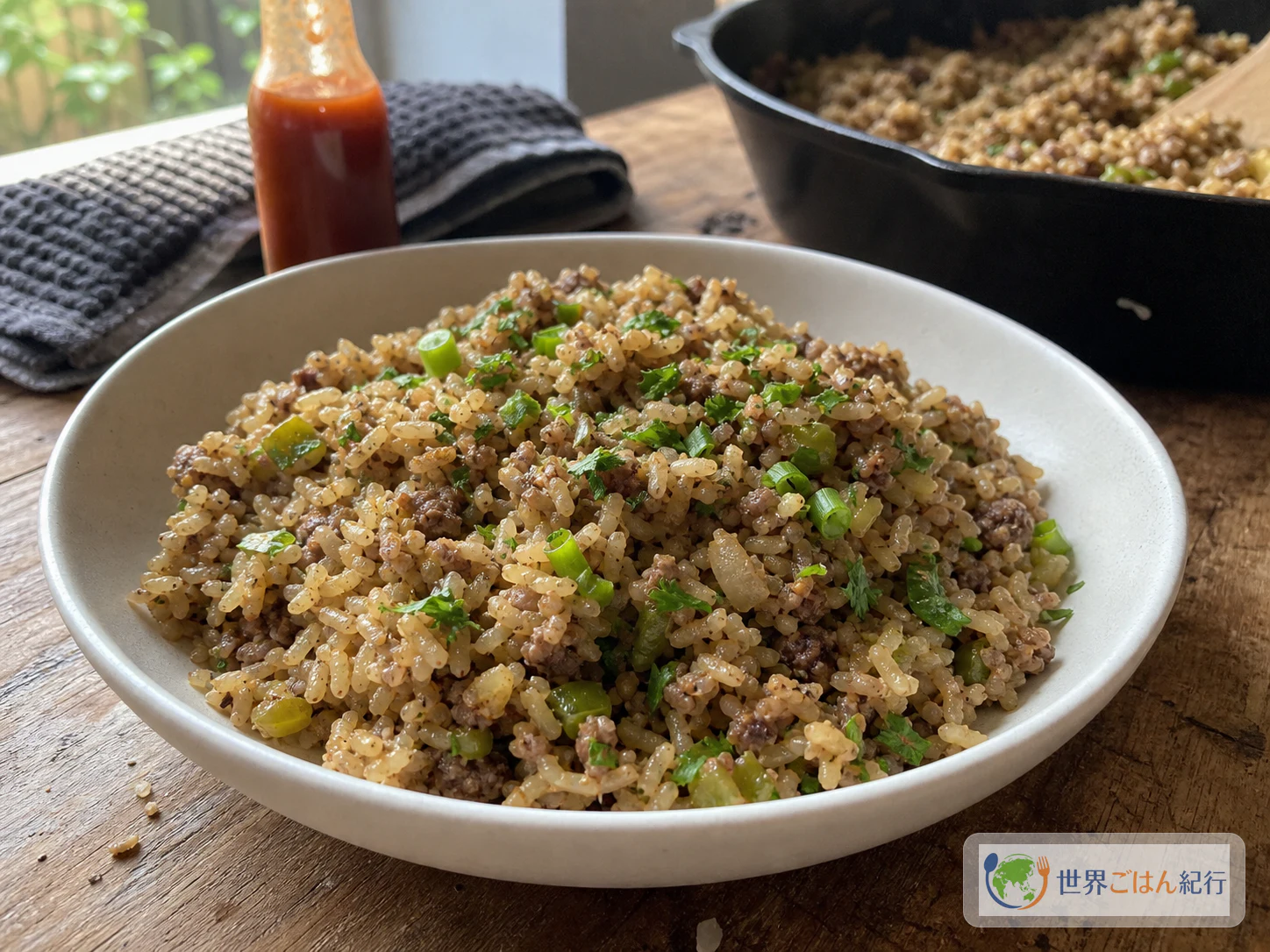
Dirty Rice: Louisiana Rice with Chicken Livers, Ground Pork and the Holy Trinity
Ingredients
Rice and meat
| Ingredient | Amount | Buying notes & substitutes |
|---|---|---|
| Long-grain rice | 10.5 oz (300 g) | Jasmine, basmati or Calrose. For Japanese-style rice, cook it a little firm |
| Water | 1¾ cups (420 ml) | Water for cooking the long-grain rice in a pot. In a rice cooker, a little firmer than usual |
| Ground pork | 9 oz (250 g) | Mixed ground meat also works. If it is fatty, reduce the oil |
| Chicken livers | 4 oz (120 g) | Remove blood clots and white sinew, and chop finely. If you dislike it, reduce to 2.75 oz (80 g) |
| Vegetable oil | 1 tbsp | If the ground meat is fatty, 2 tsp |
Aromatics
| Ingredient | Amount | Buying notes & substitutes |
|---|---|---|
| Onion | 1 (6.5 oz / 180 g) | Cut into 0.25 inch (7 mm) dice |
| Celery | 1 stalk (3.5 oz / 100 g) | Chopping in a few leaves too brings out aroma |
| Green bell pepper | 3 (4 oz / 120 g) | Remove seeds and pith |
| Garlic | 3 cloves (15 g) | Minced |
| Scallions | 2 | Thinly sliced. For finishing |
| Parsley | 10 g | Coarsely chopped. If none, add a little celery leaf |
Seasonings
| Ingredient | Amount | Role |
|---|---|---|
| Unsalted chicken stock | 1 cup (220 ml) | Granulated chicken broth dissolved weakly also works |
| Worcestershire sauce | 2 tsp | Ties together the aroma of the meat and liver |
| Dried thyme | 1 tsp | The herbal aroma of Louisiana cooking |
| Dried oregano | 1/2 tsp | Cuts the heaviness of the meat |
| Smoked paprika | 1 tsp | Adds smokiness and a brown aroma |
| Cayenne pepper | 1/4 tsp | Start modestly with the heat |
| Black pepper | 1/2 tsp | Coarsely ground |
| Bay leaf | 1 | For aroma while the stock reduces |
| Salt | 1 1/4 tsp | Divided between the meat, rice and finishing |
| Hot sauce | 2 tsp | Add at the table. Don't put too much in the pot |
Steps
1Cook the rice firm
25 min
Rinse 10.5 oz (300 g) long-grain rice twice, until the water is only slightly cloudy white, and drain in a sieve for 5 minutes. Put the rice, 1¾ cups (420 ml) water and 1/4 tsp salt in a small pot and bring to a boil over medium-high heat. When it is bubbling all over, lower to low heat, cover and cook for 12 minutes. Turn off the heat, let it steam for 10 minutes, then loosen lightly with a fork. Look for grains that are a little firm and a surface with no water left. If using Japanese-style rice, spread it on a plate after cooking and let the steam out for about 5 minutes.
2Prepare the liver and aromatics
12 min
No heat is used. Remove the blood clots and white sinew from 4 oz (120 g) chicken livers, soak in cold water for 10 minutes, and wipe the water off well. Chop about 0.25 inch (5 mm) and lightly pound with the knife so it blends easily with the ground meat. Cut 6.5 oz (180 g) onion, 3.5 oz (100 g) celery and 4 oz (120 g) bell pepper into 0.25 inch (7 mm) dice and mince 15 g garlic. Leftover moisture on the liver spatters in the pan and brings out gaminess, so press it with paper towels to dry the surface before moving on.
3Sear the ground meat and liver
8 min
Put 1 tbsp vegetable oil in a frying pan and warm it over medium-high heat for 1 minute. Spread 9 oz (250 g) ground pork, cook it undisturbed for 2 minutes, then break it up with a wooden spoon. Add the chicken liver, sprinkle with 1/2 tsp salt and 1/2 tsp black pepper, and cook 4 more minutes. Cook until the red of the meat is gone, the surface of the liver is gray-brown, and a thin layer of brown savoriness remains on the bottom of the pan. Cook any large pieces of liver through to the center. With a thermometer, check for 165°F (74°C). If 2 tbsp or more of fat collects, blot a little with paper towels.
4Cook the holy trinity
8 min
Lower the heat to medium and add the onion, celery and bell pepper. Cook for 5 minutes, scraping the bottom of the pan with a wooden spoon, so the moisture of the vegetables loosens the brown savoriness. When the corners of the onion are translucent, the green smell of the bell pepper has softened and everything is moist, add the garlic and cook 1 more minute. If it starts to scorch, add 1 tbsp chicken stock and scrape the bottom. Keep the heat at medium so the vegetables sizzle.
5Reduce the stock and spices
9 min
Lower to medium-low heat, add 1 tsp dried thyme, 1/2 tsp dried oregano, 1 tsp smoked paprika, 1/4 tsp cayenne and 1 bay leaf, and stir for 30 seconds. When the aroma of the spices rises, pour in 1 cup (220 ml) chicken stock and 2 tsp Worcestershire sauce. Return to medium heat and reduce for 6 minutes at a heat that keeps small bubbles coming from the surface. Keep reducing until a line drawn with the wooden spoon stays for about 1 second and not too much liquid collects at the bottom. Add 1/4 tsp salt here, and taste only the sauce, aiming for it to taste a little strong.
6Combine with the rice and stain it brown
5 min
Remove the bay leaf and add the cooked rice. The heat is low. With a wooden spoon or large spoon, turn broadly from the bottom of the pan, mixing for 3 minutes without crushing the grains. When the rice has absorbed the meat base and turned a light brown with less white left, turn off the heat. The rice is ready when the grains shine moist on the surface, don't clump into balls when the spoon goes through, and leave thin bits of meat at the bottom. If there's too much liquid, cook uncovered over low heat for 2 more minutes. If the rice is too dry, add 1 tbsp chicken stock. Taste, then decide on the final 1/4 tsp salt after the sauce and rice are combined.
7Rest and finish
5 min
Turn off the heat, cover, and rest for 3 minutes. The residual heat lets the aroma of the meat reach the center of the rice, and the moisture at the bottom settles. Remove the lid, add the scallions, parsley and 2 tsp hot sauce, and turn broadly just twice. Plate it when the grains are loosened, the brown savoriness from the bottom is mixed in here and there, and it is not pressed down into mush. Rather than settling the heat completely in the pot, adding hot sauce at the table makes it easier for a family to eat.