Ingredients and steps on one page. Print it, or choose “Save as PDF” in the print dialog.
Sekai Gohan
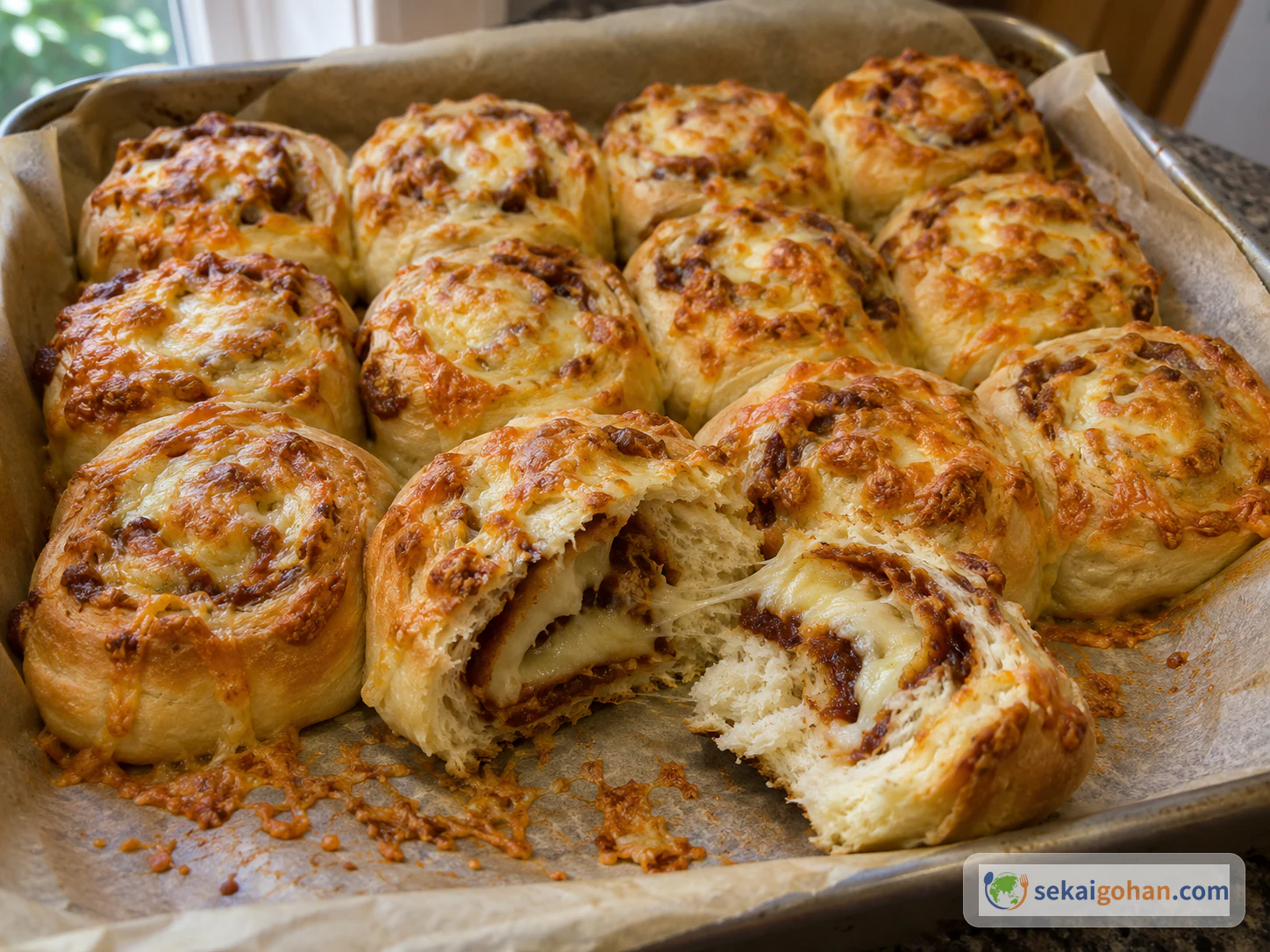
Cheesymite Scroll: Australian Bakery Vegemite and Cheese Swirl Bread
Ingredients
| Ingredient | Amount | Role |
|---|---|---|
| Bread flour | 4¼ cups (1 L), levelled | The structure of the soft, pull-apart crumb |
| Instant yeast (rapid-rise) | 3 tsp | Rise and the bready aroma |
| White sugar | 2 tsp | Early food for the yeast |
| Coarse cooking salt | 1¼ tsp (half that if using fine table salt) | Seasoning and a firmer dough |
| Milk, warmed | 1½ cups plus 2 tbsp (375 ml + 40 ml) | Moisture, softness and dairy richness |
| Salted butter, softened | 1¾ oz (50 g) | Spread under the Vegemite for flavour and layers |
| Vegemite | 4 tbsp (60 ml) | The salty, savoury, slightly bitter heart of the scroll |
| Colby cheese, grated | 1 lb 2 oz (500 g): 10½ oz (300 g) inside, 7 oz (200 g) on top | The filling and the browned crust |
Steps
1Mix the dry ingredients
Put the flour, yeast, sugar and salt in a large bowl, or in the bowl of a stand mixer or food processor. Stir them briefly with a wooden spoon or a few pulses. This spreads the yeast and salt through the flour so they do not sit together in one spot, where the salt would slow the yeast. The mix is ready when it looks evenly flecked, with no clumps of salt or yeast.
2Add the warm milk
Warm the milk to 95–105°F (35–40°C); on high in the microwave this takes about 1 minute. Without a thermometer, aim for bathwater you could happily lie in for a long time. At 130–140°F (55–60°C) the yeast dies. Pour the milk into the centre of the flour and mix on low speed until no dry flour remains, which leaves a rough, shaggy dough.
3Knead until the dough stretches thin
Switch to medium speed and knead for 5 minutes. Pinch off a small piece and stretch it between your fingers: well-kneaded dough pulls into a thin, see-through film without tearing, while under-kneaded dough splits at once. If the dough feels dry, add warm milk a spoonful at a time; if it is sticky, add flour a little at a time. Knead and wait a few minutes before you judge, because the dough keeps absorbing liquid. It is done when the surface is smooth and glossy and the film holds.
4Let the dough double
Shape the dough into a ball, return it to the bowl and cover with plastic wrap. Leave it somewhere warm, at least 77°F (25°C), for 1½ hours, until doubled in size. Dip a finger in flour and press it into the dough: when the hole stays put, the rise is done. Stop at double; dough left to triple uses up its yeast and will barely rise in the oven.
5Roll out the rectangle
Press the dough gently to knock out the gas and turn it onto a floured bench. Shape it into a rough rectangle with your hands, then roll it to 19 × 11 inches (48 × 28 cm). Work the rolling pin evenly from the centre outward, since an even sheet gives even layers and twelve scrolls of the same size. The sheet is ready when it is the same thickness from corner to corner.
6Spread the butter and Vegemite
Spread the softened butter over the whole sheet. Spread the Vegemite on top of the butter; the butter lets it glide thin and even instead of dragging the dough. Leave a narrow bare border, about ⅜ inch (1 cm), because filling right to the edge squeezes out when you roll. You want a thin, near-black layer with the dough showing faintly through it in places.
7Scatter the cheese
Take the 10½ oz (300 g) of grated cheese for the filling. Scatter it evenly over the Vegemite, reaching into the corners so every scroll gets the same amount. Keep the bare border clear so the log seals. The sheet is ready when the dark layer is hidden under an even blanket of cheese.
8Roll, cut and pan
Lift the long edge nearest you and roll the sheet into a long log, firmly but without pressing hard enough to leave finger marks. Rest it seam side down. Cut it into 12 even pieces with a sharp knife or bench scraper. Set them cut side up in the lined pan with small gaps between them, so the spiral faces the oven. Each piece should show a clear spiral of dark spread and cheese.
9Second rise
Cover the pan with plastic wrap brushed with oil and leave it somewhere warm for 30 minutes. The scrolls should grow by 30–50% and just begin to touch each other. Heat the oven to 355°F (180°C), or 320°F (160°C) for a fan-forced oven, while they rise. In a cold kitchen this rise takes longer, so judge by size rather than by the clock.
10Top and bake in two stages
Scatter the remaining 7 oz (200 g) of cheese over the scrolls. Bake for 25 minutes at 355°F (180°C). Turn the pan front to back, raise the oven to 390°F (200°C), or 355°F (180°C) for fan-forced, and bake 10 minutes more. Check the oven during those 10 minutes, since different cheeses brown at very different speeds and burnt cheese turns bitter. The bake is done when the top cheese is light golden and crisp, darker around the edges of the pan.
11Rest and lift out
Leave the scrolls in the pan for 5 minutes. Lift the whole slab out by the paper overhang onto a wire rack and let it rest 5 minutes more. Cutting straight away tears the cheese and dough apart, while a short rest lets the cheese settle. Tear the scrolls apart by hand while they are still warm. They are ready when each one pulls away cleanly with strings of cheese and keeps its shape.