Ingredients and steps on one page. Print it, or choose “Save as PDF” in the print dialog.
Sekai Gohan
Lamingtons: Australian Sponge Squares in Chocolate and Coconut
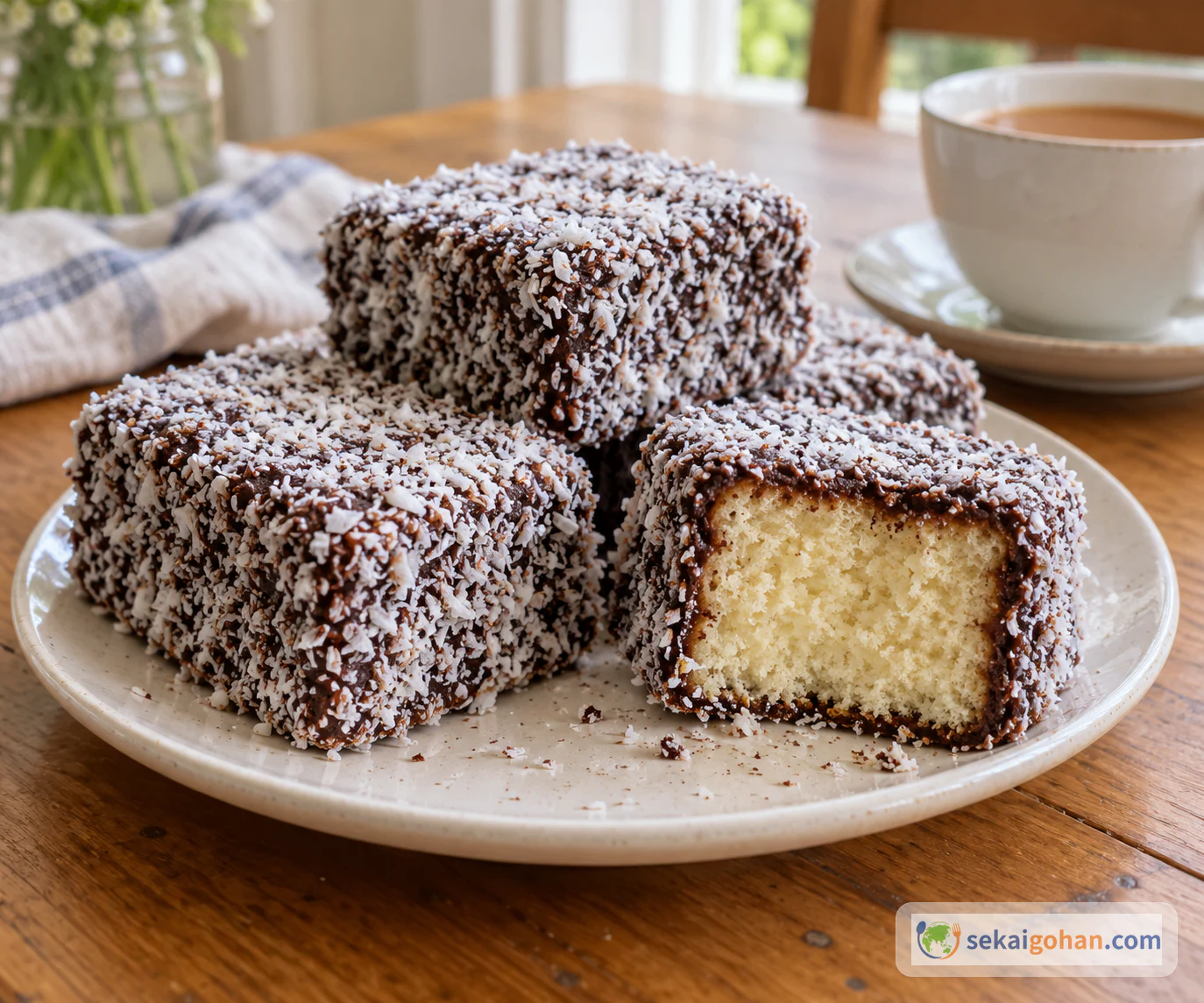
Ingredients
Sponge
| Ingredient | Amount | Role and how to choose |
|---|---|---|
| Eggs | 4 (about 55–60 g each) | Bring to room temperature so they whip to a stable foam |
| Caster sugar (superfine sugar) | 5.5 oz (150 g) | Whipped with the eggs; gives sweetness and helps the foam hold its shape |
| Self-raising flour | 5.5 oz (150 g) | Australian flour with raising agent already added. Do not add extra baking powder on top |
| Cornflour (cornstarch) | 1.25 oz (35 g) | Australian "cornflour" is cornstarch. Use cornstarch; do not swap in potato starch |
| Chilled butter | 25 g | Chopped, then melted in the boiling water below |
| Boiling water | ¼ cup (80 ml) | Melts the butter so it can be folded evenly into the batter |
Chocolate icing
| Ingredient | Amount | Role and how to choose |
|---|---|---|
| Boiling water | ¾ cup (200 ml) | Loosens the icing so it coats smoothly. Handle with care |
| Cocoa powder | 20 g | Unsweetened cocoa, for colour and bitterness |
| Caster sugar | 5.5 oz (150 g) | Sweetness and body for the icing |
| Dark chocolate (about 70%) | 9 oz (260 g) | Chopped. Bitterness and how firmly the coating sets |
To finish
| Ingredient | Amount | Role and how to choose |
|---|---|---|
| Desiccated or shredded coconut | 7.5 oz (216 g) | Unsweetened dried coconut, for aroma and texture on the outside |
Steps
1Prepare the pan and the oven
Grease the 20 × 30 cm pan lightly and line the base with baking paper, pressing it into the corners so the sponge is easy to lift out later. Preheat the oven to 180°C (350°F) conventional, or 160°C (320°F) fan-forced.
2Whisk the eggs and sugar to a thick ribbon
Put the room-temperature eggs and 5.5 oz (150 g) caster sugar into a deep bowl and beat until the mixture turns pale and thick, about 5–8 minutes. You do not need a thermometer. Lift the beaters: the mixture should fall back onto the surface in a thick ribbon that sits there for a moment before sinking in. This foam gives the sponge its light texture, so don't cut it short.
3Sift the dry ingredients three times
Combine 5.5 oz (150 g) self-raising flour and 1.25 oz (35 g) cornflour and sift them together three times. This breaks up lumps and adds air, which makes the next step gentler.
4Fold in the flour, then the butter liquid
Sift the flour mixture over the egg foam in several additions, folding each in with a large metal spoon or a whisk, lifting from the bottom of the bowl and turning it over. Combine the ¼ cup (80 ml) boiling water with the 25 g chopped chilled butter, and when the butter has melted, fold this liquid in last. Stop as soon as no dry flour is visible. Over-mixing breaks the bubbles and gives a heavy, dense sponge.
5Pour into the pan
Pour the batter into the lined pan and level the surface gently. Get it into the oven without delay so the foam doesn't settle.
6Bake for about 25 minutes and check by touch
Bake for about 25 minutes, avoiding opening the door often. Ovens vary, so judge by the cake rather than the timer alone: the sponge is done when the centre springs back when pressed lightly and the edges are starting to come away from the sides of the pan.
7Cool completely
Turn the sponge out onto a wire rack and let it cool completely. A warm sponge crumbles when cut and falls apart in the icing. Chill it for a few hours or bake it the day before: a firmer sponge is easier to coat. If you're short on time, about 20 minutes in the freezer also firms it up; this step is optional.
8Cut into 20 pieces
Trim any dry edges. Then cut the sponge into 20 pieces of roughly 2 inches (5 cm). A 20 × 30 cm slab would divide into 24 exact 2-inch (5 cm) squares, so aim for 20 pieces of similar size rather than exact measurements. A ruler keeps the pieces even, which keeps the amount of icing and the finished look consistent. Brush off any large crumbs.
9Make the chocolate icing over a water bath
In a heatproof bowl set over a saucepan of simmering water, combine the ¾ cup (200 ml) boiling water, 20 g cocoa and 5.5 oz (150 g) caster sugar, then add the chopped dark chocolate and stir until melted. The icing is ready when it is smooth and fluid enough to coat a piece of cake. Take care with steam and boiling water, and keep the bowl stable on the pan.
10Dip briefly and let the excess drip off
Using two forks, dip one piece of sponge briefly into the icing, then lift it and let the excess drip back into the bowl. Keep the dip short: a long soak lets the sponge absorb too much icing, so it loses its shape and sheds crumbs into the bowl. Support the piece from underneath with the forks. When the icing cools and thickens, return the bowl to the water bath to loosen it.
11Roll in coconut with a second pair of forks
Transfer the iced piece to a shallow tray of desiccated coconut and, using a separate, clean pair of forks, roll it until every side is covered. Keeping the coconut forks out of the icing stops the coconut from clumping. Roll rather than pressing hard, and do it before the icing dries.
12Leave to set
Place the finished lamingtons on baking paper or a wire rack and leave them until the coating has settled. Then they're ready to serve, ideally with tea.