Ingredients and steps on one page. Print it, or choose “Save as PDF” in the print dialog.
Sekai Gohan
Kokoda: Fijian Coconut and Lime Fish Salad
Ingredients
Fish and miti
| Ingredient | Amount | Substitutes & notes |
|---|---|---|
| White fish for raw consumption (loin) | 1 lb (500 g) | Sea bream, flounder, sea bass, etc. For fish with no label, make the cooked version |
| Lime juice | 1 cup (240 ml) | Lemon juice also works, but the aroma is sharper |
| Unsweetened coconut milk (thick type) | ¾ cup (200 ml) | If using coconut cream, start by adding ½ cup (150 ml) |
| Salt | 5 g | 3 g for the fish, 2 g for the miti. Adjust by the salt stated on the product |
| Black pepper | 1 g | Coarsely ground. White pepper is fine |
| Ginger | 10 g | Grated. If you dislike it, reduce to 5 g |
| Red chili | 1 (about 5 g) | 1 green chili, or 1/2 to hold back the heat |
Vegetables and plating
| Ingredient | Amount | Substitutes & notes |
|---|---|---|
| Red onion | 2.75 oz (80 g) | White onion also works. Cut into 0.125-inch (2 mm) dice |
| Tomato | 6.5 oz (180 g) | Remove the seeds and excess moisture and cut into 0.5-inch (1 cm) dice |
| Cucumber | 4 oz (120 g) | Peel in stripes and cut into 0.5-inch (1 cm) dice |
| Red or green bell pepper | 2.75 oz (80 g) | 2 small green peppers also work. Cut into 0.25-inch (5 mm) dice |
| Cilantro | 10 g | Substitute 10 g green onion or 5 g dill |
| Lime wedges | 4 | Add just before eating |
| Lettuce | 4 leaves | Laid on the plate. Optional |
| Cassava or taro | 10.5 oz (300 g) | Cook and serve alongside. Don't handle raw |
Steps
1Remove the skin and bones and even out the corners
10 min
Remove the skin and blood line from the white fish loin, and feel for pin bones with your fingers. Pull out the bones, then cut the fish into cubes about 0.5 inches (1.5 cm) on each side. If sizes are uneven, the thin pieces turn white while the thick ones stay translucent. Move the cut fish into a glass bowl right away and refrigerate it.
2Soak in lime juice and chill
1–2 hours
Sprinkle 3 g salt over the fish and pour in 1 cup (240 ml) lime juice. If the fish rises above the liquid, use a smaller bowl or add juice 1.5 tbsp (20 ml) at a time, so the cubes stay submerged. Cover and refrigerate, turning the fish over once at the 1-hour mark. It is ready when the center, not just the surface, has turned white and pressing with a finger still leaves a little raw softness.
Turning white means the protein has changed in the acid. It is not a safety step like heating or freezing. If you are not sure the fish is fit for raw eating, skip this step and make the cooked version below.
3Make the aroma of the miti
10 min
Finely chop 10 g ginger and the seeded chili, and mix with ¾ cup (200 ml) unsweetened coconut milk, 2 g salt, and 1 g black pepper. If you want a stronger aroma, lightly crush the chopped ginger and chili in a mortar before adding. Stop before it becomes a full paste. Leave red flecks and ginger fibers visible, so the miti doesn't cover the sweetness of the fish.
4Drain the fish
5 min
Move the fish to a fine sieve and drain the juice thoroughly without breaking the 0.5-inch (1.5 cm) cubes. Drain until the whiteness reaches the center, the surface no longer looks wet, and the corners stay intact. If too much juice remains, the sourness turns sharp when the miti goes in, and water from the vegetables piles on. Don't rinse the fish with water.
5Combine the vegetables and miti
10 min
Cut the red onion, tomato, cucumber, and bell pepper and add them to the fish first. Pour in half the miti and turn it over in big sweeps, and if the corners of the fish hold, add the rest. It is done when the coconut milk coats the fish and vegetables in a thin layer and no clear water collects in the bottom of the bowl. Taste, and add salt 1 g at a time.
6Serve right away, without over-chilling
5 min
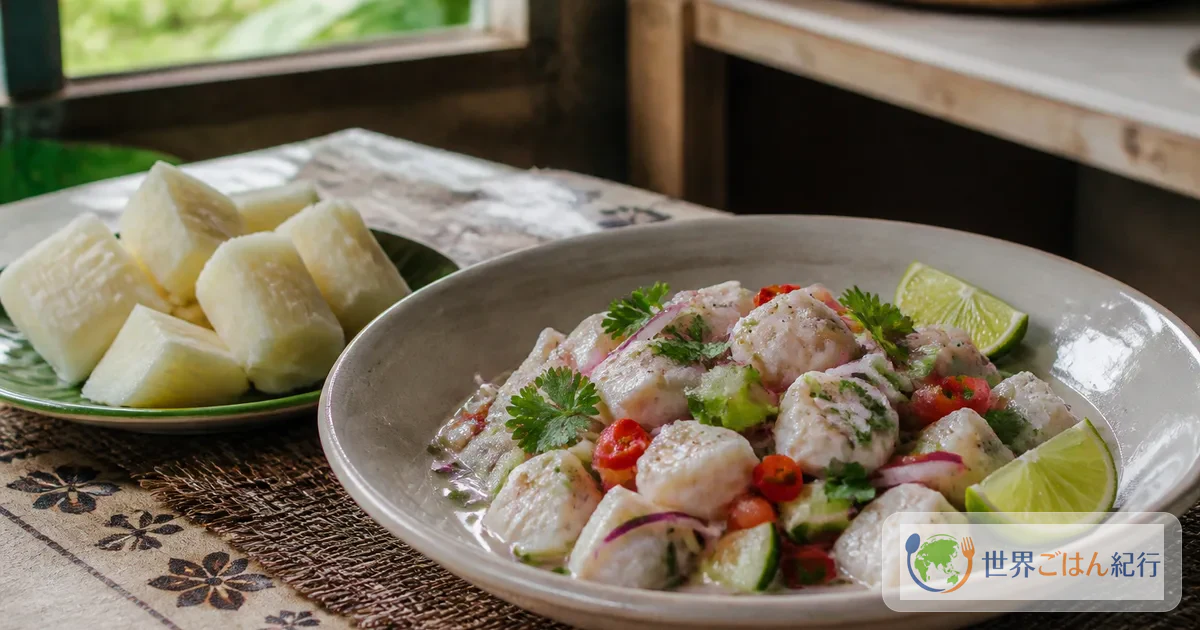
Spoon the kokoda onto a plate lined with lettuce, and add cilantro and lime wedges. Rest it 10 minutes in the refrigerator to round out the sharpness of the onion slightly. Over-chilling tends to make the coconut's fat clump into grains, so don't return it to the refrigerator until just before eating. If you serve cassava or taro, put it on a separate plate.