Ingredients and steps on one page. Print it, or choose “Save as PDF” in the print dialog.
Sekai Gohan
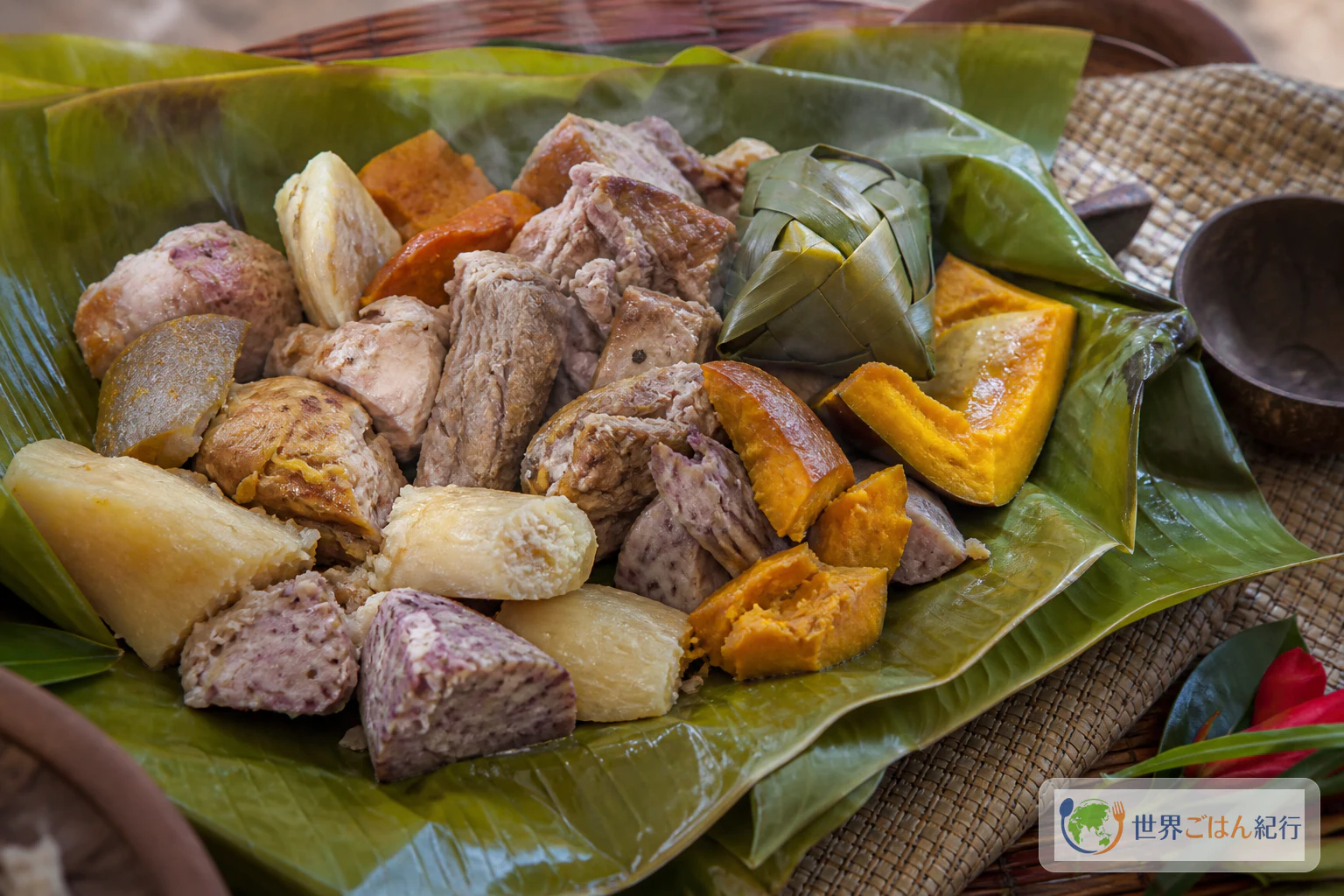
Lovo: Fijian Earth-Oven Feast, Made in a Home Oven
Ingredients
| Ingredient | Amount | Substitutes & notes |
|---|---|---|
| Boneless chicken thighs | 1 lb (500 g) | Cut one thigh into 2 inches (5 cm) cubes. Skin-on gives off more fat |
| Pork shoulder, in a block | 1 lb (500 g) | Cut into 2 inches (5 cm) cubes. Pork belly is fattier, so reduce it to 1 lb (450 g) |
| Taro | 10.5 oz (300 g) | Peel thickly and cut into 1.5 inches (4 cm) cubes |
| Cassava | 10.5 oz (300 g) | Remove skin and core; cut into 1.5 inches (4 cm) cubes |
| Sweet potato | 10.5 oz (300 g) | Leave the skin on; cut into 1.5 inches (4 cm) cubes |
| Pumpkin or kabocha | 9 oz (250 g) | Remove seeds and pulp; cut into 1.5 inches (4 cm) cubes |
| Cooking banana leaves | 4–6 leaves | Thaw frozen leaves before use. Without them, use parchment and aluminum foil |
| Edible taro leaves | 8 leaves | For the palusami-style bundles. Without them, use 7 oz (200 g) Swiss chard or spinach |
| Coconut milk (unsweetened, regular) | ¾ cup (200 ml) | The same amount of coconut cream also works |
| Onion | 3.5 oz (100 g) | Finely diced, 0.25 inch (5 mm) |
| Soy sauce | 3 tbsp (45 ml) | Sweet soy-style flavor, as used in Fiji |
| Light brown sugar | 12 g | White sugar is fine too |
| Ginger | 15 g | Grated |
| Garlic | 10 g | Grated |
| Lemon or lime juice | 3 tbsp (45 ml) | 2 tbsp (30 ml) for the meat, 1 tbsp (15 ml) for the coconut bundles |
| Salt | 7 g | 4 g for the meat, 3 g for the coconut bundles |
| Black pepper | 1 g | For seasoning the meat |
| Water | ½ cup (100 ml) | Goes in the bottom of the pot |
Steps
1Marinate the meat
10 min
Marinate in the refrigerator for 4 hours to overnight.
In a bowl, mix 3 tbsp (45 ml) soy sauce, 12 g sugar, 15 g ginger, 10 g garlic, 2 tbsp (30 ml) lemon or lime juice, 4 g salt and 1 g black pepper.
Cut the chicken thighs and pork shoulder into 2 inches (5 cm) cubes, coat them all over with the marinade, and put them in a storage bag.
It is ready when the surface of the meat is evenly wet, a little liquid pools at the bottom of the bag, and the ginger aroma is strong.
Refrigerate for at least 4 hours. Don't leave it at room temperature for long; take it out 30 minutes before cooking so it is easy to place in the pot.
2Prepare the roots and leaves
20 min
Peel the taro thickly. Remove the skin and the hard central core from the cassava.
Cut the taro, cassava, sweet potato and pumpkin into 1.5 inches (4 cm) cubes, and soak only the taro and cassava in water for 5 minutes after cutting to rinse off surface starch.
Rinse the banana leaves under running water and warm one side at a time for a few seconds over a low flame or above boiling water.
They are ready to wrap when they turn from dark green to a slightly glossy color, the white veins don't crack when folded, and they feel soft and pliable.
Pat frozen leaves dry after thawing, and double up the leaves wherever they are torn.
3Make the coconut leaf bundles
15 min
Wash the edible taro leaves. If there is a hard stem, cut off 1 inch (2 cm) from the base.
Mix ¾ cup (200 ml) coconut milk, 3.5 oz (100 g) onion, 1 tbsp (15 ml) lemon or lime juice and 3 g salt. Overlap 4 leaves slightly in the center.
Stir the mixture until white and even. Spoon about 3.5 tbsp (50 ml) onto each bundle, then fold the leaf edges inward and wrap in aluminum foil.
If using Swiss chard or spinach, overlap the leaves one at a time to a thickness that won't leak.
Lift a bundle to check: if no liquid runs out and the leaf edges overlap, it won't fall apart in the pot.
4Layer the roots, meat and leaf bundles in the pot
10 min
Preheat the oven to 350°F (170°C).
Lay 2 banana leaves in the bottom of a heavy lidded pot and spread out the 1.5 inches (4 cm) cubes of taro and cassava first.
On top, add the 1.5 inches (4 cm) cubes of sweet potato and pumpkin, then the 2 inches (5 cm) cubes of chicken and pork, lightly drained of marinade.
Don't clump the meat in one spot; spread it from the center to the edges so steam can circulate between the roots.
Finally, set the coconut leaf bundles on top and pour ½ cup (100 ml) of water in along the edge of the pot. Check that the root corners are intact and the leaves cover the bottom of the pot, so steam can circulate well.
5Seal the lid and bake
110–120 min
Cover the mouth of the pot with a double layer of aluminum foil, put on the lid, and place it in the 350°F (170°C) oven.
Do not open the lid for the first 90 minutes.
After 90 minutes, insert a skewer into the center of a thick piece of pork and check that the juices run clear, not red, and that the skewer goes through the roots.
Cook chicken until the center reaches 167°F (75°C) or higher for at least 1 minute.
If the skewer still meets resistance or the center of the meat isn't hot enough, close the foil again and add 15 minutes at a time.
When the corners of the roots have softened, the leaves are a dark olive color, and the smell of coconut and ginger rises from the gap around the lid, steam has reached the whole pot.
6Rest and serve on the leaves
10 min
Take the pot from the oven and rest it for 10 minutes with the lid on.
Hot steam will rise, so keep your face away and open the foil by folding it back from the near side to the far side.
Take out one 2 inches (5 cm) piece of meat and cut it open: the center should be cooked through and white, and the roots should split with chopsticks or a fork.
Spread the roots on a large banana leaf or platter and add the meat and coconut bundles.
This is not the scale of a full village lovo. Still, serving from the center of the pot, rather than plating individually from the start, brings you closer to the feel of the table.