Ingredients and steps on one page. Print it, or choose “Save as PDF” in the print dialog.
Sekai Gohan
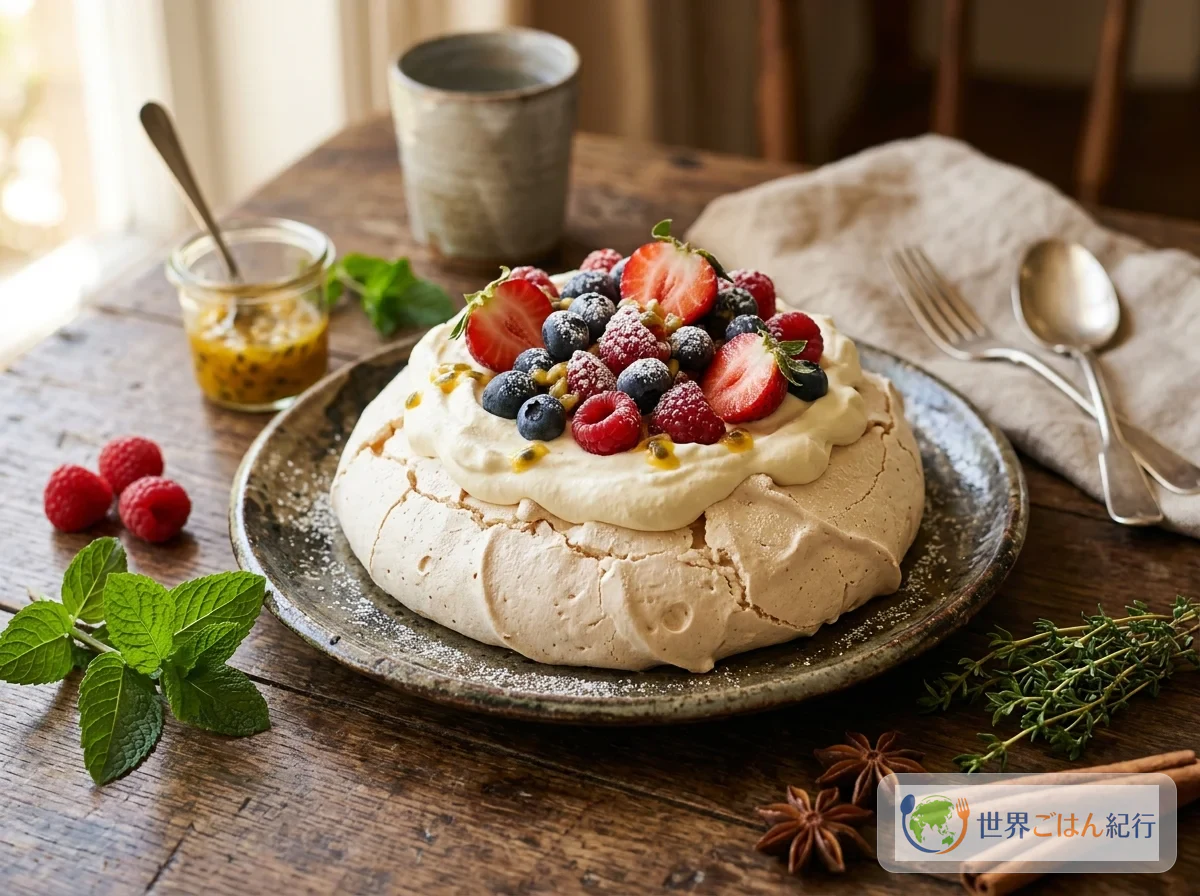
Pavlova: New Zealand's Meringue Dessert with Cream and Fruit
Ingredients
Ingredients
| Ingredient | Amount | Substitutes & notes |
|---|---|---|
| Egg whites | 6 | Bring to room temperature. Take them out of the refrigerator at least 30 minutes ahead |
| Granulated sugar | 10.5 oz (300 g) | Fine white sugar has more moisture, so granulated is easier to handle the first time |
| Cornstarch | 1 tbsp | The key to the soft interior |
| White wine vinegar | 1 tsp | Lemon juice also works. Stabilizes the meringue |
| Vanilla extract | 1 tsp | - |
| Salt | A pinch | Helps the egg whites whip |
Ingredients
| Ingredient | Amount | Substitutes & notes |
|---|---|---|
| Heavy cream | 1¾ cups (400 ml) | 35% butterfat or higher. Whip to soft-medium peaks |
| Kiwifruit | 3 | Sliced. New Zealand kiwifruit match well in aroma if you can get them |
| Strawberries | 7 oz (200 g) | Halved |
| Passion fruit | 3 | Halved, with the pulp and juice |
| Blueberries | 3.5 oz (100 g) | Whole |
| Mint leaves | A few | For garnish |
Steps
1Prepare the baking sheet and temperature
5 min
Preheat the oven to 150°C (300°F). Wait at least 10 minutes for the oven temperature to stabilize, and if you use a thermometer, line the baking sheet with parchment once it reaches 145–150°C. Draw a 25 cm circle in pencil, then flip the paper over so only the drawn line shows faintly through. If pencil lines remain on the top side of the paper they will touch the meringue, so be sure to flip it.
Too hot is the enemyPavlova is baked slowly at a low temperature. Baked at 180°C (350°F) or above, the outside colors first and the inside tends to hollow out. A two-stage bake, starting at 150°C and drying at 120°C (250°F), makes only the surface a thin shell and tends to leave the center moist.
2Whip the meringue
12 min
Put 6 egg whites and a pinch of salt in a clean bowl and whip on low speed with a hand mixer for 1 minute. When the foam turns fine, whip on medium for 2 minutes, and when soft peaks form, switch to high and add the granulated sugar 1 tablespoon at a time. Add sugar at a pace of about 2 tablespoons per minute, and lightly scrape down the sides with a spatula along the way so no gritty sugar remains at the bottom of the bowl.
Once all the sugar is in, whip on high for 3 more minutes. Stop when the meringue doesn't fall even with the bowl turned upside down, the tips of the peaks curve just slightly and the surface is glossy. Rub a little between your fingertips, and if you can barely feel any sugar grains, move on. If you slice the kiwifruit 0.25 inch (5 mm) thick and cut the strawberries in half lengthwise ahead of time, you can place them at the end without crushing the meringue.
Fat is the enemyIf even a trace of fat clings to the bowl or whisk, the egg whites won't whip. Wipe the bowl with lemon juice or wash it with hot water before using. Don't force egg whites that have yolk in them; use them in another dish. Cracking each egg into a small dish first and checking that no yolk got in before moving it to the large bowl reduces failures.
3Fold in the stabilizers
2 min
Sprinkle 1 tbsp cornstarch, 1 tsp white wine vinegar and 1 tsp vanilla extract over the meringue. No heat is used. Slide a spatula in from the bottom of the bowl and repeat a scoop-and-turn motion only 6 to 8 times. It is enough once the white streaks of powder are gone and everything is uniform with the gloss still there. Stop before overmixing dulls the shine on the surface.
4Shape the meringue base
5 min
Spread the meringue with a spatula along the circle guide on the baking sheet. No heat is used. Keep it within the 10 inches (25 cm) circle, build the outer edge up to about 2 inches (5 cm) high, and make a slight hollow in the center. If the bottom is too thin it tends to crack after baking, so leave about 1 inches (2 cm) of thickness in the center as well.
Make rough streaks on the sides with the spatula. Rather than shaping a perfect circle, prioritize a slightly higher rim and a hollow in the middle to hold the cream. A mound shape with a large cavity inside tends to crack during baking.
5Bake in two stages and cool
1 hr 15 min, plus at least 2 hr cooling
Place the sheet on the middle rack and bake at 300°F (150°C) for 15 minutes. When the surface begins to turn a very pale cream, lower to 250°F (120°C) without opening the door and bake for another 60 minutes. It is done when the surface is dry, feels firm like a thin shell when lightly touched with a finger, and fine cracks have appeared on the sides. If it is still white and damp, add 10 minutes at 250°F (120°C).
When it finishes baking, turn off the heat and leave it cooling inside the oven with the door open about 1 inches (3 cm) for at least 2 hours. Taking it out suddenly causes large cracks from the temperature difference, and the center shrinks. Not touching it until it has fully cooled is the surest way to move it cleanly to a plate.
Don't worry about fine cracksFine cracks aren't a failure. They're the natural cracking that tends to happen when the inside stays moist and only the outside dries. What you want to avoid is a crack that splits all the way to the bottom and leaves a hollow. In that case, suspect undissolved sugar, too high a temperature at the start of baking, or cooling too fast.
6Finish with cream and fruit
10 min
Move the fully cooled base to a plate. Whip 1¾ cups (400 ml) heavy cream to soft-medium peaks. Stop when the peaks bend gently as you lift the whisk and the cream drips slowly when scooped. Over-whipped cream gets heavy and crushes the center of the meringue.
Put the cream in the center hollow and scatter the kiwifruit cut 0.25 inch (5 mm) thick, the strawberries halved lengthwise and the blueberries without overlapping. Finally, halve the passion fruit and spoon the juice and seeds directly over the top. You want to eat it before the water in the fruit runs down, so aim for no more than 30 minutes from assembly to the table.
When cutting, don't press the knife in; let it break through lightly from the top. If the outside crumbles crisply and the inside looks white and stretchy, it has the true pavlova finish.