Ingredients and steps on one page. Print it, or choose “Save as PDF” in the print dialog.
Sekai Gohan
Palusami: Samoan Taro Leaves and Coconut Cream, Baked in the Oven
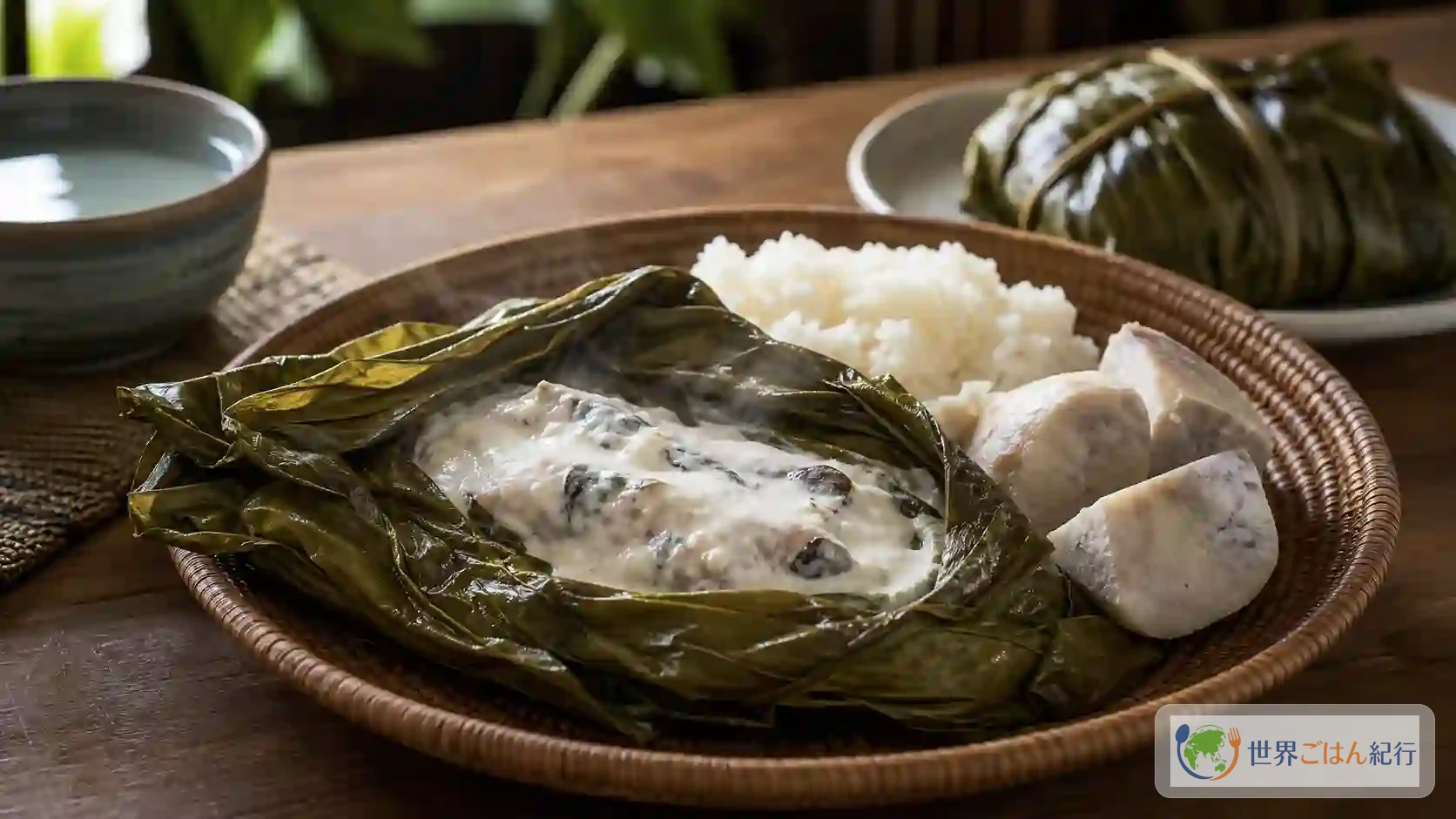
Ingredients
| Ingredient | Amount | Substitutes & notes |
|---|---|---|
| Edible taro leaves (young leaves) | 12 | 3 per parcel. If you cannot get them, substitute 14 oz (400 g) large spinach leaves |
| Coconut milk (unsweetened, full-fat) | 1¾ cups (400 ml) | The same amount of coconut cream if you have it. Avoid the light type |
| Onion | 1 (about 4 oz/120 g) | New onions are watery, so drain lightly after mincing |
| Lemon juice | 2 tbsp (30 ml) | Lime juice also works |
| Salt | 6 g | Adjust at the end, as coconut milk products differ |
Steps
1Wash the leaves and make them ready to eat
10 min
Wash the edible taro leaves one by one under running water, and check the thick central vein and the tough stem with your fingers.
With young leaves, cut off 1 inches (2–3 cm) of the tough base of the stem and wipe the leaves dry without tearing them.
If the leaves are large and tough, boil them in boiling water for 2 minutes, drain, let them cool slightly, and pat the surface dry.
Never taste the leaves raw.
2Make the coconut mixture
5 min
In a bowl, combine 1¾ cups (400 ml) coconut milk, 4 oz (120 g) onion minced into 0.25 inch (5 mm) pieces, 2 tbsp (30 ml) lemon juice, and 6 g salt.
If white solids float in the can when you open it, that is only separation from temperature differences, so use the entire contents.
If the liquid does not run off a lifted spoon in a stream but leaves a thin film, it is thick enough for wrapping.
3Stack the leaves to make a bowl
5 min
Stack the leaves three at a time, turning the tips in slightly different directions.
Make a hollow about 4 inches (10 cm) across in the center, and pour in about ½ cup (100 ml) of the coconut mixture per parcel.
Leave 1 inches (3 cm) clear at the edge of the leaves.
If you overfill, the leaves tear as you fold and the cream runs out.
4Close the parcels and bake
50–60 min
Preheat the oven to 350°F (180°C).
Fold the edges of the leaves toward the center so the four corners overlap and close, then wrap in aluminum foil without any gaps.
Set the parcels in a deep baking dish and bake at 350°F (180°C) for 50 minutes.
If the stems are thick, or if you substituted spinach, bake another 10 minutes.
Palusami is not a dish to brown on the surface.
Aim for leaves that have turned a dark olive green, a parcel that makes no sloshing sound when you press it, and a center that is hot all the way through.
5Rest, then open
5 min
Take the parcels out and rest them for 5 minutes with the foil still closed.
Hot steam is trapped inside, so keep your face back and open them by folding the foil from the near side to the far side.
It is done when the leaf yields with no resistance to a light press of chopsticks and the coconut flows slowly over the back of a spoon.
If the leaves are tough and do not look cooked through, do not eat them; close the parcels again and bake another 10 minutes at 350°F (180°C) at a time.