Ingredients and steps on one page. Print it, or choose “Save as PDF” in the print dialog.
Sekai Gohan
Salteñas: Bolivian Baked Empanadas Filled with Soup
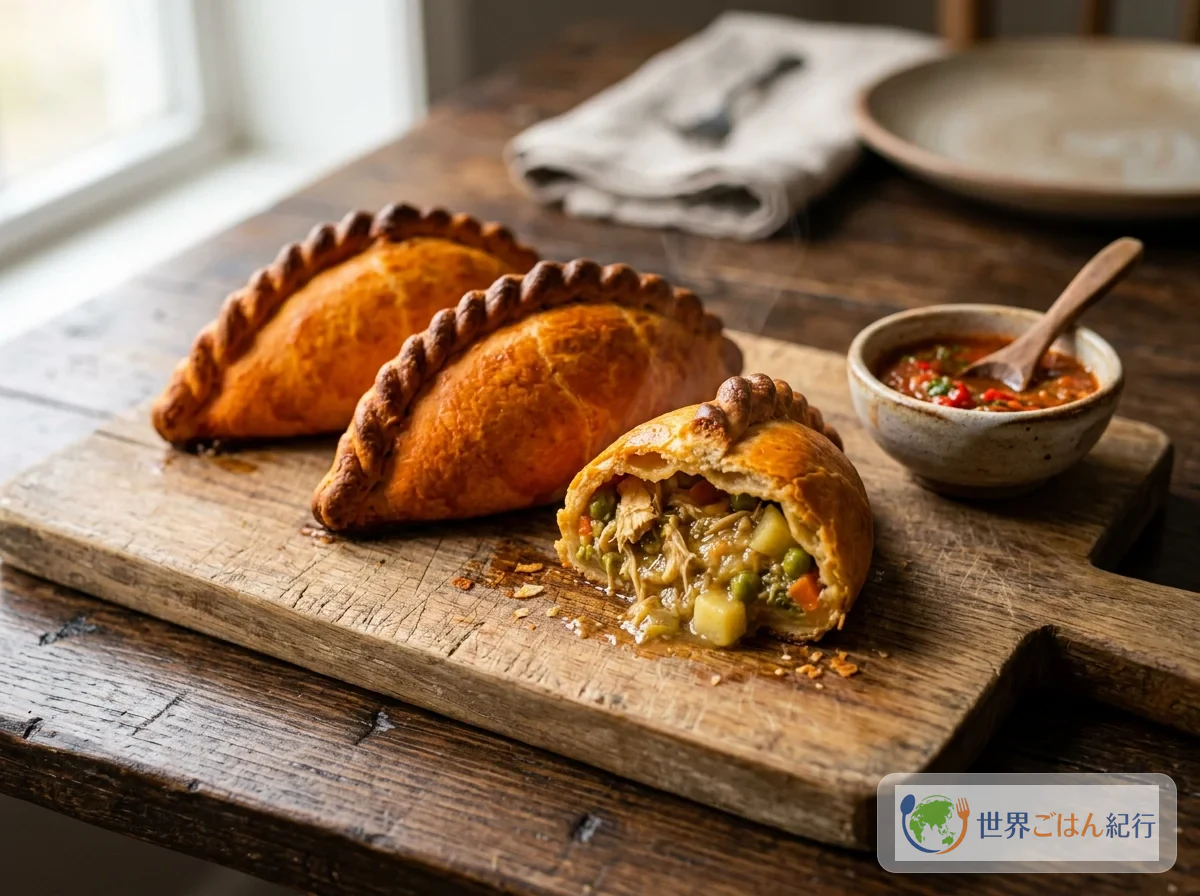
Ingredients
Dough (masa)
| Ingredient | Amount | Substitutes & notes |
|---|---|---|
| All-purpose flour | 500 g | Can be replaced with 250 g bread flour + 250 g cake flour |
| Unsalted butter | 80 g (chilled and cubed) | — |
| Lard | 30 g | Use butter if you don't have it |
| Sugar | 3 tbsp | Salteña dough is sweet |
| Salt | 1 tsp | — |
| Egg yolks | 2 | Add color and flavor to the dough |
| Water | 120 ml–150 ml | Adjust while checking the dough's firmness (about 1/2–2/3 cup) |
| Ground turmeric | 1/2 tsp | For orange color (in place of annatto) |
Filling (jigote)
| Ingredient | Amount | Substitutes & notes |
|---|---|---|
| Boneless chicken thighs | 400 g (cut into 1.5 cm cubes) | About 14 oz. For the beef version, use beef shank |
| Onion | 1 (finely chopped) | — |
| Potatoes | 2 (cut into 1 cm cubes and parboiled) | Waxy potatoes hold their shape best |
| Green peas | 100 g (frozen is fine) | — |
| Powdered gelatin | 15 g | The key to a soupy filling |
| Aji amarillo paste | 2 tbsp | If unavailable, use 1 tsp turmeric + 1/2 tsp cayenne pepper |
| Ground cumin | 1 tsp | — |
| Paprika | 1 tsp | — |
| Oregano | 1/2 tsp | — |
| Sugar | 1 tbsp | The filling gets a touch of sweetness too |
| Salt | 1 tsp | — |
| Vegetable oil | 2 tbsp | — |
| Chicken broth | 400 ml | The base of the filling's soup (about 1 2/3 cups) |
| Green olives | 12 (halved) | — |
| Hard-boiled eggs | 2 (cut into wedges) | For finishing (one wedge per salteña) |
Finishing
| Ingredient | Amount | Notes |
|---|---|---|
| Egg | 1 (beaten) | Brush on before baking (for shine) |
Steps
1Sauté the onion
5 min
Heat the oil in a pot over medium heat for about 30 seconds, then sauté the chopped onion. You're looking for onion that has turned translucent and smells sweet, with a little liquid on the bottom of the pot. Move on before it browns. If it burns here, the broth turns murky and bitterness comes forward over sweetness.
2Toast the spices
1 min
Add the aji amarillo, cumin, paprika and oregano and fry briefly, still over medium heat. It's ready when the paste has blended into the oil, the surface is bubbling and the raw, powdery smell is gone. If it looks like it might scorch, turn the heat down to medium-low so only the aroma moves into the oil.
3Brown the chicken
3–4 min
Add the chicken thighs and stir-fry over medium heat. It's enough for the surface to turn pale with light browning here and there. The chicken doesn't need to be cooked through yet; move on to the broth while it still holds some juices. If spices stick to the bottom of the pot, scrape them up with a wooden spatula as you stir.
4Simmer in broth
20 min
Add the 1¾ cups (400 ml) chicken broth and the sugar, bring to a gentle bubble over medium heat, then lower the heat and simmer for 15 minutes. Add the parboiled potatoes and peas and simmer 5 minutes more. The broth should just tremble, with the potato cubes still slightly rounded at the corners. A hard boil breaks up the filling, and the liquid tends to run out first when you wrap it.
5Set with gelatin
4 hr 10 min (including chilling time)
Turn off the heat, sprinkle the powdered gelatin over the whole surface and stir well until no granules are visible. Season with salt and spread it in a thin layer in a tray. Once it has cooled slightly, refrigerate for at least 4 hours, ideally overnight, until it sets into a wobbly jelly that breaks apart when scooped with a spoon. Never move on to wrapping while it's still warm.
6Mix the all-purpose flour, sugar, salt and turmeric in a bowl
5 min
No heat needed for this step. Add the cold butter and lard and rub them into the flour, pinching with your fingertips. Work quickly before the butter melts; once the whole mixture looks like yellow crumbs, it's ready for the liquid. On days when your hands are warm, put the whole bowl back in the fridge for 5 minutes before continuing.
7Add the egg yolks and water and knead until the dough comes together
3 min
No heat needed for this step. Add the egg yolks and ½ cup (120 ml) water and knead until it forms a single mass. If it's very sticky, add flour 1 tsp at a time; if it's stiff enough to crack, add water 1 tsp at a time, and stop once the surface is smooth. Over-kneading makes the edges tough, so there's no need to slam it on the counter.
8Rest the dough
30 min or more
No heat needed for this step. Wrap the dough tightly in plastic wrap and let it rest in the refrigerator. Chilling firms up the fat, and the dough becomes soft enough that a fingerprint springs back slowly, which makes it easier to roll into thin ovals. If you make it the day before, take it out of the fridge 30 minutes before wrapping to let it soften a little.
9Roll out the dough
10 min
No heat needed for this step. Divide the dough into 12 pieces and roll each one with a rolling pin into an oval about 6 inches (15 cm) across. Keeping the center slightly thicker and the edges thinner makes them easier to wrap and keeps the finished rim from turning hard. If you roll it evenly thin all the way to the edge, it tends to tear and let the broth escape.
10Add the filling
5 min
No heat needed for this step. Place 3–4 tbsp of the cold filling in the center of each, and add 1 olive and 1 wedge of hard-boiled egg (each egg cut into 6). Handle the filling while it's still a jelly; if the surface turns glossy and starts to melt, put it straight back in the fridge. Overfilling makes the seam lift, so go easy on the first few.
11Seal with the repulgue
10 min
No heat needed for this step. Brush a thin layer of water along the edge of the dough, fold it closed into a half-moon, then fold the top over thickly. Shape all 12, pressing the seams with your fingers to check for gaps. The repulgue is decoration but also the stopper, so finish by checking that the base of each pleat isn't lifting.
12Brush with egg wash
3 min
No heat needed for this step. Line a baking sheet with parchment paper and arrange the salteñas with space between them. Brush thinly with beaten egg twice, making sure the shine reaches into the folds. Smooth out any excess with the brush so the egg doesn't pool on the sheet.
13Bake at high heat
20–25 min
Bake in an oven preheated to 220°C (425°F). They're done when the crust goes from golden to orange and the bottoms are dry and well baked. Don't open the oven door for the first 10 minutes, so the high heat sets the dough quickly. Past 25 minutes the broth inside tends to shrink, so with a home oven that browns quickly, check the bottoms at the 20-minute mark.