Ingredients and steps on one page. Print it, or choose “Save as PDF” in the print dialog.
Sekai Gohan
Bobó de Camarão: Bahian Shrimp in Cassava Cream
Ingredients
The bobó itself
| Ingredient | Amount | Substitutes and notes |
|---|---|---|
| Raw shell-on shrimp | 1 lb (500 g) | 14 oz (400 g) if peeled only. Without shells, use unsalted seafood stock |
| Cassava (manioc) | 1.25 lb (600 g) | Frozen cassava also works. Remove the hard fibers in the center |
| Unsweetened coconut milk | ¾ cup (200 ml) | Coconut cream is too rich; if using it, thin with an equal amount of water |
| Dendê oil (edible red palm oil) | 2 tbsp (30 ml) | For the first time, split into 1 tbsp (15 ml) for frying and 1 tbsp (15 ml) for finishing |
| Rice bran oil or vegetable oil | 1 tbsp (15 ml) | For frying the aromatics. Olive oil also works |
| Onion | 5.5 oz (150 g) | 1 medium. Finely chopped |
| Red bell pepper | 3.5 oz (100 g) | 1/2. Or 2 regular green peppers |
| Tomato | 7 oz (200 g) | 2 medium. Or 5.5 oz (150 g) canned diced tomatoes |
| Garlic | 10 g | 2 cloves. Finely chopped |
| Lime juice | 1 tbsp (15 ml) | Lemon juice also works. For seasoning the shrimp |
| Cilantro | 15 g | Brings in the Bahian aroma. Flat-leaf parsley if you dislike it |
| Salt | 8 g | Divided between the shrimp and the sauce overall |
| Black pepper | 1 g | About 1/2 tsp |
| Water | 3 cups (700 ml) | For stock from the shrimp shells. 2½ cups (600 ml) unsalted stock if using peeled shrimp |
To serve alongside
| Ingredient | Amount | Substitutes and notes |
|---|---|---|
| White rice | 2 cups (rice-cooker measure) | The staple that catches the bobó. Freshly cooked or cold rice both work |
| Farofa | 80 g | A Brazilian side of toasted cassava flour. If none, dry-toast fine breadcrumbs |
| Lime | 1 | Served on the side. For those who want more sourness |
Steps
1Make stock from the shrimp shells
15 min
Peel the shrimp, remove the veins, and return them to the refrigerator. If you have shells and heads, put 1 tsp (5 ml) of rice bran oil in a pot and fry them over medium heat for 3 minutes, moving them until they turn red and fragrant. Pour in 3 cups (700 ml) of water, bring to a boil, simmer over medium-low for 10 minutes, and strain through a strainer.
Without shells, use 2½ cups (600 ml) of unsalted seafood or vegetable stock. If using salted granulated stock, start the final salt at 4 g. Measure the stock after straining rather than keeping it hot, which makes it easier to adjust for how firm the cassava is.
2Boil the cassava until soft
25–35 min
Peel the cassava thickly and cut into 1 inches (3 cm) wide pieces. If hard fibers show in the thick center, don't force a fine trimming; leave it to be removed after cooking. Put 2 cups (450 ml) of shrimp stock in a pot, add the cassava, and heat over medium.
Boil until a fork goes in without resistance and the pieces crumble slightly when lifted. Start checking at 25 minutes, then every 5 minutes, since frozen cassava and different varieties cook at different speeds. While warm, remove the hard fiber at the center, and save the cooking liquid.
3Make the cassava into a cream
8 min
Run it in short bursts at first, and once smooth, blend continuously for only 30 seconds. Don't run a hot mixture in a sealed container. For models with a feed opening, follow the manual and let the steam escape.
No heat is used. With the stove turned off, run the food processor, and if the cassava is too hot, let it stand 5 minutes before blending.
The goal is a thickness where a spoonful holds a mound and, dropped into the pot, spreads slowly. If it is stiff, add the reserved stock 1 tbsp (15 ml) at a time. Adding a lot of water at once here lengthens the later reducing and weakens the coconut aroma.
Combining the aromatics and shrimp
4Fry the onion, bell pepper, and tomato
12 min
Put 2 tsp (10 ml) of rice bran oil and 1 tbsp (15 ml) of dendê oil in a deep skillet over medium heat. Fry the onion 4 minutes, and when translucent add the red bell pepper for 3 minutes. Fry the garlic for 30 seconds, then add the tomato, 4 g of salt, and black pepper.
Reduce 5 to 6 minutes, until the tomato breaks down and the track of the wooden spoon stays for about 2 seconds. If you move on while still watery, the flavor blurs when the cassava cream goes in. The next signal is when a little oil returns to the surface and a thin film forms on the bottom of the pot.
5Cook the shrimp briefly
4 min
Coat the shrimp with 1 tbsp (15 ml) of lime juice and 2 g of salt and use within 10 minutes. Put them in the pot of aromatics and cook over medium to medium-high heat, 1 1/2 minutes on one side and about 1 minute after turning. When the flesh curls and turns white and opaque throughout, lower the heat for the moment.
The shrimp keeps cooking from residual heat afterward. Translucent parts are not safe to eat, but if you simmer it long just because it turned red, it hardens in the sauce. Cook the shrimp until the flesh is white and opaque throughout.
6Add the cassava cream and finish
6 min
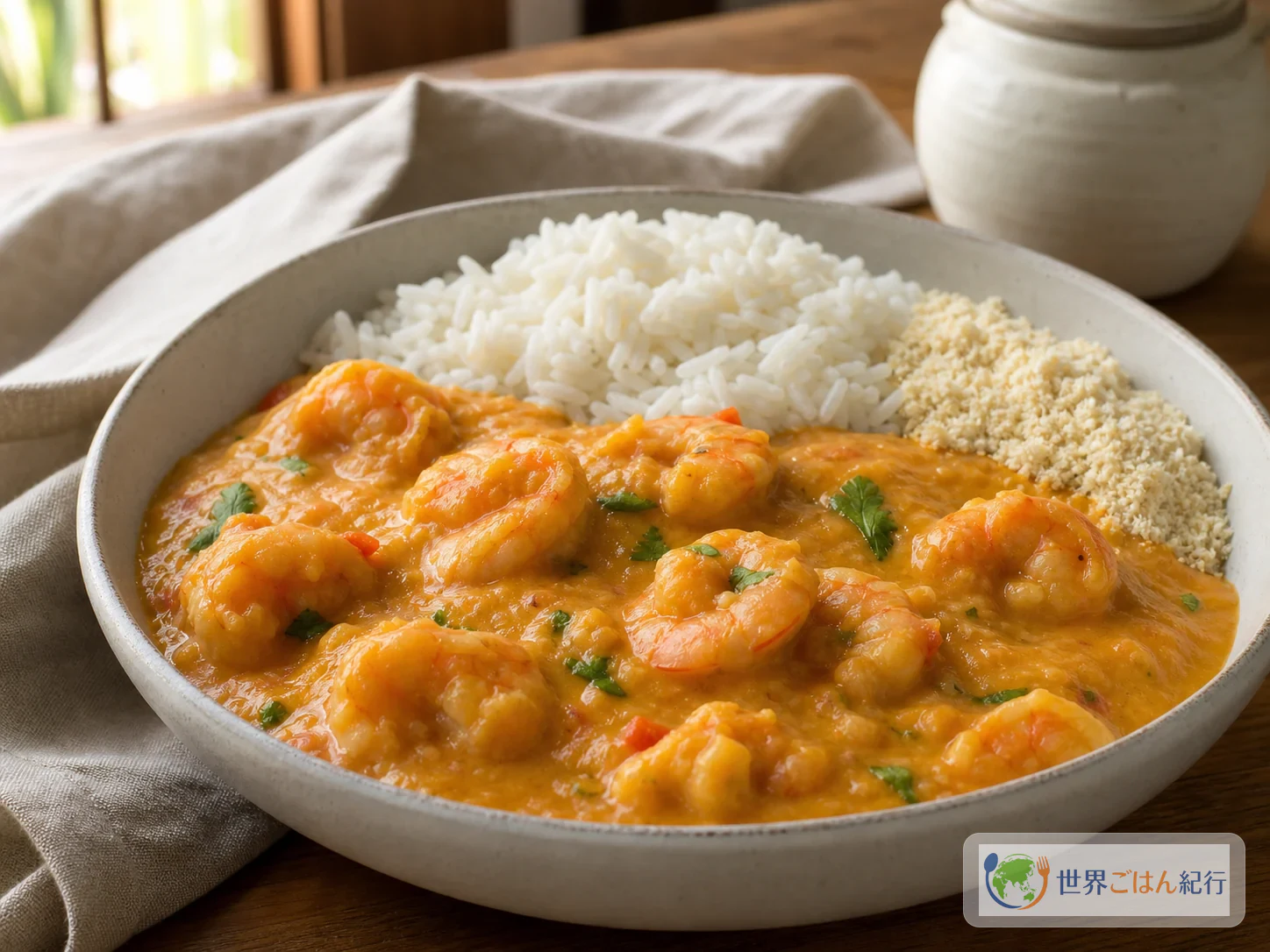
Per person, serve about 9 oz (250 g) of bobó, 5.5 oz (150 g) of white rice, and 20 g of farofa. Pour the bobó onto one side of a dish 2 to 3 cm deep, and set the rice and farofa beside it so the sauce doesn't spread too far.
Lower the heat and add the cassava cream and the remaining 3.5 tbsp–½ cup (50–100 ml) of shrimp stock. Mix widely from the bottom and warm 3 to 4 minutes at a level where small bubbles barely appear. A thickness where tracing the pot bottom with a wooden spoon leaves a line for a moment is the thickness for plating.
Turn off the heat and add the remaining 1 tbsp (15 ml) of dendê oil and the chopped cilantro. Taste for salt and add the remaining 2 g if needed. The aroma is easier to notice if dendê oil is stirred in at the end than if added to a rolling boil. Serve with white rice and farofa, with lime on a separate plate so each person can squeeze it.