Ingredients and steps on one page. Print it, or choose “Save as PDF” in the print dialog.
Sekai Gohan
Caruru: Bahian Okra Stew with Dried Shrimp, Nuts and Dendê Oil
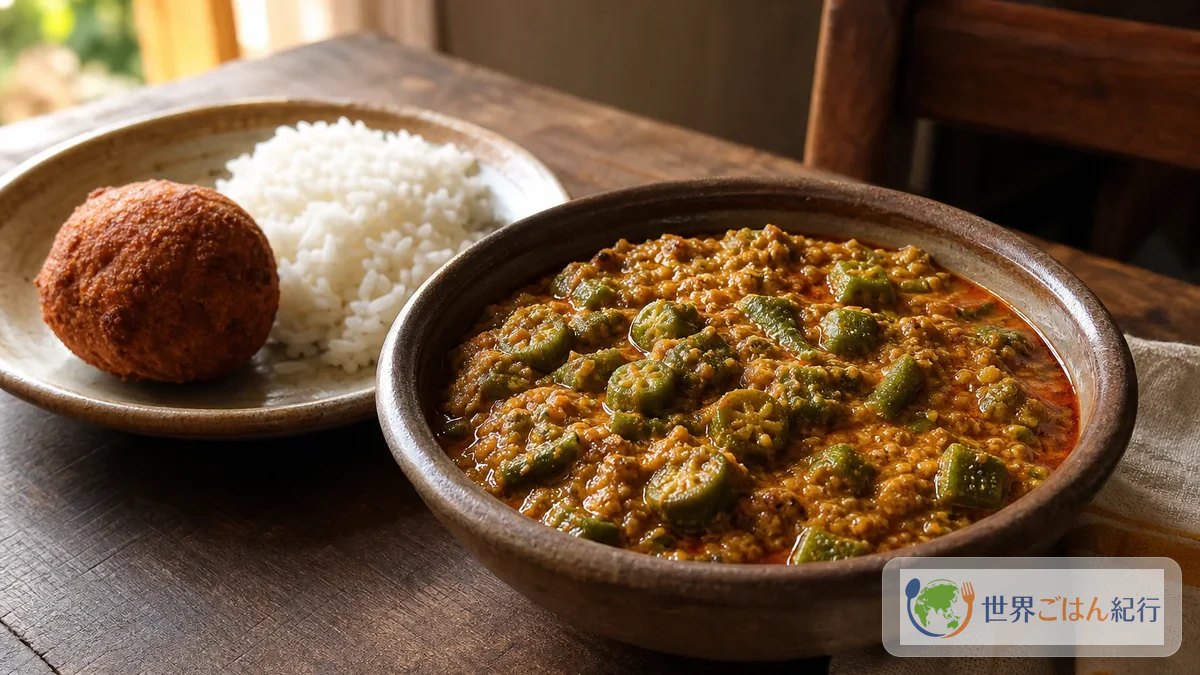
Ingredients
| Ingredient | Amount | Substitutes & notes |
|---|---|---|
| Okra | 400 g | Fresh recommended. Frozen sliced okra is used without thawing, but the slime and aroma change |
| Rice bran oil or neutral oil | 1 tsp | Used to briefly sear the okra |
| Dendê oil | 40 ml | 30 ml for simmering, 10 ml for finishing. Choose edible red palm oil |
| Dried shrimp powder | 35 g | If granular, chop coarsely first. If salted, reduce the salt |
| Cashews | 30 g | Use unsalted. Omit if there is a nut allergy |
| Peanuts | 20 g | Unsalted, skin-on is fine. Use together with the cashews |
| Onion | 100 g | Finely chopped. Cook a little longer if it's a sharp variety |
| Ginger | 10 g | Grated |
| Garlic | 1 clove | Finely chopped |
| Water or vegetable broth | 200 ml | Check the salt of bouillon powder |
| Lime juice | 15 ml | Lemon juice also works. Added at the end |
| Cilantro | 10 g | Flat-leaf parsley if you don't like it. The aroma differs |
| Salt | from 1/2 tsp | Adjust at the end by the saltiness of the shrimp and broth |
| Rice | about 2 cups | Serve with cooked white rice |
Steps
1Make a coarse paste of the nuts and dried shrimp
8 min
Medium heat.
Warm a dry skillet, toss the cashews and peanuts for about 3 minutes, and turn off the heat when they smell fragrant.
You don't need to cool them completely, but don't add hot oil or water; grind them in a mortar with the dried shrimp powder and ginger.
Stop when nut pieces about the size of rice grains remain, not when everything is powder.
2Dry the okra and cut it 0.5 inches (1 cm) wide
8 min
No stove.
Wash the okra under running water and wipe the surface dry with a clean cloth or paper towel.
Cut off only the hard part of the stem and slice into 0.5 inches (1 cm) rounds.
Cut it while wet and the slime turns watery.
You don't need to soak the cut okra in water or wash it with vinegar.
3Briefly sear the okra surface
5 min
High heat.
Put 1 tsp rice bran oil in the skillet and warm it until just before it smokes.
Add the 0.5 inches (1 cm) okra rounds without overlapping and sear them for 2 to 3 minutes without moving them.
When the edges of the cut surfaces turn dark green and the surface has a light browning, take them out.
This is not a step for cooking through.
This short sear keeps the liquid from going watery. It does not remove the slime.
4Build the aromatic base with dendê oil
7 min
Lowish medium heat.
Wipe excess oil from the same skillet and add 2 tbsp (30 ml) dendê oil.
Add the onion and garlic and sauté about 4 minutes, waiting until the onion begins to turn translucent.
Add the paste from step 1 and cook 2 minutes, stirring with a wooden spoon.
When the aroma of the dried shrimp rises and the oil turns red again, move on without burning it.
5Add liquid and simmer the okra
12 min
Low heat.
Add ¾ cup (200 ml) water or vegetable broth and scrape the bottom with a wooden spoon to dissolve the paste.
Keeping small bubbles coming from the sides of the pot, simmer 5 minutes with the lid slightly ajar.
Return the seared okra and simmer 7 minutes more.
Turn off the heat when a spatula drawn across the bottom leaves a line for a moment and the okra is soft without falling apart.
If the liquid runs too thin, remove the lid and reduce 2 minutes at a time.
Conversely, if it gets heavy, add water 1 tbsp at a time.
6Layer the finishing oil and lime
3 min
Low heat to heat off.
Drizzle in the remaining 2 tsp (10 ml) dendê oil and taste before adding salt a little at a time.
Turn off the heat and mix in the lime juice and cilantro. It is done when the thickness hasn't changed, a thin film of oil spreads across the surface, cilantro is scattered through, and the liquid slowly returns when you turn the spatula.
Adding acid first makes the aroma escape and the liquid tighten, so add it last.