Ingredients and steps on one page. Print it, or choose “Save as PDF” in the print dialog.
Sekai Gohan
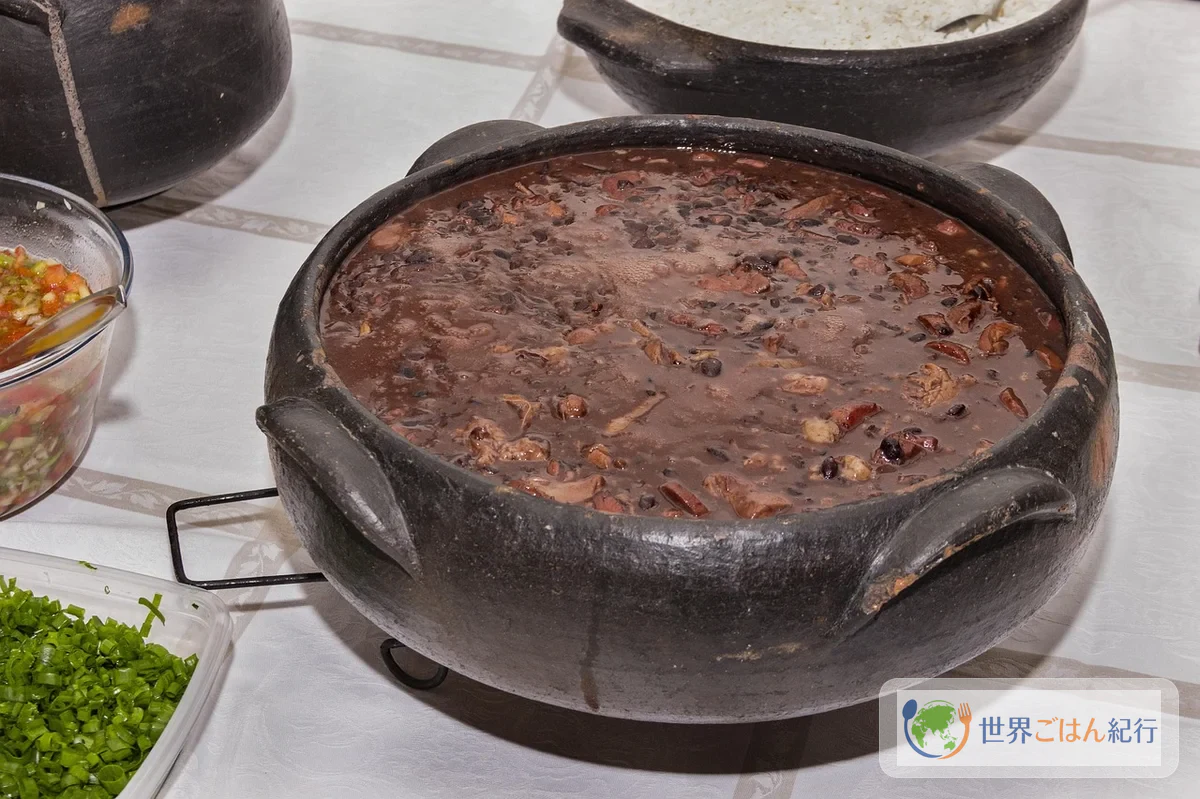
Feijoada: Brazil's Black Bean and Pork Stew
Ingredients
Black beans and basics
| Ingredient | Amount | Substitutes & notes |
|---|---|---|
| Dried black beans (black turtle beans) | 250 g | About 9 oz. Sold as "black beans" in supermarkets, Latin American grocers or online. Not the same as black soybeans |
| Water (for simmering) | 1.5 L | About 6 1/3 cups. Add more if it runs low; keep the beans just covered |
| Onion (large) | 1 | Half thinly sliced (for the sofrito in step 4); the other half goes to uses such as the farofa (1/4 onion) |
| Garlic | 6 cloves | Minced. Brazilian cooking uses garlic generously |
| Bay leaves | 2 | Dried leaves are fine; they release their aroma slowly during the simmer |
| Orange (half, unpeeled) | 1/2 | Add it peel and all. Its citrus aroma and acidity added during the simmer ease the heaviness of the fat |
| Vegetable oil | 1 tbsp | Olive oil works too. Soybean oil is the most common in Brazil |
| Salt | 1 tsp | Adjust at the end; the meats release salt as well |
| Black pepper | 1/2 tsp | Coarsely ground, added at the end |
Meats (combining three kinds is the authentic approach)
| Ingredient | Amount | Substitutes & notes |
|---|---|---|
| Pork belly, in one piece (unsmoked) | 250 g | About 9 oz. Slab bacon also works. Choose a piece with a good balance of fat and lean |
| Smoked sausage (coarse-ground) | 200 g | About 7 oz. Chorizo, kielbasa or any smoked sausage works. A coarse grind is key to the texture |
| Beef (stewing cut) | 150 g | About 5 oz. Canned corned beef (1 can) can stand in. In Brazil, carne seca (salted, dried beef) is used. Beef shank is also a good match |
Traditional feijoada uses 6 to 8 kinds of meat, such as pig's ears, beef tongue and linguiça (Brazilian sausage). In a home kitchen, pork belly, smoked sausage and beef make the best-balanced trio. Meat from different animals, prepared in different ways, creates layered savory flavor. A single kind of meat won't give you the depth of the real thing.
Farofa (side dish, strongly recommended)
| Ingredient | Amount | Substitutes & notes |
|---|---|---|
| Dried breadcrumbs | 100 g | About 3 1/2 oz. The traditional choice is cassava (manioc) flour; use it if you can find it. Fine breadcrumbs come closest in texture |
| Salted butter | 2 tbsp | The nutty browned butter coats the crisp crumbs |
| Bacon (thin slices) | 3 slices | Chop into 5 mm (1/4 in) pieces. Fry until crisp so the fat flavors the farofa |
| Onion (small) | 1/4 | Finely chopped |
To serve
| Ingredient | Amount | Substitutes & notes |
|---|---|---|
| Cooked white rice | 4 bowls | Short-grain rice is fine. To get closer to Brazilian long-grain rice (arroz agulhinha), use a little less water |
| Kale | 4–5 leaves | Young spring cabbage can stand in. Cut into 0.25 inch (5 mm) ribbons and sauté with olive oil and garlic |
| Orange | 1 | Slice to serve alongside. Squeezing the juice over as you eat cuts the richness |
Steps
1Soak the black beans
Put 250 g black beans in a bowl and cover with three times their volume of water (at least 750 ml, about 3 cups). Leave overnight at room temperature or in the refrigerator. They're ready when they've absorbed the water and swelled to about twice their size. Remove any beans that float while soaking (they're hollow and defective).
2Prepare the meat
Put the pork belly in water and refrigerate for 8 hours. Changing the water once or twice along the way draws out excess salt and any bloody smell. It's normal for the water to turn slightly cloudy. Store-bought smoked sausage doesn't need desalting.
3Parboil the meat
Drain the soaked black beans in a colander and discard the soaking water (this removes the oligosaccharides that cause gas). Put the pork belly in a pot, add water just to cover and parboil over medium heat for 20 minutes, then discard the cooking water and cut the pork into 1 1/4–1 1/2 inches (3–4 cm) cubes. Parboiling removes excess scum and salt, so the finished stew tastes clean.
4Start the main simmer
In a large pot of at least 5 liters (5 quarts), combine the drained black beans, parboiled pork belly, smoked sausage cut into 1 inch (2 cm) rounds, beef cut into 1 inch (3 cm) cubes, 2 bay leaves and the orange half (peel on). Pour in 1.5 liters of water and set over medium heat. When it boils, carefully skim the scum from the surface and lower the heat to low or medium-low. Set the lid slightly ajar so steam can escape.
5Simmer slowly
Keep the heat at low to medium-low and simmer until the beans are completely tender. Check the water level every 30 minutes, and if the beans are about to poke above the surface, add water 1 cup at a time. The goal is beans that hold their shape but crush between your fingers. When stirring with a wooden spoon, make sure nothing sticks to the bottom of the pot.
6Thicken with a bean paste
After 2 hours of simmering, scoop out 2 ladlefuls of beans. Heat 1 tbsp oil in a skillet and sauté half an onion, thinly sliced, and 4 cloves of garlic, minced, over medium heat for 5–7 minutes until golden. Add the scooped beans to the skillet and roughly mash them with a wooden spoon so they come together with the sofrito. Return this mashed bean paste to the pot, and the broth quickly thickens and darkens. This is the key step that sets a great feijoada apart from an ordinary one.
7Finish the stew
Remove the orange and bay leaves. If the meat is in large pieces, cut it into bite-size pieces. Simmer uncovered over medium heat for 10 minutes to reduce; it's done when the broth has thickened. Season with salt and black pepper. Ideally, the broth falls slowly from a spoon.
8Make the farofa
In a skillet, fry the bacon, chopped into 0.25 inch (5 mm) pieces, over medium heat for 4–5 minutes until crisp. Add 2 tbsp butter to melt, then add the chopped onion and sauté for 2 minutes. Add the breadcrumbs all at once and keep stirring over medium heat for 10–12 minutes. It's done when the crumbs are light brown and crunchy. Season with a pinch of salt. Look for a toasty aroma and light browning.