Ingredients and steps on one page. Print it, or choose “Save as PDF” in the print dialog.
Sekai Gohan
Pão de Queijo: Brazilian Cheese Bread from Minas Gerais
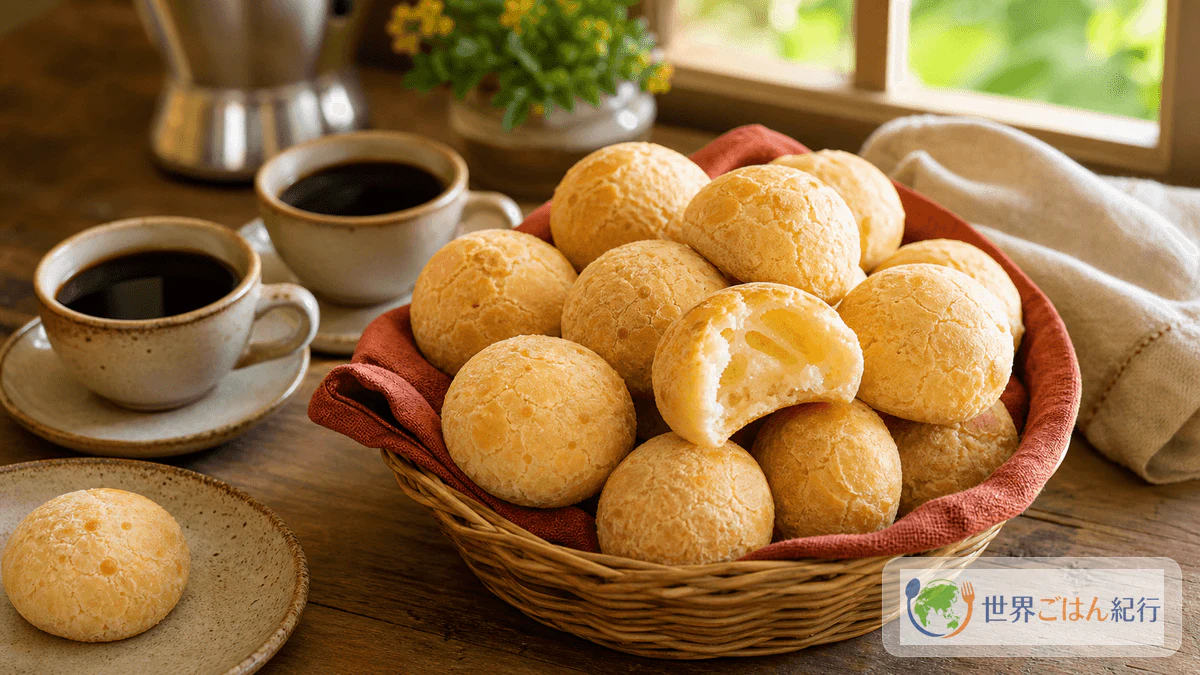
Ingredients
Basic pão de queijo
| Ingredient | Amount | Substitutes & notes |
|---|---|---|
| Tapioca starch or cassava starch | 10 oz (280 g) | Stands in for polvilho doce. If you have polvilho azedo, swap in just 2.75 oz (80 g) |
| Milk | ½ cup (150 ml) | Gives more browning and dairy aroma than water alone |
| Water | ¼ cup (80 ml) | Keeps the dough from getting heavier than with milk alone |
| Vegetable oil | ¼ cup (60 ml) | Rice bran oil or another neutral oil works. Avoid strongly flavored oils |
| Salted butter | 15 g | For flavor. If unsalted, add a little more salt |
| Salt | 1/2 tsp | 1/3 tsp if your cheese is very salty |
| Eggs | 2 | Medium to large. Take out of the fridge 10 minutes ahead |
| Shredded mozzarella | 4 oz (110 g) | Pizza cheese works. Use a little less if the product is very oily |
| Grated Parmesan | 1.5 oz (45 g) | Parmesan-style. Adds salt and savory depth |
| Salty white cheese | 1.5 oz (40 g) | If available: queijo fresco, or a little feta |
| Oil for your hands | 2 tsp | For shaping. Too much makes the surface greasy |
Steps
1Heat the liquid until it bubbles
In a pot, combine ½ cup (150 ml) milk, ¼ cup (80 ml) water, ¼ cup (60 ml) vegetable oil, 15 g salted butter and 1/2 tsp salt. Heat over medium for 4–5 minutes, and turn off the heat once small bubbles rise steadily around the edge of the pot and the butter has completely melted. Boiling it hard reduces the liquid, so stop at a gentle bubble rather than a rolling boil.
2Gelatinize the tapioca starch with heat
Put 10 oz (280 g) tapioca starch in a large bowl and pour in the hot liquid in 3 additions. Mix with a wooden spatula for 3–4 minutes, pressing down from the bottom. It's fine when all the starch is moistened and forms a lumpy mass with a little white powder still showing. A light press leaves cracks, and when squeezed it holds together as a clump about 1 inches (2 cm) thick. Adding water here to make it perfectly smooth makes it hard to roll later.
3Let it cool slightly and mix in the eggs
Spread the dough up the sides of the bowl and leave it for 12–15 minutes. When it no longer feels hot to your finger and the steam has died down, add the eggs one at a time. After the first egg, mix with a wooden spatula for 3 minutes until the dough is glossy again; mix the second for 3 minutes the same way. If the eggs go in while the dough is still hot, they set into small grains on their own, and the rise is uneven in the oven.
4Mix in the cheese and let it rest
Add 4 oz (110 g) shredded mozzarella, 1.5 oz (45 g) grated Parmesan and 1.5 oz (40 g) salty white cheese and mix with a spatula for 4–5 minutes. It's ready when the cheese is spread throughout and the dough falls heavily from the spatula in a sticky mass. Smoothing the top with the spatula leaves shallow lines, and the dough doesn't run when you tilt the bowl. Keep mixing until the dough, spread about 1 inches (3 cm) thick on the bottom of the bowl, holds a mounded shape when pushed together with the spatula. Cover the bowl with plastic wrap and rest it at room temperature for 10 minutes. During the rest, the starch absorbs moisture, and the dough becomes firm enough to shape into 1.5 inches (4 cm) balls in the next step.
5Roll with oiled hands
Rub your hands lightly with oil and divide the dough into 18 portions. Aim for about 1 oz (30 g) each, shape into balls about 1.5 inches (4 cm) across, and set them 1.5 inches (4 cm) apart on a baking sheet lined with parchment paper. Well-shaped balls have a glossy surface, don't slump when pressed, and flatten only slightly on the bottom when set down. This step is done when all 18 balls on the sheet are a uniform 1.5 inches (4 cm) across and their surfaces are still glossy, not dried out. Finish shaping within 10–12 minutes so the dough doesn't dry out. If the surface cracks, add a little more oil to your hands and smooth it. If the dough is very sticky, adjust with oil on your hands before adding any starch.
6Bake at 400°F (210°C) until puffed
Preheat the oven to 210°C (410°F), put in the baking sheet and bake for 18–22 minutes. Don't open the door for the first 15 minutes. They're done when the surface has puffed, cracked and turned light golden in places. If the tops scorch in a small oven, lower it to 200°C (390°F) and bake 2–3 minutes longer. Even if the color is pale, they're cooked if they feel light when lifted and the bottoms are dry.
7Rest on a rack and eat while hot
Move them to a wire rack and let them rest for 5 minutes. Eaten straight away, the steam inside is intense; a short rest lets the outside dry thinly. Success is a slightly hollow center with moist, chewy, stretchy dough when you break one open. Serve with coffee or café com leite, or as an appetizer before a light meat dish served with vinagrete.