Ingredients and steps on one page. Print it, or choose “Save as PDF” in the print dialog.
Sekai Gohan
Ropa Vieja: Cuban Shredded Beef in Tomato Sauce
Ingredients
Main ingredients
| Ingredient | Amount | Substitutes & notes |
|---|---|---|
| Flank steak (bavette) | 1.75 lb (800 g) | Beef shank or chuck can stand in. Choose a cut that tears along the grain |
| Canned whole tomatoes | 14 oz (400 g) (1 can) | Crush by hand |
| Tomato paste | 2 tbsp | Builds the richness |
| Bell peppers (1 red, 1 green) | 7 oz (200 g) total | Cut into thin strips. Green peppers also work |
| Onion | 1 large | Coarsely chopped |
| Garlic | 6 cloves | Minced |
| Green olives, pitted | 2 oz (60 g) | Sliced |
| Capers | 1 tbsp | Rinse off the salt first |
| Dry white wine | ½ cup (120 ml) | Cooking sake can stand in |
| Beef broth | 2 cups (500 ml) | Bouillon granules and water also work |
| Bay leaves | 2 | — |
| Olive oil | 3 tbsp | — |
In Cuba the traditional cut is flank steak, called falda. The key is to choose a cut with clear muscle fibers that can be torn by hand after simmering. Substitutes include skirt steak, bavette, and beef shank. Sirloin and tenderloin have grain that is too fine, and will not give the shredded texture ropa vieja is known for.
Seasonings for the sofrito
| Ingredient | Amount | Substitutes & notes |
|---|---|---|
| Ground cumin | 2 tsp | The backbone spice of ropa vieja |
| Dried oregano | 1 tsp | Mexican oregano is ideal |
| Smoked paprika | 1 tsp | Spanish pimentón is best |
| Salt | 1 tsp | Adjust to taste |
| Black pepper | 1/2 tsp | — |
| Sugar | 1 tsp | Rounds off the acidity of the tomato |
Take the cumin out of ropa vieja and it is just tomato stew. If you can, dry-toast whole cumin seeds in a frying pan and crush them; the aroma is much stronger than store-bought powder.
Sides
| Ingredient | Amount | Substitutes & notes |
|---|---|---|
| White rice | 3 gō | A rice-cooker cup (gō) is 180 ml, so about 540 ml of dry rice. Jasmine rice also works |
| Black beans (canned, cooked) | 400 g (1 can) | The Cuban standard |
| Plantains (if available) | 2 | Ripe sweet bananas can stand in |
Steps
1Simmer the beef
1 hour 30 min
Put the flank steak in a large pot in 3–4 cm thick chunks and pour in water to cover (about 1.5 liters). Add 2 bay leaves, the outer skin of an onion (if you have it), and 2 garlic cloves lightly crushed with the flat of a knife so they release their aroma. Bring to a boil over high heat, skim the scum carefully, then lower the heat, cover, and simmer for 1 hour 30 minutes.
When the meat shreds easily with a fork, it is done. Set aside 2 cups (500 ml) of the cooking liquid. This is the base of the sauce. You do not need bouillon; this liquid alone has plenty of savoriness.
Do not skip the simmeringSome quick recipes skip the pre-simmer and go straight to the sauce, but the pre-simmer is what loosens the fibers enough for the meat to tear into neat strands. With a pressure cooker, you can cut it to 40 minutes.
2Shred the beef by hand
10 min
Take the meat out and let it cool for about 10 minutes. On a cutting board, use two forks to pull it into thin strands along the grain. The thickness of a disposable chopstick is ideal.
This is the most important step of ropa vieja. Shred carefully until it looks like a pile of tattered cloth, true to the name "old clothes," and loosens softly when you pinch it. Cutting against the grain leaves you with plain lumps of meat.
Tips for shreddingShred the meat when it is cool enough to touch (around 140°F (60°C)), so you do not burn your hands. Once it is completely cold the fibers harden and become harder to tear. Hold a fork in each hand and pull outward from both ends of the meat for an even result.
3Make the sofrito
15 min
Heat 3 tbsp olive oil in a large frying pan (or shallow pot) over medium heat. Add the chopped onion and cook for 5 minutes, until translucent. Add the minced garlic and cook for 1 minute, until fragrant.
Add the sliced bell peppers and cook for 3 minutes, until soft. Add the ground cumin, oregano, and smoked paprika, and cook for 30 seconds, until the spices smell fragrant. Stir constantly so nothing scorches.
What is sofrito?Sofrito is the aromatic base of Latin American cooking. The word comes from the Spanish sofreír (to fry gently), and in Cuba the usual combination is onion, garlic, pepper, and tomato. A similar base (refogado) is used in Brazilian feijoada too, and Latin American stews are hard to imagine without this aromatic base.
4Make the tomato sauce
10 min
Add the canned whole tomatoes to the sofrito, crushing them by hand as you go. If you leave some lumps of about 1 inches (2 cm), the tomato texture survives the simmering. Pour in 2 tbsp tomato paste, ½ cup (120 ml) white wine, and the 2 cups (500 ml) of reserved cooking liquid. Add 1 tsp sugar, bring to a boil over medium heat, then lower to a simmer.
Season with 1 tsp salt and 1/2 tsp black pepper. Simmer the sauce for about 10 minutes, until it thickens slightly.
5Simmer the beef in the sauce
30 min
Add the shredded beef to the sauce, trimmed to about the thickness of a disposable chopstick, and mix well until the red sauce coats each fiber of the meat. Scatter in the green olives and capers. Cover and simmer over low heat for 30 minutes. Stir once along the way, and add cooking liquid if it seems dry.
The ideal finish is meat that has soaked up plenty of sauce, with little liquid left and just a thin layer of sauce at the bottom of the pan. Too much liquid makes the flavor fuzzy, so remove the lid and cook off the moisture. Adjust the salt at the end.
Add the olives and capers at the endAdd the olives and capers in the last 15 minutes of the simmer. This keeps the texture of the olives and the flavor of the capers, so the accents stand out. Adjust to your taste.
6Prepare the sides and plate
10 min
Cook the white rice, and warm the black beans from the can over medium heat. If you have plantains, cut them on the diagonal 0.5 inches (1 cm) thick and fry both sides in butter until browned on the surface (maduros).
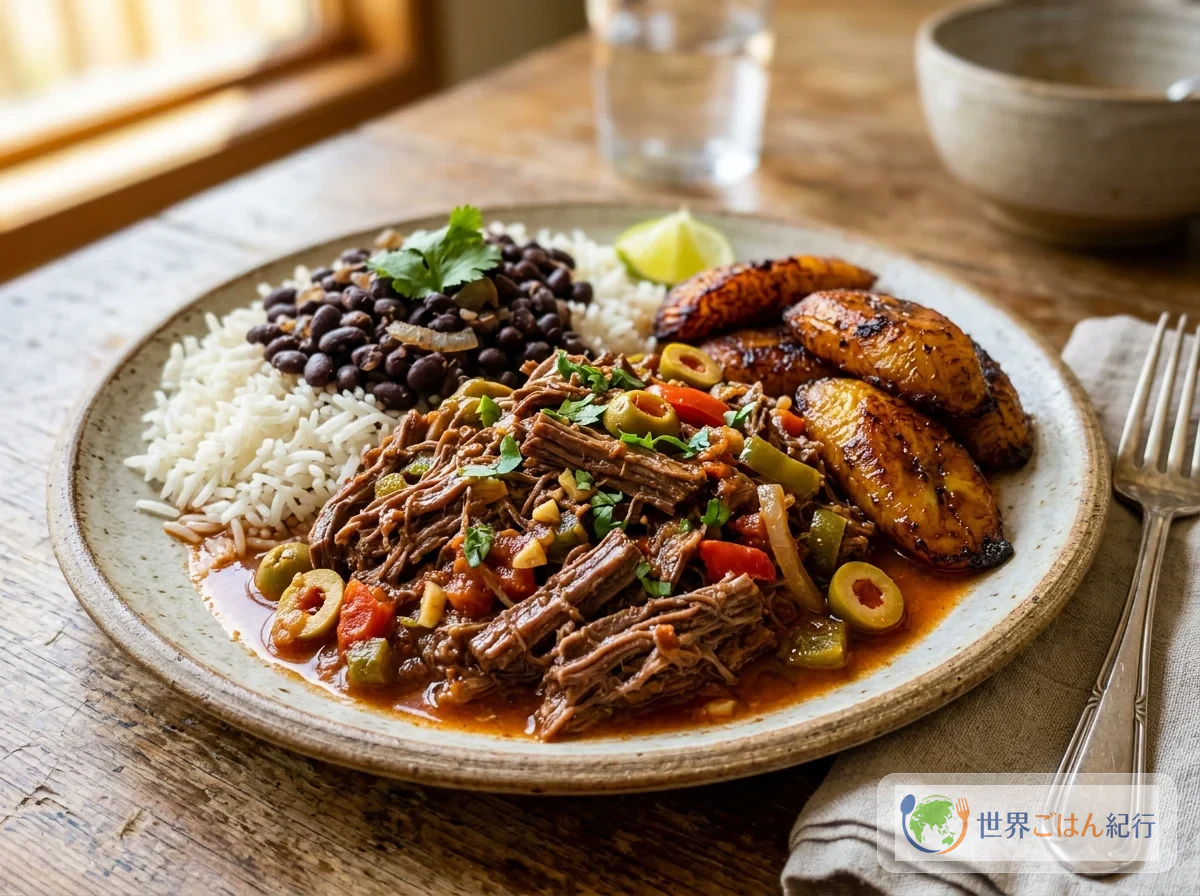
Put the rice on the plate, set the black beans beside it, and spoon plenty of ropa vieja in the center. Place the maduros alongside, scatter cilantro leaves (if you have them), and squeeze lime over it to tighten the whole dish.