Ingredients and steps on one page. Print it, or choose “Save as PDF” in the print dialog.
Sekai Gohan
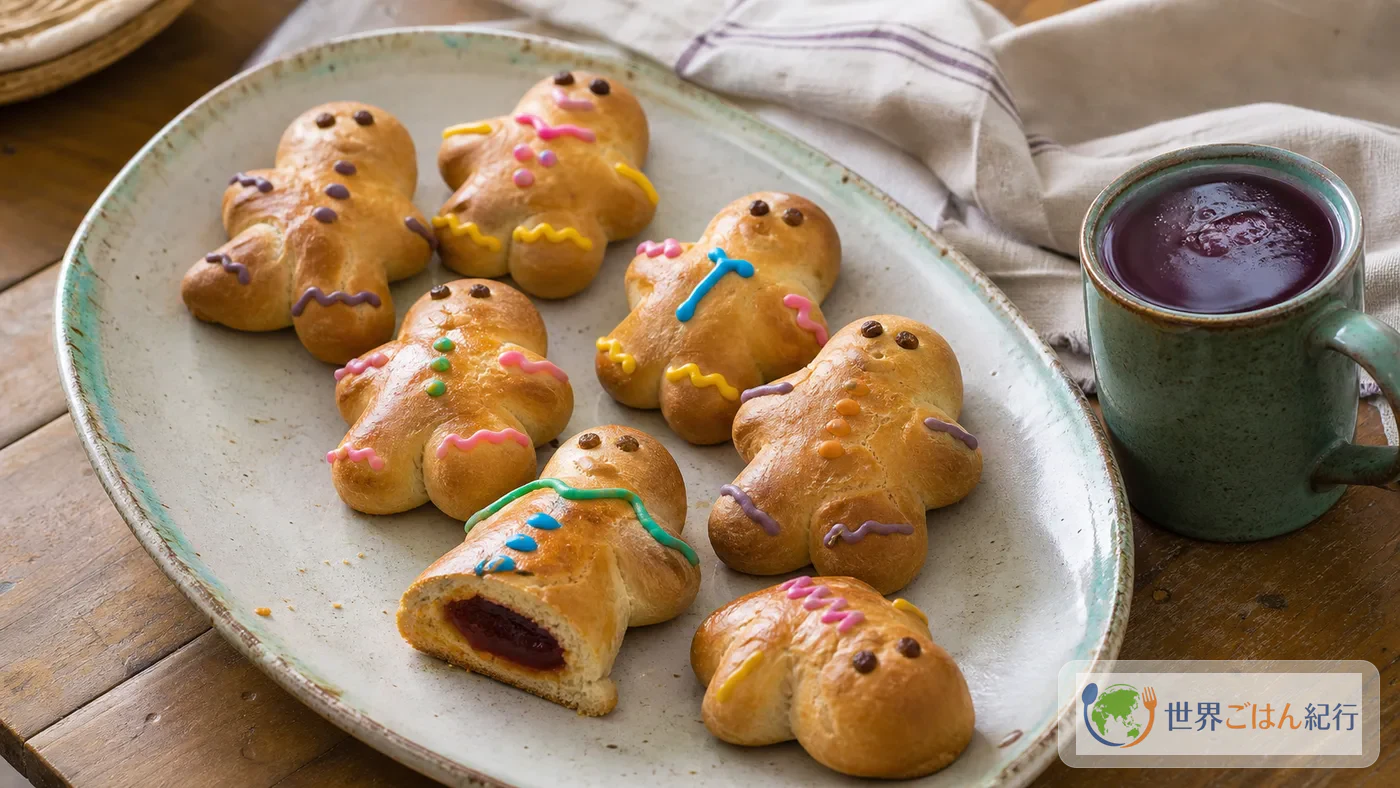
Guagua de Pan (Wawa de Pan): Ecuador's Sweet Bread Dolls
Ingredients
Dough
| Ingredient | Amount | Notes on choosing |
|---|---|---|
| Bread flour | 420 g | The backbone of the rise |
| Cake flour (or soft all-purpose flour) | 80 g | Makes the texture slightly lighter |
| Dry yeast | 7 g | Instant type. Old yeast rises weakly |
| Milk | 230 ml | Warm to 38–40°C (100–104°F) before using |
| Sugar | 75 g | 10 g for the yeast, 65 g for the dough |
| Eggs | 2 | Bring to room temperature. About 100 g without shells |
| Unsalted butter | 80 g | Cut into 1 cm cubes and soften |
| Salt | 6 g | Tightens the outline of a sweet dough |
| Orange zest | 5 g | Grated. Leave out the white pith, which is bitter |
| Ground cinnamon | 2 g | A little under 1 tsp |
| Orange blossom water | 2.5 ml | 1/2 tsp. Strong, so don't overdo it |
Guava filling
| Ingredient | Amount | Role |
|---|---|---|
| Guava paste or firm guava jam | 6.5 oz (180 g) | The center of the tartness and South American aroma |
| Orange juice or water | 2.5 tbsp (40 ml) | Loosens the paste to a workable firmness |
| Lemon juice | 2 tsp (10 ml) | Tightens the sweetness and keeps the baked bread from feeling heavy |
| Cinnamon stick | 1/2 stick | Perfumes the filling; remove before wrapping |
Finishing
| Ingredient | Amount | How it is used |
|---|---|---|
| Egg yolk | 1 | Glaze before baking |
| Milk | 2 tsp (10 ml) | Mixed into the yolk so it brushes on thinly |
| Powdered sugar | 6.5 oz (180 g) | For the icing |
| Milk | 1.5 tbsp (25 ml) | Adjusts the firmness of the icing |
| Lemon juice | 1 tsp (5 ml) | Cuts the sweetness and helps it dry |
| Food coloring | 1 drop each of red, yellow, and green | For lines on the face and clothing. If powdered, a tiny pinch |
| Cocoa powder | 2 g | Used for brown lines |
Steps
1Activate the yeast
10 min
Warm 1 cup (230 ml) milk in a small pot over low heat, or in a microwave at 600 W for 40–50 seconds, to 38–40°C. Stir in 10 g sugar and 7 g dry yeast and leave for 8 minutes. Go on when fine bubbles float on the surface and the milky layer has thickened a little. If no bubbles appear, the yeast is old or the milk was too hot, so start over here.
2Knead the dough
15 min
Put 15 oz (420 g) bread flour, 2.75 oz (80 g) cake flour, 2.25 oz (65 g) sugar, 6 g salt, 2 g cinnamon, and 5 g orange zest in a bowl, add 2 eggs and the yeast milk, and mix. When almost no dry flour remains, work in 2.75 oz (80 g) soft butter in 3 additions, turn the dough out onto the counter, and knead 10 minutes. Aim for a dough temperature of 24–27°C. Knead until the surface is smooth and a thin stretch forms a coarse membrane.
3First proof and make the filling
70 min
Shape the dough into a ball, put it in a lightly oiled bowl, and proof about 60 minutes at around 82°F (28°C). It is ready when it has grown about 1.6 times and a finger dent springs back slowly. Meanwhile, put 6.5 oz (180 g) guava paste, 2.5 tbsp (40 ml) orange juice, 2 tsp (10 ml) lemon juice, and 1/2 cinnamon stick in a small pot and heat 4–5 minutes over low heat. Turn off the heat when fine bubbles form and a spatula dragged across the bottom leaves a path for a moment; remove the cinnamon and let it cool.
4Shape the dolls
25 min
Divide the dough into 8 pieces of about 3.75 oz (105 g) each. Set aside about 10 g from each piece for the arms, and roll the rest into an oval about 4.5 inches (12 cm) long and 3 inches (8 cm) wide. Put 20 g of the cooled filling in the center, pinch the edges closed, and place seam-side down. Pinch the top 1/4 lightly to make the head, with the lower part as the body, and attach the reserved dough sideways as 2 arms. Making them thin and tight makes them crack in baking, so stop at arms thicker than a pencil.
5Second proof and glaze
35 min
Line a baking sheet with parchment and place the shaped dough at least 1 inches (3 cm) apart. Leave about 30 minutes at around 82°F (28°C), until it has grown 1.2–1.3 times. Preheat the oven to 350°F (180°C), and brush a thin coat of a mixture of 1 egg yolk and 2 tsp (10 ml) milk over the surface. Pooled egg wash causes uneven browning, so squeeze the brush lightly before brushing.
6Bake
18 min
Bake 16–18 minutes in a 350°F (180°C) oven. They are ready when the surface is pale golden and the bottom has a light color. If they color too quickly, loosely drape aluminum foil over them after 12 minutes. When the internal temperature reaches 90–92°C, they are done. Overbaking makes them hard the next day and makes the icing lines crack more easily.
7Cool and draw the faces
25 min
Move the baked breads to a rack and cool at least 20 minutes. Mix 6.5 oz (180 g) powdered sugar, 1.5 tbsp (25 ml) milk, and 1 tsp (5 ml) lemon juice until no lumps remain, it is glossy, and it falls from a spoon in a slow ribbon. Divide into small dishes, stir in the food coloring 1 drop at a time, and draw the face, hair, and clothing lines. If the lines bleed, add 5 g powdered sugar; if too firm, add 0.5 tsp (2 ml) milk. Leave 15 minutes until completely dry, then move to a plate.