Ingredients and steps on one page. Print it, or choose “Save as PDF” in the print dialog.
Sekai Gohan
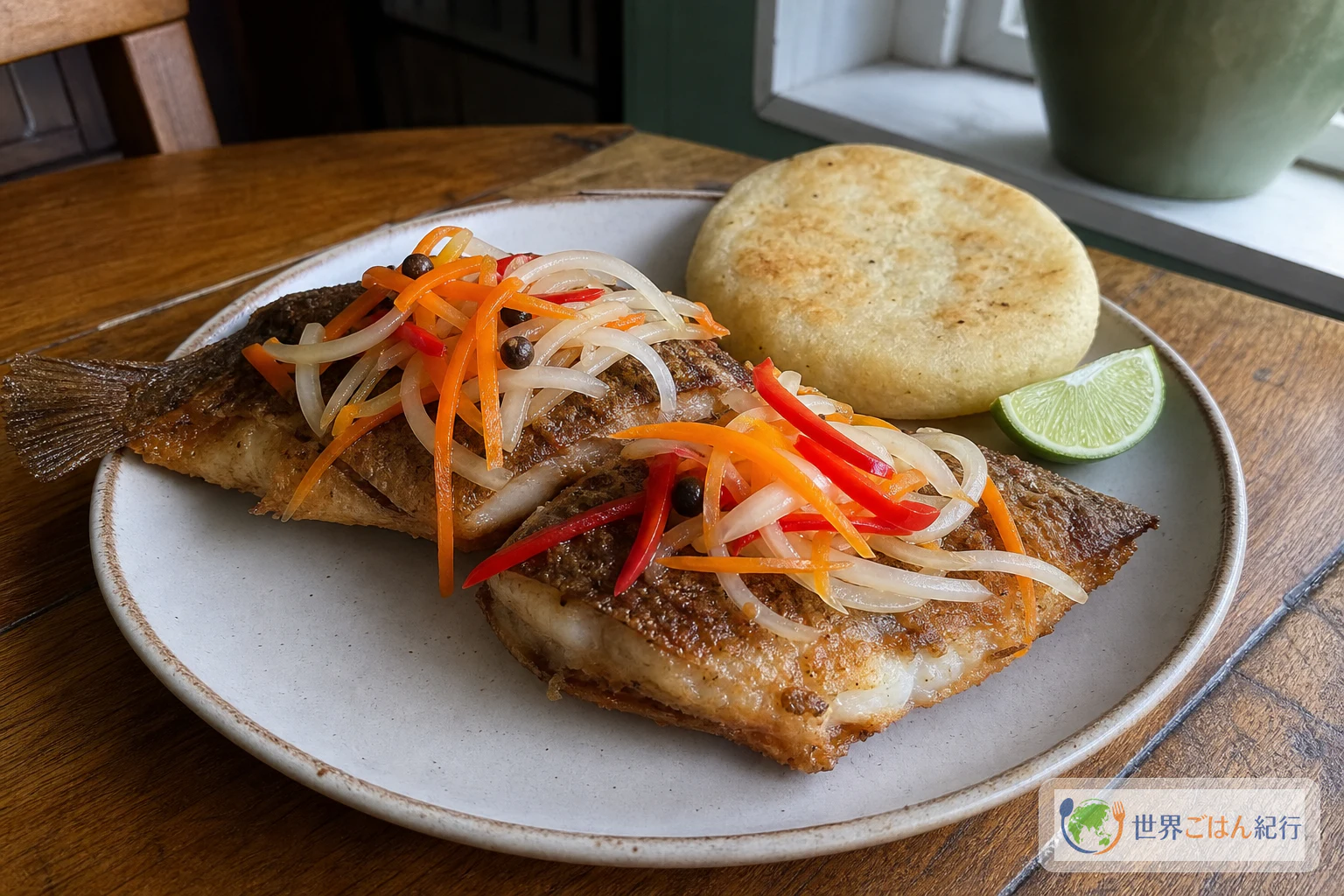
Jamaican Escovitch Fish: Crisp Fried Fish with Hot Pickled Vegetables
Ingredients
Fish and coating
| Ingredient | Amount | Substitutes & notes |
|---|---|---|
| Skin-on white fish fillets | 4 fillets (600 g total) | Sea bream, grunt, sea bass, etc. Bone-in is fine (about 1 1/3 lb) |
| Salt | 1 tsp (for the fish) | About 0.8% of the fish weight |
| Black pepper | 1/2 tsp | Coarsely ground keeps more aroma |
| All-purpose flour | 40 g | Rice flour works; the coating is slightly lighter (about 1/3 cup) |
| Frying oil | 150 ml | About 5 mm deep in a pan roughly 20 cm (8 in) across (about 2/3 cup) |
Escovitch pickle
| Ingredient | Amount | Substitutes & notes |
|---|---|---|
| White vinegar | 120 ml | With a milder grain vinegar, check the acidity and add 10–20 ml more water (1/2 cup) |
| Water | 80 ml | Softer than using vinegar alone (1/3 cup) |
| Brown sugar | 1 tbsp (about 9 g) | Light cane sugar works |
| Salt | 1/2 tsp | Adjust at the end to taste |
| Allspice (whole) | 10 berries | Called pimento berries in Jamaica. Coarsely crush 5 for the fish |
| Onion | 1/2 (about 100 g) | Thin strips, 5 mm wide |
| Carrot | 1/2 (about 70 g) | Thin strips, 3 mm wide |
| Red bell pepper | 1/2 (about 70 g) | Chayote works |
| Red chile | 1 | With Scotch bonnet, start with 1/4–1/2 |
| Garlic | 1 clove | Crush, then slice thin |
Steps
1Dry the fish and make the spiced salt
15 min
Don't rinse the fish; blot the surface and belly side dry with paper towels. Put 5 allspice berries, 1 tsp salt and 1/2 tsp black pepper in a mortar or small bowl and crush coarsely, until the berries are roughly halved. Rub the mixture over both sides of the fish and let it sit for 10 minutes somewhere not too warm. If moisture beads up on the surface, blot again just before frying. If you grind the spices as fine as powder, the aroma clumps in one spot, so leave some texture. The prep is done when the surface of the fish is dry, the coarse salt looks dry and loose, and the seasoning clings in a thin, even layer.
2Dust with flour and fry
15–18 min
Dust the fish lightly with the 40 g flour and tap off the excess. Pour the 150 ml oil into a skillet and heat over medium to 170–180°C (340–355°F). A pinch of flour dropped in should immediately spread into fine bubbles. Add the fish 2 fillets at a time, skin side down, without overlapping. Don't move them for the first 3 minutes; once the skin has set and the edges turn golden, lower the heat to medium-low. For fillets 2–3 cm thick, cook 4–5 minutes per side, until the flesh turns opaque white and springs back when pressed with chopsticks or a spatula. Aim for an internal temperature of 63°C (145°F). If the oil spatters, there is still moisture on the fish. Turn down the heat, then bring it back up gradually.
3Warm the pickled vegetables briefly
8 min
Put ½ cup (120 ml) white vinegar, ¼ cup (80 ml) water, 1 tbsp brown sugar, 1/2 tsp salt, the remaining 5 allspice berries and the garlic in a small saucepan over medium-low heat. When it starts to bubble, add the onion, carrot, red bell pepper and red chile and simmer for just 2–3 minutes. Turn off the heat before the vegetables go fully soft, when the edges of the onion turn translucent and the center of the carrot still has bite. If you cook off too much acidity, the pickle can't do its job of cutting through the oil from the fish. Taste: if it's too sharp, add 1 tbsp water; if it needs sweetness, add just 1 tsp sugar.
4Pour the hot pickle over the fish and let it rest
5–10 min
Set the fried fish on a rack or paper towels and drain off excess oil for 1 minute. Arrange the fish on a platter and pour over the just-off-the-heat pickle, liquid and all. Eaten right away, the crisp skin and the sourness stay distinct; after 5 minutes, the liquid soaks partly into the coating and the fish's richness melds with the acidity. If crisp skin is your top priority, pour the liquid around the fish and pile only the vegetables on top. If you're cutting the fish, slice the thick part into 4–5 cm pieces and check that the cut surface flakes white. It's done when, after plating, the flesh is no longer translucent and flakes white all the way to the center.