Ingredients and steps on one page. Print it, or choose “Save as PDF” in the print dialog.
Sekai Gohan
Tacu Tacu: Peruvian Pan-Fried Beans and Rice with a Crisp Crust
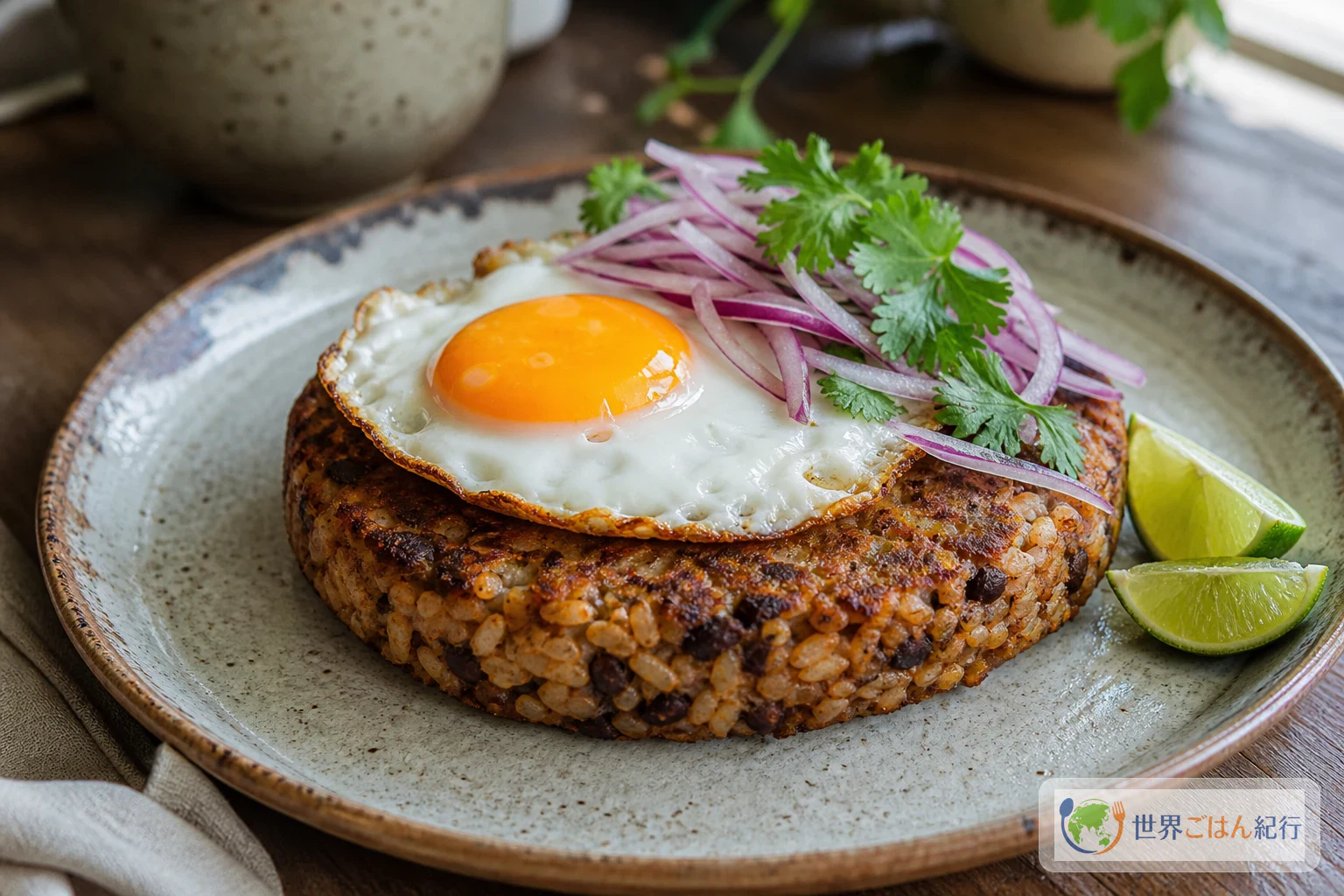
Ingredients
The beans and rice
| Ingredient | Amount | Substitutes & notes |
|---|---|---|
| Cooked rice | 1.25 lb (600 g) | Refrigerated. If warm, spread it out and cool for 30 minutes |
| Cooked white beans | 1 lb (480 g) | Canary beans are the traditional choice. For canned, drain and pat dry |
| Red onion | 5.5 oz (150 g) | Use 2.75 oz (80 g) finely chopped for the base and 2.5 oz (70 g) thinly sliced for the topping |
| Garlic | 3 cloves | Minced. Part of the aromatic base |
| Ají amarillo paste | 1 oz (30 g) (2 tbsp) | See below for substitutes. Yellow bell pepper alone gives too little heat and fruity aroma |
| Neutral oil | 3 tbsp | Replaces the pork lard of the traditional method |
| Dried oregano | 1/2 tsp | Sets the herb aroma. Use 1/3 tsp if powdered |
| Black pepper | 1/3 tsp | Freshly ground goes well |
| Salt | 2/3 tsp | Adjust after checking the beans' saltiness |
| Water or bean cooking liquid | up to 2 tbsp | Use 1 tbsp at a time, only if it's dry and won't hold together |
For finishing
| Ingredient | Amount | Substitutes & notes |
|---|---|---|
| Eggs | 4 | Fried and served on top. Omit if not wanted |
| Red onion | 2.5 oz (70 g) | Sliced 0.125 inch (2 mm) thick. If sharp, soak in water for 2 minutes |
| Lime juice | 2 tbsp | 1 tbsp lemon juice plus 1 tbsp rice vinegar also works |
| Cilantro | 10 g | If you dislike it, flat-leaf parsley; the aroma changes |
| Salt | 1/4 tsp | For the onion topping |
Steps
1Match the moisture of the beans and rice
5 min
Drain canned beans in a sieve, rinse lightly under running water and let them sit for 10 minutes. If liquid remains on the surface, pat with paper towels. Break up clumps of cold rice with your fingers and put 1.25 lb (600 g) in a bowl. Add the beans in two halves and, without mixing yet, check the size of the grains and their moisture.
If the beans' surface looks wet and shiny, wait another 5 minutes. Rush this and the mixture loosens later even though you haven't added water. It's ready when the beans are loose, the rice grains aren't sticky and no liquid collects at the bottom of the bowl.
2Make the onion and ají aromatic base
6 min
Put 1 tbsp oil in a skillet and warm for 30 seconds over medium heat. Add 2.75 oz (80 g) finely chopped red onion and the 3 cloves of garlic and cook for 3 minutes. When the edges of the onion are translucent and lightly golden at the tips, add 1 oz (30 g) ají amarillo, the oregano and black pepper. Cook for 1 more minute over medium heat, and stop when the oil turns from yellow to orange and the raw smell of the chile is gone.
If you add the ají from the start, it sticks to the pan bottom before its aroma develops. Loosening it first with the moisture of the onion and then working it into the oil is the order that prevents scorching.
3Mash the beans and combine with the rice
7 min
Add the beans to the aromatic base and cook for 4 minutes over medium-low heat. With a wooden spoon, crush only a third of the beans and leave the rest whole. Once some bean skins split and the beans mash softly, with the moisture at the bottom of the pan cooked off, add the rice. Don't cut through the mixture; spend 3 minutes turning it from the bottom and pressing.
The guide is that when you press one spot with the spoon the mixture holds together, and when you lift it, it falls in big clumps. If it is so dry that it cracks, add just 1 tbsp water or bean cooking liquid. If it still spreads, don't add water; cook off moisture 1 minute at a time over medium-low heat.
4Shape to 1 inch (2 cm) thick and rest
7 min
Turn off the heat, move the mixture to a cutting board and divide it in two. Using a lightly oiled spatula, press each into a disc 15 cm to 6.5 inches (16 cm) across and 1 inch (2 cm) thick. If an edge cracks, rather than closing the crack with your fingers, push the whole mixture inward and then smooth the surface. After shaping, leave it for 5 minutes to let steam escape from the surface.
A larger diameter looks nice on the table but is harder to flip. The first time, dividing into 4 rounds of 4 inches (10 cm) across and 0.5 inches (1.5 cm) thick tastes no different.
5Cook one side without moving it
12 min
Preheat the same skillet over medium heat for 2 minutes and use the remaining 2 tbsp oil, 1 tbsp at a time. Place only one disc in the pan and press with the flat of the spatula for 30 seconds. Keep the heat at medium and don't move it for 5 to 6 minutes. The oil is ready at 170 to 180°C (340 to 355°F), when it spreads quietly.
It's time to flip when the raised edge has dried slightly, a toasty sound keeps coming from the bottom and, when you slide in the spatula, the disc moves as one piece. If the bottom is still pale golden it's too early; even if it's dark brown, flip before black spots appear. After taking out the first one, add 1 tbsp oil and cook the second the same way.
6Flip, warm through the center and add the egg
10 min
Place a large plate over the disc and invert the pan to move it onto the plate. Slide it from the plate back into the pan and cook 4 to 5 minutes over medium-low heat. If you're nervous about flipping, support it from both halves with two spatulas, or shape it smaller. Turn off the heat when both sides are brown and set and steam rises from the center.
If the center is only lukewarm, lower the heat and cover for just 1 minute. Fry eggs in a separate pan and top with the topping of thinly sliced red onion, lime, cilantro and salt. If you serve eggs, cook them until the surface of the yolk is also set.