Ingredients and steps on one page. Print it, or choose “Save as PDF” in the print dialog.
Sekai Gohan
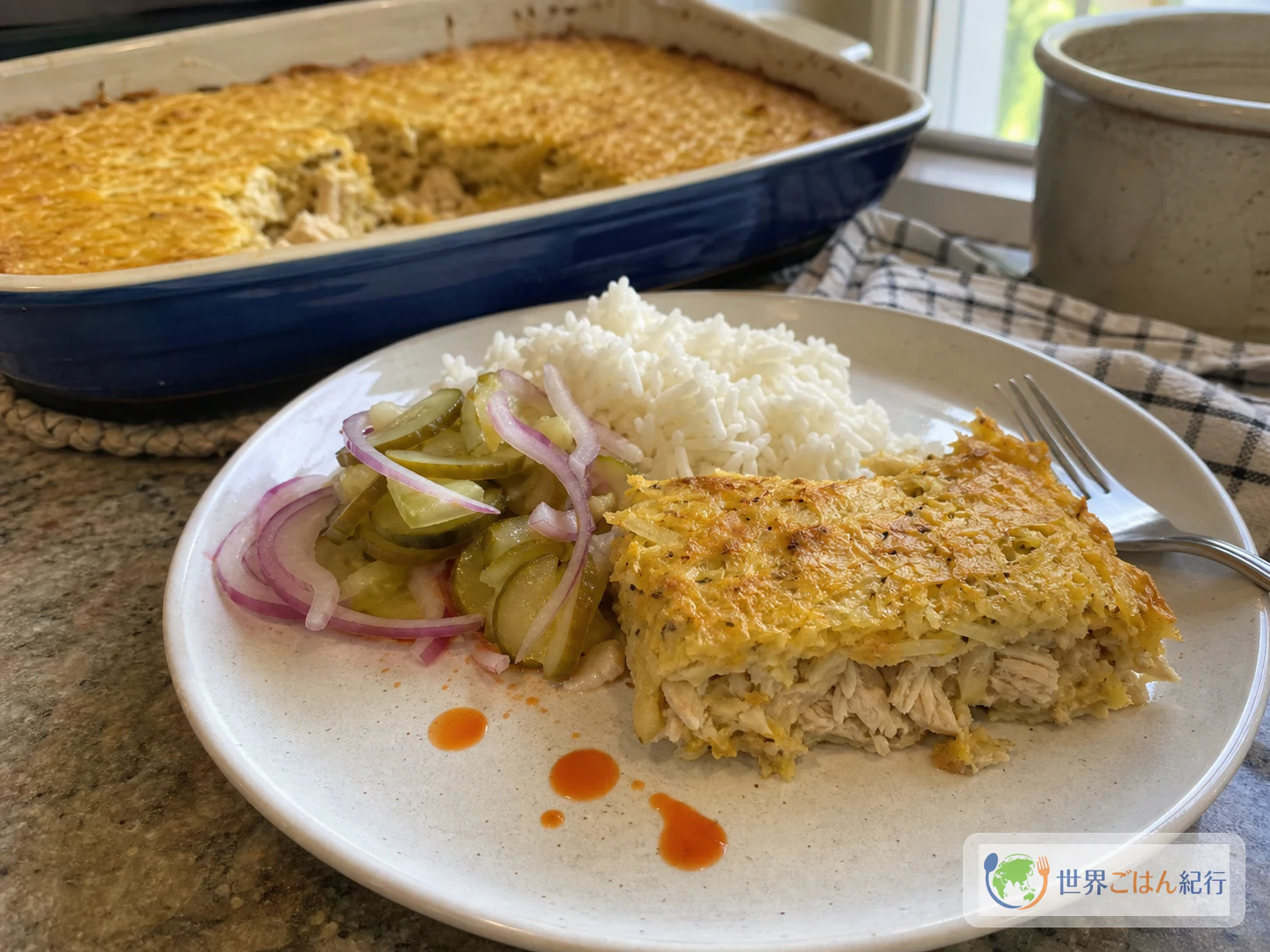
Pom: Suriname's Baked Chicken and Taro Casserole
Ingredients
Root batter
| Ingredient | Amount | Substitutes & notes |
|---|---|---|
| Frozen taro or taro root | 1.75 lb (850 g) | Weight after peeling. If frozen taro root, thaw and pat dry |
| Orange juice | ¾ cup (160 ml) | 100% juice also works. If it is a very sweet product, reduce the sugar |
| Lemon juice | 2 tbsp | Lime juice also works |
| Melted butter | 1 oz (30 g) | Can be made with 2 tbsp vegetable oil, but the aroma is lighter |
| Sugar | 2 tsp | 1 tsp if the citrus is sweet |
| Salt | 3/4 tsp | Adjust at the end according to the saltiness of the chicken's juices |
| Nutmeg | 1/4 tsp | Too much tastes medicinal |
| Allspice | 1/4 tsp | A warm aroma. If none, use a little more black pepper |
Chicken and sauce
| Ingredient | Amount | Substitutes & notes |
|---|---|---|
| Chicken thighs | 1.5 lb (650 g) | 1.75 lb (750 g) if bone-in. Boneless in 1.5 inches (4 cm) cubes |
| Salt | 1 tsp | To season the chicken |
| Black pepper | 1/2 tsp | Coarsely ground |
| Onion | 1, 7 oz (200 g) | 0.5 inches (1 cm) dice |
| Garlic | 3 cloves | Finely chopped |
| Tomatoes | 2, 10.5 oz (300 g) | 0.5 inches (1.5 cm) dice. 7 oz (200 g) if canned tomatoes |
| Celery leaves or parsley | 15 g | Coarsely chopped |
| Tomato paste | 1 tbsp | Adds color and richness to the juices |
| Lemon juice | 1 tbsp | Sourness for the chicken juices side |
| Water or chicken stock | ½ cup (150 ml) | To prevent scorching |
| Butter | 20 g | The fat for browning the chicken |
| Scotch bonnet-type pepper sauce | 1/4 tsp | If you dislike heat, do not put it in the pot; add a few drops at the table |
Steps
1Grate the taro
20 min
No heat. While semi-thawed, peel off the skin and hard parts of 1.75 lb (850 g) frozen taro or taro root and cut into 2 to 3 cm cubes. If your hands itch, wear gloves. Grate coarsely on a box grater, and chop long-fibered parts on a board to about 0.5 inches (1 cm). If using frozen taro root, microwave it at 600 W for 6 minutes, until a skewer slides in easily and it crushes softly under a finger, then mash coarsely. Press out excess liquid with paper towels. Stop when fine grains and stickiness remain. The batter should not turn into a complete paste.
2Brown the chicken
10 min
Warm a frying pan over medium heat for 1 minute and melt 20 g butter. Rub 1 tsp salt and 1/2 tsp black pepper into 1.5 lb (650 g) chicken thighs cut into 1.5 inches (4 cm) cubes, until the salt is worked evenly into the surface and no watery liquid remains. Arrange them skin side or fattier side down, cook for 3 minutes, turn and cook for 2 more minutes, and take them out when the surface has taken a light brown. Do not cook them through here. Stop when brown savory bits remain on the bottom of the pan and about 1 tbsp of fat rendered from the chicken is left.
3Simmer the chicken citrus sauce
18 min
Lower the same pan to medium-low heat and add 7 oz (200 g) onion cut into 0.5 inches (1 cm) dice and 3 cloves finely chopped garlic. Cook for 4 minutes until the onion is translucent, add 10.5 oz (300 g) tomatoes, 1 tbsp tomato paste and 15 g celery leaves or parsley, and cook down for 3 minutes. Return the chicken, and add ½ cup (150 ml) water or chicken stock, 1 tbsp lemon juice and 1/4 tsp Scotch bonnet-type pepper sauce. Lower to low heat and cook for 8 minutes, until the surface bubbles gently and dragging a wooden spoon across the bottom leaves a trail in the red juices for about 1 second.
4Mix the juices and citrus into the root batter
8 min
No heat. Take the chicken out onto a plate and measure out about ½ cup (100 ml) of the juices in the pan. To the grated root, add ¾ cup (160 ml) orange juice, 2 tbsp lemon juice, 1 oz (30 g) melted butter, 2 tsp sugar, 3/4 tsp salt, 1/4 tsp nutmeg, 1/4 tsp allspice and the measured juices. Mix with a wooden spoon for about 2 minutes. It is right when white streaks of root are fewer and the whole is pale orange and falls in a thick drizzle. If it is watery, leave it 5 minutes to let the root absorb it before moving on.
5Layer in the baking dish
10 min
No heat. Preheat the oven to 400°F (200°C). Lightly grease the inside of the baking dish with butter or oil and spread half the root batter on the bottom to a thickness of about 0.5 inches (1 cm). Layer the chicken and sauce in the center, not packing it to the edge, and leave a margin of about 0.5 inches (1 cm) around. Put the remaining root batter on top and level it with a spatula. No browning is needed yet. Thin spots scorch easily, so spread the batter evenly to the corners. Keep going until the chicken is hidden and the batter springs back when you press it lightly.
6Bake in the oven
75 min
Cover the baking dish loosely with aluminum foil and bake in a 400°F (200°C) oven for 35 minutes. By then the heat should reach the center and the juices should bubble at the edge of the dish. Remove the foil, lower the oven to 350°F (180°C) and bake 35 to 40 minutes more. Take it out when the surface is golden, the oil at the edge foams finely, and pressing the center gives back springiness rather than liquid. If only the surface is getting too dark, put the foil back for the last 15 minutes.
7Check the internal temperature and rest
12 min
No heat. When it comes out, leave it on a rack for 5 minutes, then insert an instant-read thermometer into the chicken at the center. If it has reached 165°F (74°C) or more, rest it 7 more minutes. If not, return it to a 350°F (180°C) oven, add 5 minutes at a time, and check again. During the rest the batter settles, so the juices are less likely to run out when you cut it. Wet the knife before cutting, and the browned surface comes off less.