Ingredients and steps on one page. Print it, or choose “Save as PDF” in the print dialog.
Sekai Gohan
Callaloo: Trinidad and Tobago's Leafy Green Stew
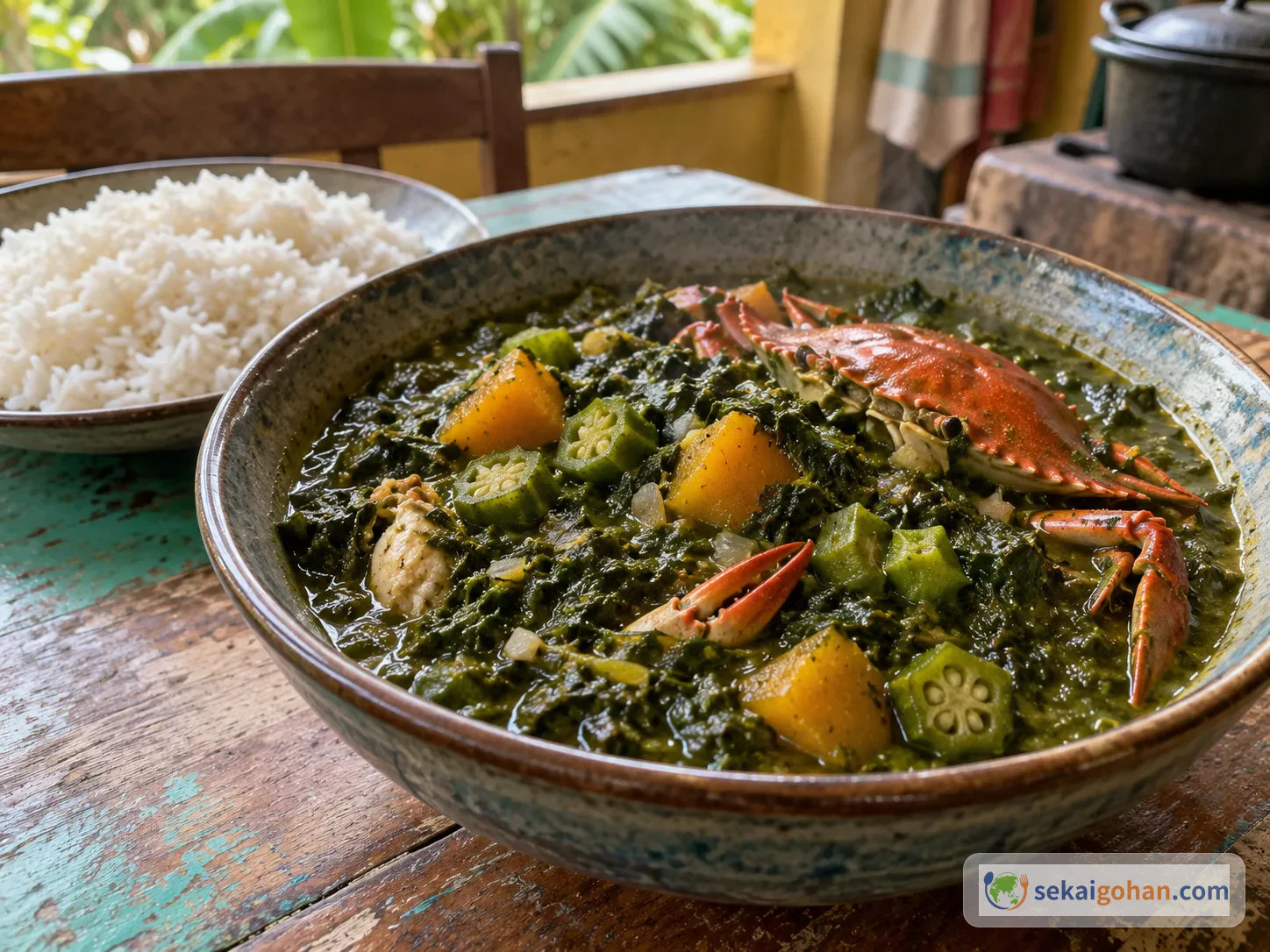
Ingredients
Leaves and main ingredients
| Ingredient | Amount | Substitutes & notes |
|---|---|---|
| Edible taro leaves (dasheen leaves) | 10.5 oz (300 g) | Young leaves labeled edible only. Spinach, 10.5 oz (300 g), can substitute. Never eat raw |
| Okra | 5.5 oz (160 g) (8–10 pods) | Cut 0.5 inches (1 cm) wide; it builds the body |
| Pumpkin | 5.5 oz (150 g) | Peel and seed, cut in 1 inch (2 cm) cubes. Adds sweetness close to local pumpkin |
| Crab (swimming crab for cooking) | 2 (about 10.5 oz (300 g) in total) | Can change to 7 oz (200 g) salted pork, or a vegetable version without crab |
| Cooked rice | 1.25 lb (600 g) (cooked) | Omit if you eat it as a stew instead of a rice dish |
Coconut broth and aromatics
| Ingredient | Amount | Substitutes & notes |
|---|---|---|
| Coconut milk | 1¾ cups (400 ml) | Canned or carton. Thickness varies, so use it all first and adjust with water at the end |
| Water | ¾ cup (200 ml) | Used at the start of simmering. To thin, add 3.5 tbsp (50 ml) more at a time |
| Onion | 3.5 oz (100 g) (1/2) | Minced into 0.25 inch (5 mm) pieces |
| Garlic | 2 cloves (about 10g) | Minced |
| Celery | 20g | Cut 0.125 inch (3 mm) wide. If you dislike it, don't omit it; use 10g to soften the aroma |
| Scallion or chives | 20g | Cut 0.25 inch (5 mm) wide. Stands in for local spring chive |
| Bell pepper | 1/2 (about 1.75 oz (50 g)) | Stands in for pimento pepper. Use apart from the hot chile |
| Fresh thyme | 2 sprigs | 1/2 tsp if dried |
| Parsley | 5g | Minced. An aromatic supplement to match the Tobago tourism board's ingredients |
| Unsalted butter | 15g | 1 tbsp (15 ml) vegetable oil can substitute. Use unsalted for the salted pork version |
| Scotch bonnet pepper | 1 | Use whole. To reduce heat, 1/4 habanero or 1 green chile. Optional |
| Salt | start with 2g and adjust | Starting amount for the crab version. For the salted pork version, add only after tasting at the end |
Steps
1Prep the leaves
Check the edible label and confirm they are young leaves. Then rinse 10.5 oz (300 g) of edible taro leaves under running water. Remove the tough stems and cut into 3–4 cm strips. Do not taste them raw. Boil in plenty of boiling water for at least 30 minutes until fully cooked, then drain and discard the water. If the seller gives precise instructions, follow them first. For 10.5 oz (300 g) of spinach, cut into 3–4 cm strips, boil in boiling water for 1 minute, plunge into cold water and squeeze hard. Do not use taro leaves with no edible label, and do not cook wild or foraged leaves. Time is 10 minutes for spinach and more than 35 minutes for taro leaves. The leaves are ready for the pot when they are completely wilted and the excess water has run off.
2Cut the aromatics and fillings
Cut the onion into 0.25 inch (5 mm) pieces, mince the garlic, cut the celery and bell pepper 0.125 inch (3 mm) wide, the scallion 0.25 inch (5 mm) wide, the pumpkin into 1 inch (2 cm) cubes, and the okra 0.5 inches (1 cm) wide. Cutting evenly keeps differences in doneness small. Wash the surface of the crab shells and split the 2 swimming crabs for cooking in half. For the salted pork version, soak 7 oz (200 g) in water for at least 8 hours, change the water, bring it to a boil in a separate pot over medium heat, simmer 5 minutes after it boils, and discard the water. The prep is done when the water is cloudy white, the surface of the meat has firmed up and the strong salty smell has faded. Use the Scotch bonnet whole, uncut. Even when you want less heat, do not chop the seeds and scatter them. Time is 20 minutes. If the pumpkin corners are even and you can see body on the cut surface of the okra, the ingredients are ready.
3Simmer the fillings soft in water
Melt 15 g of unsalted butter in a heavy deep pot over medium-low heat. Sauté the onion, garlic, celery and bell pepper for only 2 minutes. Do not brown them. Add the prepped leaves, okra, pumpkin, thyme, parsley, crab or salted pork, Scotch bonnet and ¾ cup (200 ml) of water. When it boils, lower to low heat, cover, and simmer about 30 minutes for both the crab and the salted pork versions. For the salted pork version, simmer until the pieces are soft. Move on when the pumpkin crumbles when pressed with a wooden spoon, the okra is soft and no fibers of the leaves remain. If the water is about to disappear from the bottom, add just 3.5 tbsp (50 ml).
4Add the coconut milk and bring the flavor together
When the vegetables are soft enough, add 1¾ cups (400 ml) of coconut milk and simmer over low heat for about 10 minutes. Do not keep it at a hard boil; keep it so that small bubbles come up at the edge of the pot. It is almost done when the white liquid has mixed evenly into the green broth and the pumpkin has fallen apart. Also check whether the crab meat has turned opaque, or, for the salted pork version, whether the meat is hot through to the center. For the crab version, add 2 g of salt. For the salted meat version, taste first and add no salt. Time is 10 minutes. To thicken the broth, remove the lid and reduce the liquid for only the last 2 minutes. If it is about to scorch, add 3.5 tbsp (50 ml) of water.
5Remove the crab and chile, and swizzle
Take out the crab shells, the thyme sprigs and the Scotch bonnet. For the salted pork version, leave the meat in the pot or divide it into pieces that are easy to eat. Then, imitating the Trinidadian swizzle, mash with a wooden spoon or masher for about 1 minute. The trick is not to make a complete paste, but a thick puree that still has a little of the leaf fragments and the body of the okra. If you use an immersion blender, press the blade to the bottom of the pot so the hot liquid does not splash. If the body is too strong, add water 3.5 tbsp (50 ml) at a time. Finally, taste, add salt, and adjust so it flows thickly from a spoon if for rice, or thinly if for soup. Time is 5 minutes.