Ingredients and steps on one page. Print it, or choose “Save as PDF” in the print dialog.
Sekai Gohan
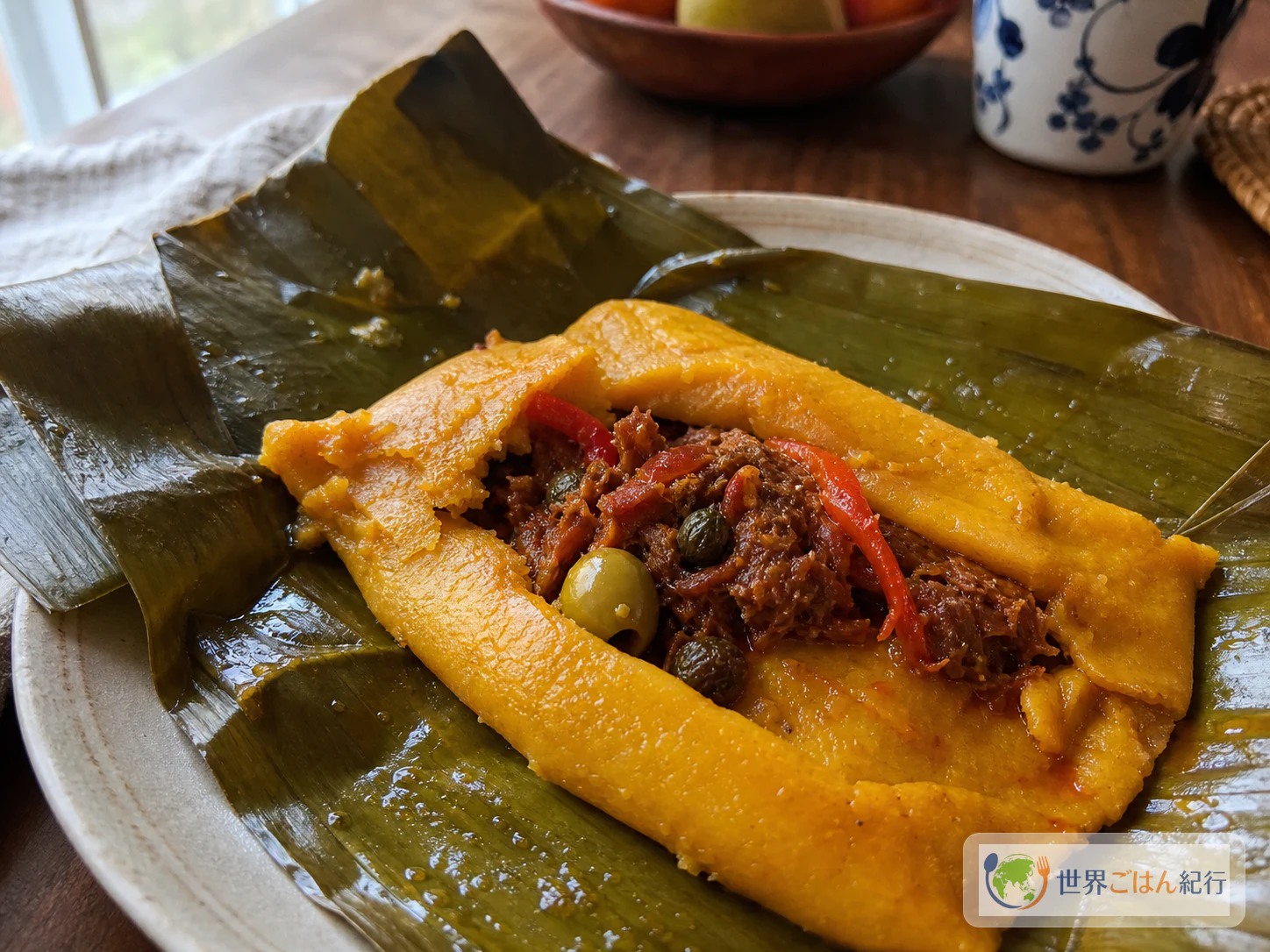
Hallaca: Venezuela's Holiday Banana-Leaf Parcels of Corn Masa and Stewed Meat
Ingredients
Meat guiso
| Ingredient | Amount | Substitutes & notes |
|---|---|---|
| Beef chuck or beef shank | 10.5 oz (300 g) | 0.5 inches (1.5 cm) cubes. A cut that shreds when stewed is suitable |
| Pork shoulder | 9 oz (250 g) | 0.5 inches (1.5 cm) cubes. If too lean, the guiso dries out |
| Chicken thighs | 9 oz (250 g) | 1 inches (2 cm) cubes. You can remove the skin |
| Onion | 7 oz (200 g) | Minced to 0.25 inch (5 mm) |
| Red bell pepper | 5.5 oz (150 g) | Half for the guiso, half cut into strips for garnish |
| Green bell pepper | 2.75 oz (80 g) | 0.25 inch (5 mm) dice. Adds a green aroma |
| Long green onion or scallions | 2 oz (60 g) | Sliced thin |
| Garlic | 20 g | About 4 cloves, minced |
| Tomato | 9 oz (250 g) | 0.5 inches (1 cm) dice. If using canned diced tomatoes, 7 oz (200 g) |
| White wine | ½ cup (100 ml) | 3.5 tbsp (50 ml) cooking sake and 3.5 tbsp (50 ml) water also works |
| Chicken broth | 1¼ cups (300 ml) | Leaning unsalted, adjusting the salt later |
| Capers | 1 oz (30 g) | Also use 2 tsp of the brine |
| Green olives | 24 | Pitted ones are easier to handle |
| Raisins | 1.75 oz (50 g) | If you dislike sweetness, reduce to 1.25 oz (35 g) |
| Ground cumin | 1 tsp | Pulls the meat aroma together |
| Paprika | 2 tsp | Adds color and a sweet aroma |
| Salt | 1 1/2 tsp | If using adobo, start at 1 tsp |
| Black pepper | 1/2 tsp | Coarsely ground |
| Neutral oil | 2 tbsp | For the guiso |
Corn dough and wrapping
| Ingredient | Amount | Substitutes & notes |
|---|---|---|
| Masarepa | 1 lb (500 g) | Precooked corn flour such as Harina P.A.N. Cornstarch won't work |
| Warm chicken broth | 3 cups (700 ml) | Around 60 degrees C. Cold broth doesn't blend with the flour easily |
| Annatto oil | ½ cup (90 ml) | Heat 2 tbsp annatto seeds in ½ cup (120 ml) oil over low heat and strain |
| Salt | 1 tsp | Adjust for the saltiness of the broth |
| Frozen banana leaves | 8–10 sheets | At least 12 inches (30 cm) square. Include some for patching tears |
| Kitchen string | about 8 m | 80–100 cm per hallaca |
| Neutral oil | 2 tbsp | Brushed thin on the leaves |
Garnishes
| Ingredient | Amount | Substitutes & notes |
|---|---|---|
| Green olives | 16 | 2 per hallaca |
| Raisins | 1.5 oz (40 g) | 5 g per hallaca |
| Capers | 20 g | Salty, so don't scatter too many |
| Red bell pepper strips | 2.75 oz (80 g) | About 0.25 inch (5 mm) wide |
Steps
1Stew the meat guiso
55 min
Heat/temperature: stir-fry over medium heat, then simmer gently over low heat
Coat the beef, pork, and chicken with 1 tsp salt, black pepper, cumin, and paprika and leave for 10 minutes. Heat the oil in a pot over medium heat, add the meat, and stir-fry about 6 minutes until the surface changes color. Add the 0.25 inch (5 mm)-diced onion, 0.25 inch (5 mm)-diced green bell pepper, half the red bell pepper, and the garlic, and cook 8 minutes until the vegetables are softened and fragrant. Add the tomato, white wine, broth, and caper brine, and when it boils, lower to low heat and simmer 35 minutes. Stop when the meat has fallen apart and about 4 tbsp of liquid remains at the bottom of the pot.
2Knead the dough with annatto oil
18 min
Heat/temperature: oil over low heat at about 80 degrees C; the dough is not heated
In a small pot, put ½ cup (120 ml) neutral oil and 2 tbsp annatto seeds and warm over low heat for 3 minutes. When the oil turns orange and fine bubbles come from the seeds, turn off the heat, strain, and use ½ cup (90 ml). In a large bowl, put 1 lb (500 g) masarepa and 1 tsp salt and mix in 3 cups (700 ml) warm broth in 3 additions. Add the annatto oil and knead by hand for 4 minutes. A good sign is that the dough is softer than an earlobe and a crack made with a finger closes slowly.
3Soften the banana leaves
15 min
Heat/temperature: briefly warm over steam or low heat
Rinse the thawed banana leaves under running water and wipe dry with a cloth. Shave thick parts of the hard midrib thin with a knife, and cut eight 12 inches (30 cm) squares and a few 4 inches (10 cm) squares for patching. Warm each side over a steaming pot for 30 seconds, or pass each side about 6 inches (15 cm) above a low flame for 5 seconds. They are ready when they bend without cracking and the surface has a sheen. Stop before black scorch marks appear.
4Spread the masa on the leaves
20 min
Working temperature: room temperature; don't let leaves or dough dry out
Place a banana leaf on the work surface and brush the surface thinly with oil. Take about 4 oz (110 g) dough, set it in the center, and spread it into a rectangle 0.25 inch (5–6 mm) thick, about 7 inches (18 cm) tall by 5.5 inches (14 cm) wide. If the edge is made too thin it tears when wrapping, so leave the outer 0.5 inches (1 cm) slightly thicker. A little water on your hands keeps the dough from sticking to your fingers.
5Add the guiso and garnishes
15 min
Working temperature: room temperature; let the guiso cool slightly
Place about 3 tbsp of the cooled guiso in a long strip down the center. Top with 2 olives, 5 g raisins, a few capers, and strips of red bell pepper. If you spread the filling to the edges it will come out at the seam, so leave at least 1 inches (3 cm) of margin on each side. If the guiso is hot the dough loosens, so wait until the heat has dissipated and the oil has set a little before wrapping.
6Fold the leaf and tie with string
25 min
Working temperature: room temperature; keep a cloth over the dough while wrapping
Lift the left and right sides of the leaf and close at the center so the edges of the masa meet. Fold the whole leaf over to one side, folding in the top and bottom ends to make a rectangular parcel. Layer a patch leaf over any tears. Tie the string once lengthwise and twice crosswise, leaving enough slack for one finger to fit. If tied too tightly, the dough swells during boiling, pushes on the leaf, and splits it.
7Simmer gently in a large pot
45 min
Heat/temperature: after boiling, medium-low heat with small bubbles at 90–95 degrees C
Bring 3.25 quarts (3 L) water to a boil in a deep pot and add 1 tsp salt. Add the hallacas without overlapping, and if they float, hold them down lightly with a plate or drop lid. When it boils again, lower to medium-low and simmer 45 minutes with small bubbles rising from the sides of the pot. If the water dances violently the leaves tend to unravel, and if too weak the heat doesn't reach the center. Turn them over once midway so the whole parcel is submerged.
8Rest, then open the leaf
10 min
Heat/temperature: turn off the heat and let it settle on residual heat
Lift the boiled hallacas out with tongs and rest on a sieve for 10 minutes. If opened right away the dough collapses easily from the steam, so wait until the surface moisture settles. Undo the knot of the string and open the leaf wide to each side. It's done when the masa holds its shape, the guiso at the center is hot, and the leaf's aroma has transferred. At the table, use the leaf as a plate and serve from it.