Ingredients and steps on one page. Print it, or choose “Save as PDF” in the print dialog.
Sekai Gohan
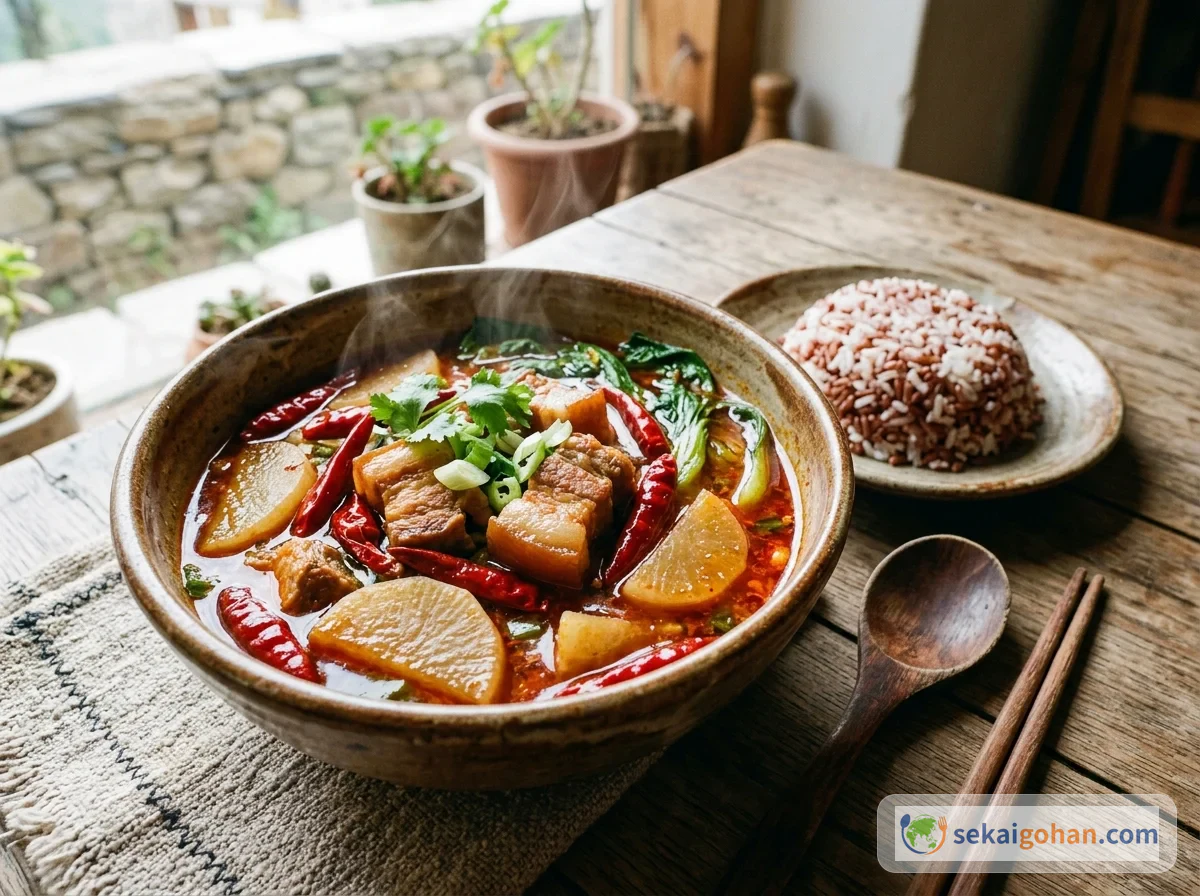
Phaksha Paa: Bhutanese Pork Belly and Radish Stew with Red Chilies
Ingredients
Main
| Ingredient | Amount | Substitutes and notes |
|---|---|---|
| Pork belly (in a block) | 14 oz (400 g) | Skinless. Mixing in 3.5 oz (100 g) of pork shoulder lightens the fat |
| Daikon radish | 14 oz (400 g) | About 1/3 of a large daikon. Peeled. Turnip also works |
| Onion | 1 (7 oz (200 g)) | Coarsely chopped |
| Dried red chilies | 6 | For less heat use 4. Removing the seeds makes it milder still |
| Komatsuna (or other leafy greens) | 3.5 oz (100 g) | Spinach or bok choy also works |
| Water | 1¼ cups (300 ml) | The daikon releases liquid, so do not start with too much |
| Salt | 1/2 tsp | Taste at the end and add more |
Aromatics and spices
| Ingredient | Amount | Substitutes and notes |
|---|---|---|
| Garlic | 2 cloves | Minced |
| Ginger | 1 piece (about 20 g) | Minced. It can also be added near the end |
| Turmeric | 1/2 tsp | Source of color and an earthy aroma. You can make it without |
| Coarsely ground black pepper | 1/4 tsp | White pepper also works |
| Sichuan peppercorns (whole) | 1/4 tsp | Optional. A small amount of ground sansho pepper can substitute |
| Asafetida | 1/8 tsp | Optional. Adds a flavor similar to onion and garlic. Fine without |
| Ghee | 1 tbsp | Optional. Butter can substitute |
On the side (red rice)
| Ingredient | Amount | Substitutes and notes |
|---|---|---|
| Rice | 2 cups | Ordinary white rice. 2 rice-cooker cups, about 360 ml |
| Red rice | 2 tbsp | Cook it mixed into the white rice. Brown rice gives a similar texture |
Steps
1Cut the ingredients
10 min
Cut the pork belly into 1 inch (2 cm) cubes. Take it out of the refrigerator and leave it for 10 minutes, and the heat will reach the middle more easily. Peel the daikon and cut it into 0.5 inch (1.5 cm)-thick quarter-rounds or half-moons. Coarsely chop the onion, mince the garlic and ginger, and cut the komatsuna into 1.5 inches (4 cm) lengths. Snap the stems off the dried chilies with your fingers. If you are removing the seeds, break them open and shake the seeds out. Wear gloves, or take care not to rub your eyes with hands that have touched them.
2Brown the pork belly
8 min
With no oil in a heavy pot, add the pork belly and set over medium heat. Leave it alone for 4 to 5 minutes, and when one side has browned, turn it, for about 8 minutes of browning in all. Move on when 2 to 3 mm of pork fat has pooled on the bottom of the pot and the corners of the meat are light golden. If there is too much fat, leave just 2 tablespoons and blot the excess with paper towels, or take it out. On low heat, liquid comes out of the meat and you end up with boiled meat rather than browned.
3Fry the onion, garlic, and ginger
4 min
Add the onion directly to the pot with the pork fat still in it. Fry over medium heat for 3 minutes, until translucent and lightly colored at the edges. Add the garlic and ginger, fry 1 minute until fragrant, then lower the heat. If you are using ghee, add 1 tablespoon here. If it looks like it will stick, add 1 tablespoon of water and scrape up the bottom of the pot.
4Add the spices, chilies, and daikon
4 min
Add 1/2 tsp turmeric, 1/4 tsp black pepper, and if using, the Sichuan peppercorns and asafetida, and stir everything for about 30 seconds. If the powder starts to scorch on the bottom, lower the heat. Then add the dried chilies and daikon and fry over medium heat for 3 minutes. When the surface of the daikon has taken on the fat and looks slightly translucent, it is the signal to add water. Chilies turn bitter if they blacken, so stop while they are still red to slightly darker red.
5Add water and simmer
35 min
Add 1¼ cups (300 ml) of water and 1/2 tsp of salt and bring to a boil over high heat. When it boils, skim off the scum, cover, and simmer on low for 30 to 35 minutes. At first the liquid will not quite cover the daikon. Stir once from the bottom every 10 minutes, and check that the broth goes from thin to slightly thickened. It is done when a chopstick slides easily through the pork belly and a bamboo skewer goes into the translucent daikon without resistance. If the liquid is low and it is about to scorch, add 3.5 tbsp (50 ml) of water at a time; if there is too much, take off the lid for the last 5 minutes. The finished broth is reddish, with fat floating on the surface in rings.
6Add the komatsuna and adjust the seasoning
3 min
Add the komatsuna cut to 1.5 inches (4 cm), stems first for 1 minute, then the leaves for 1 minute, stirring without a lid. It is enough when the broth comes together thickly and the leaves wilt. Overcooking dulls the green, so work quickly. Taste, and add salt 1/4 tsp at a time. If it is not hot enough, add a little chopped dried chili. Turn off the heat and leave for 2 minutes to let the flavor settle.
7Plate with red rice
5 min
Fluff the rice mixed with red rice and put it on a plate, and ladle a generous serving of the stew beside it. The broth has body, so it is fine to spoon it over the rice. It looks nice when the pork belly, daikon, greens, and chilies all show on one plate. Eat while hot. As it cools the fat turns white and sets.