Ingredients and steps on one page. Print it, or choose “Save as PDF” in the print dialog.
Sekai Gohan
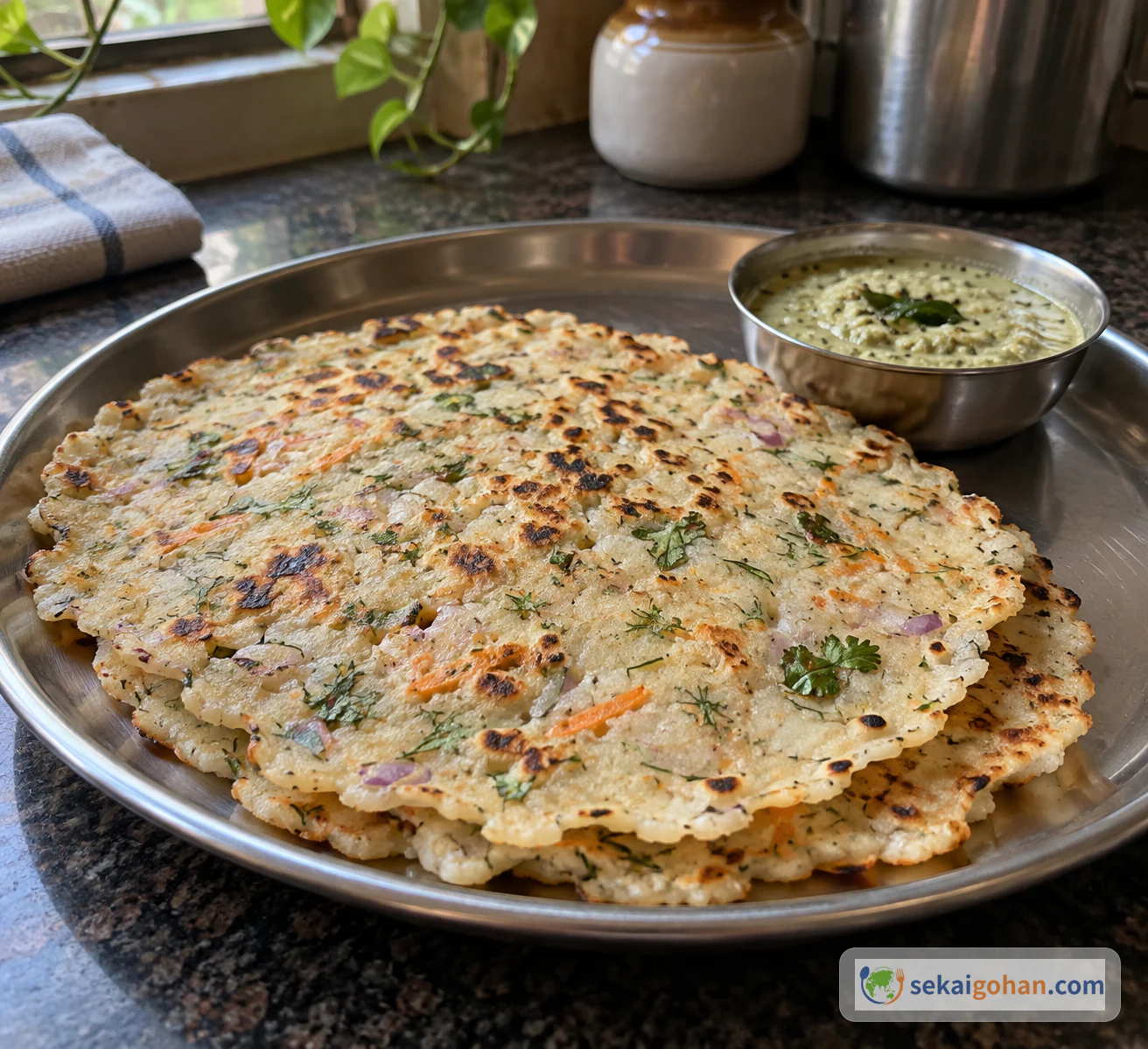
Akki Rotti: Karnataka Rice-Flour Flatbread with Onion, Dill and Coconut
Ingredients
| Ingredient | Amount | Role |
|---|---|---|
| Fine rice flour | 2 cups | The body of the dough. Measured by volume |
| Onion, large | 1 | Finely chopped. Salted first so its juices help bring the dough together |
| Carrot, small (optional) | 1 | Grated. Adds sweetness and moisture |
| Dill (sabbasige soppu) (optional) | 1/4 cup | Chopped. Its grassy aroma is characteristic |
| Freshly grated coconut | 1/4 cup | Texture and a sweet aroma |
| Green chillies | 3 | Finely chopped. Heat |
| Curry leaves | 12 | Torn |
| Cumin seeds | 1 tsp | Aroma |
| Coriander leaves (optional) | 1/4 cup | Chopped. A separate amount from the dill |
| Salt | 1 tsp | All of it goes onto the onion at the start |
| Hot water | about 1 1/4 cups | Added a little at a time; stop when the dough feels right |
| Coconut oil | 4 tbsp | For greasing the tawa and a few drops into the holes in each rotti |
| Water for wetting your fingers | As needed | Kept separate from the dough water |
Steps
1Salt the onion and let it stand for 5 minutes
Chop the onion finely, mix in the full 1 tsp of salt, and leave it for 5 minutes. Moisture will start to come out of the onion. Do not throw this liquid away; it goes into the dough with the onion, which is why the hot water is added gradually later.
2Combine the flour, vegetables, herbs and spices
In a wide bowl, combine the rice flour, the salted onion with its juices, the grated carrot, dill, grated coconut, green chillies, curry leaves and cumin seeds. Add the coriander leaves here too. Mix so the vegetables and herbs are spread evenly through the flour.
Do not add any more salt. The one teaspoon is already in the onion.
3Add hot water a little at a time
Pour in the hot water a little at a time. It needs to be hot, but not straight off the boil. Start mixing with a wooden spatula, and once the dough is cool enough to handle, finish bringing it together with your hands.
Aim for a dough softer than chapati dough: it sticks slightly to your fingers but still gathers into a mass. If it is too firm, it cracks as you spread it; if it is too soft, it is hard to lift off the pan. You may not need all of the water. This is not a dough to knead; rice flour has no gluten to develop.
4Divide the dough just before cooking
Make the dough right before you plan to cook, and divide it into lemon-sized balls. The size you choose decides how many rotti you get.
5Spread the dough on a cold tawa
With the tawa off the heat and cold, brush it thinly with coconut oil and place a ball of dough on it. Wet your fingers and push the dough outward into a thin round about 8 inches across (about 20.3 cm). Keep the thickness even so the edges don't become much thinner than the middle. Starting cold gives you time to shape with your fingers; never shape the dough with your fingers on a hot tawa.
Finish by poking three small holes in the round with a fingertip.
6Oil the holes, cover and cook over medium heat
Drop a little coconut oil into each of the three holes, from the 4 tbsp you set aside. Cover with the lid, then put the tawa over medium heat and cook for about 4 minutes. Move on when the wet sheen has gone from the top surface and brown spots have formed underneath.
7Loosen the edge, flip and cook the second side
Remove the lid, loosen the edge with a spatula, and turn the rotti over. Cook uncovered for about 2 minutes, until the second side also has brown spots and smells toasty. Lift it off and serve. A thinner round or stronger heat shortens the time.
8Cool the pan before the next rotti
Before you spread the next ball, the tawa needs to be cold again. Turn off the heat and let it cool naturally, or switch to a cool spare pan while the first one cools; this is editorial guidance that has not been tested. Khaana cools its tawa under running water for 1 minute, but pouring water on a hot pan can damage some pans or be unsafe, depending on the material, so that is not recommended here for every pan. Repeat steps 5 to 8 with the remaining dough.