Ingredients and steps on one page. Print it, or choose “Save as PDF” in the print dialog.
Sekai Gohan
Aloo Paratha: North India's Potato-Stuffed Griddle Flatbread
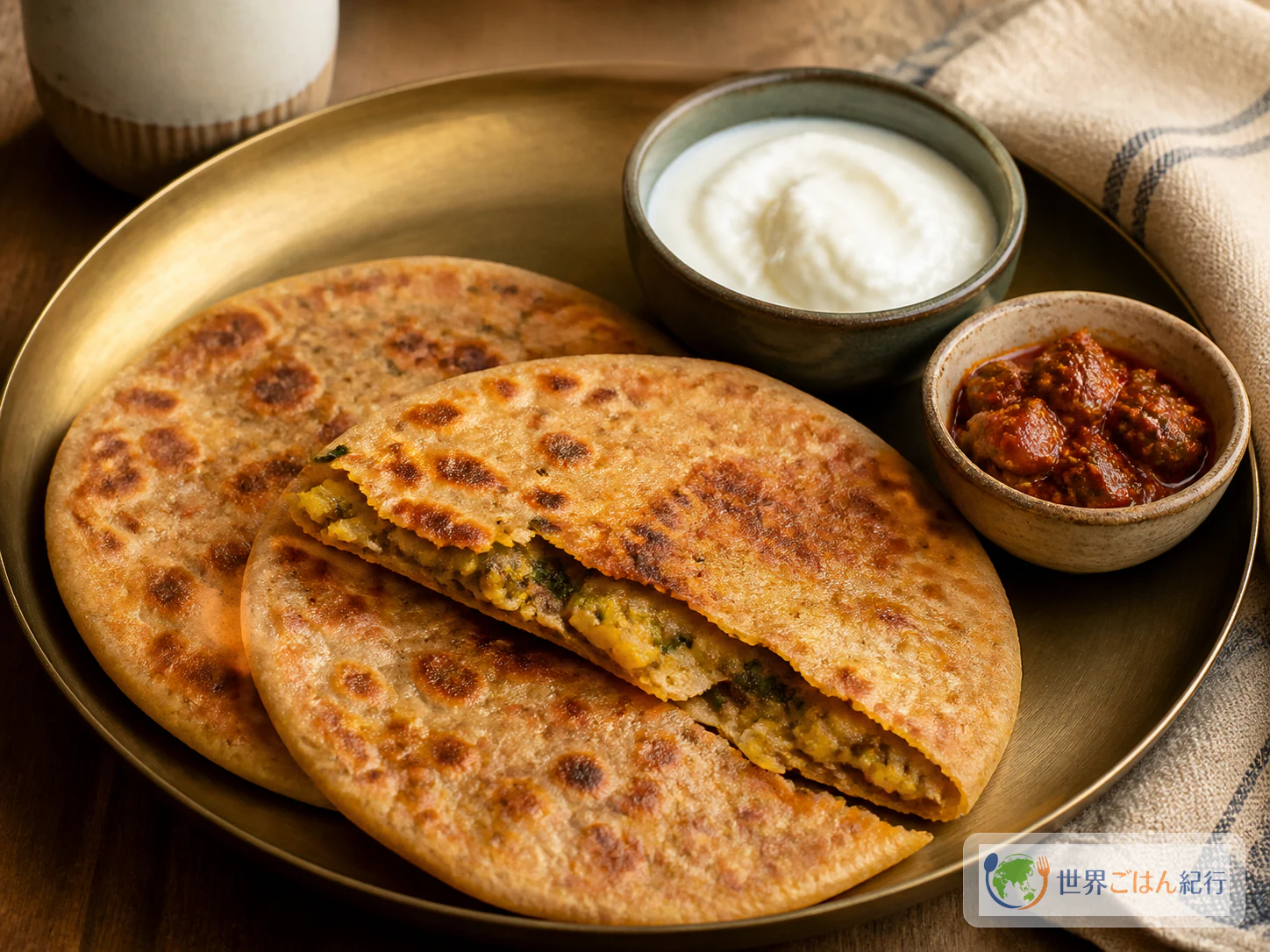
Ingredients
Dough
| Ingredient | Amount | Substitutes & notes |
|---|---|---|
| Atta (whole-wheat flour) | 300 g | 240 g whole-wheat flour plus 60 g cake flour also works |
| Salt | 5 g | A scant 1 tsp. The filling is salted too, so don't overdo it |
| Rice bran oil or vegetable oil | 15 ml | Makes the dough supple. Olive oil changes the aroma |
| Lukewarm water | 190–210 ml | 30–35°C (86–95°F). Don't add it all at once; adjust by how the dough comes together |
| Atta for dusting | 20 g | Use only when the dough sticks to the counter |
Potato filling
| Ingredient | Amount | Substitutes & notes |
|---|---|---|
| Potatoes | 1.25 lb (600 g) | Peeled and quartered. Floury potatoes are fluffy; waxy ones hold their shape |
| Ginger | 15 g | Finely chopped. Grating releases water, so chop with a knife |
| Green chili | 1 (about 8 g) | 1 shishito pepper plus a little chili powder also works |
| Cilantro | 1 oz (30 g) | 20 g scallion greens can stand in |
| Cumin seeds | 4 g | 1 tsp. 1/2 tsp if using ground cumin |
| Garam masala | 2 g | 1 tsp. If using curry powder you have, start with 1/2 tsp |
| Amchur | 2 g | 1 tsp. 1 tsp (5 ml) lemon juice also works, but not adding liquid to the dough makes it easier to wrap |
| Chili powder | 0.5 g | 1/4 tsp. Omit for less heat |
| Salt | 6 g | 1 tsp. Adjust by tasting, based on the weight of the potatoes |
For cooking and serving
| Ingredient | Amount | Substitutes & notes |
|---|---|---|
| Ghee or rice bran oil | 1.5 oz (45 g) | 3 tbsp. Use oil if avoiding dairy |
| Plain yogurt | 8.5 oz (240 g) | 2 oz (60 g) per person. Unsweetened plant-based yogurt if avoiding dairy |
| Indian mango pickle or other pickles | 2.75 oz (80 g) | 20 g per person. Japanese cucumber pickles also work |
Steps
1Boil the potatoes and drive off moisture
20 min
Peel 1.25 lb (600 g) potatoes, cut into quarters and put in a pot with water to cover. Bring to a boil over medium heat, then cook over medium-low heat for 12–15 minutes, until a bamboo skewer goes into the center without resistance, and drain. Return the pot to low heat for just 30 seconds to drive off moisture, then spread the potatoes on a tray to cool for 15 minutes. They are easiest to wrap when the surface is dry and they are just warm to the touch.
2Knead the dough and rest it
8 min + 20 min resting
Put 10.5 oz (300 g) atta, 5 g salt and 1 tbsp (15 ml) oil in a bowl, and mix in ¾ cup (190 ml) lukewarm water in 3 additions. When the dry flour disappears and it forms one mass, knead with the heel of your hand for 5 minutes, until the surface is smooth and springs back slowly when pressed. Only if dry cracks remain, add water 1 tsp (5 ml) at a time; cover and rest at room temperature for 20 minutes.
3Mash and season the filling
10 min
Mash the cooled potatoes with a fork so that no lump bigger than 0.25 inch (5 mm) remains. Add 15 g ginger, 8 g green chili, 1 oz (30 g) chopped cilantro, 4 g cumin seeds, 2 g garam masala, 2 g amchur, 0.5 g chili powder and 6 g salt and mix. If it is smooth, not sticky, and holds a round shape when squeezed in your hand, it has worked. If it's too soft, spread it out and let it sit 5 minutes before wrapping.
4Divide the dough and filling into 8
8 min
Divide the dough into 8 pieces of about 2.25 oz (65 g) each, and the filling into 8 balls of about 2.75 oz (75 g) each. Dust the surface of each dough ball lightly with flour, and press the center with your thumb to make a hollow about 3 inches (8 cm) wide. Set the filling in the center, gradually pull up the edges of the dough to enclose it, and pinch the seam shut firmly with your fingers. If you see a crack, reduce the filling and close it again.
Cooking on the tawa
5Roll the filled dough to 7–8 inches (18–20 cm)
15 min
Set it seam-side down on the counter and press gently with your palm to 0.5 inches (1 cm) thick. Dust lightly with flour and roll with a rolling pin from the center outward into a circle 7–8 inches (18–20 cm) in diameter and 2–3 mm thick. Pressing hard on one side only pushes the filling off to one side, so rotate the dough by 90 degrees each time and roll from the center with even pressure. If a small hole opens, close it with your fingers instead of piling on more flour.
6Cook both sides on a dry tawa
6 min per paratha
Preheat a tawa or heavy frying pan over medium heat for 3 minutes and lay the dough on it with no oil. Cook for 1 minute 30 seconds; when the surface color changes a little and light brown spots multiply on the underside, flip it. Cook the other side for 1 minute 30 seconds, and if there are still many white floury patches, add 30 seconds at a time. Starting over high heat sets only the outside first and leaves the potato in the center cold.
7Brush with ghee and finish toasty
2 min per paratha
Once both sides have color, lower the heat to medium-low, brush each surface with 1 tsp ghee or rice bran oil, and cook for 30–40 seconds per side, flipping as you go. Don't crush the center hard with a spatula; press the edge lightly to move the air pockets. It is done when dark brown spots appear on the surface and the dough bends supplely when you lift it. Lower the heat before it burns and check that the floury center is gone.
8Wrap in a cloth to keep it hot and serve with accompaniments
5 min
Stack the parathas on a plate right after taking them off the heat and wrap them loosely in a dry kitchen towel. Within 5 minutes add 2 oz (60 g) yogurt and 20 g pickle cut into bite-size pieces, and eat hot, tearing by hand. For any you won't eat right away, separate each with parchment paper, cool completely and move to an airtight container. If you seal them hot, steam makes the surface soggy and the toasty texture is lost.