Ingredients and steps on one page. Print it, or choose “Save as PDF” in the print dialog.
Sekai Gohan
Bagara Baingan Recipe: Hyderabad's Nutty, Tangy Baby Eggplant Curry
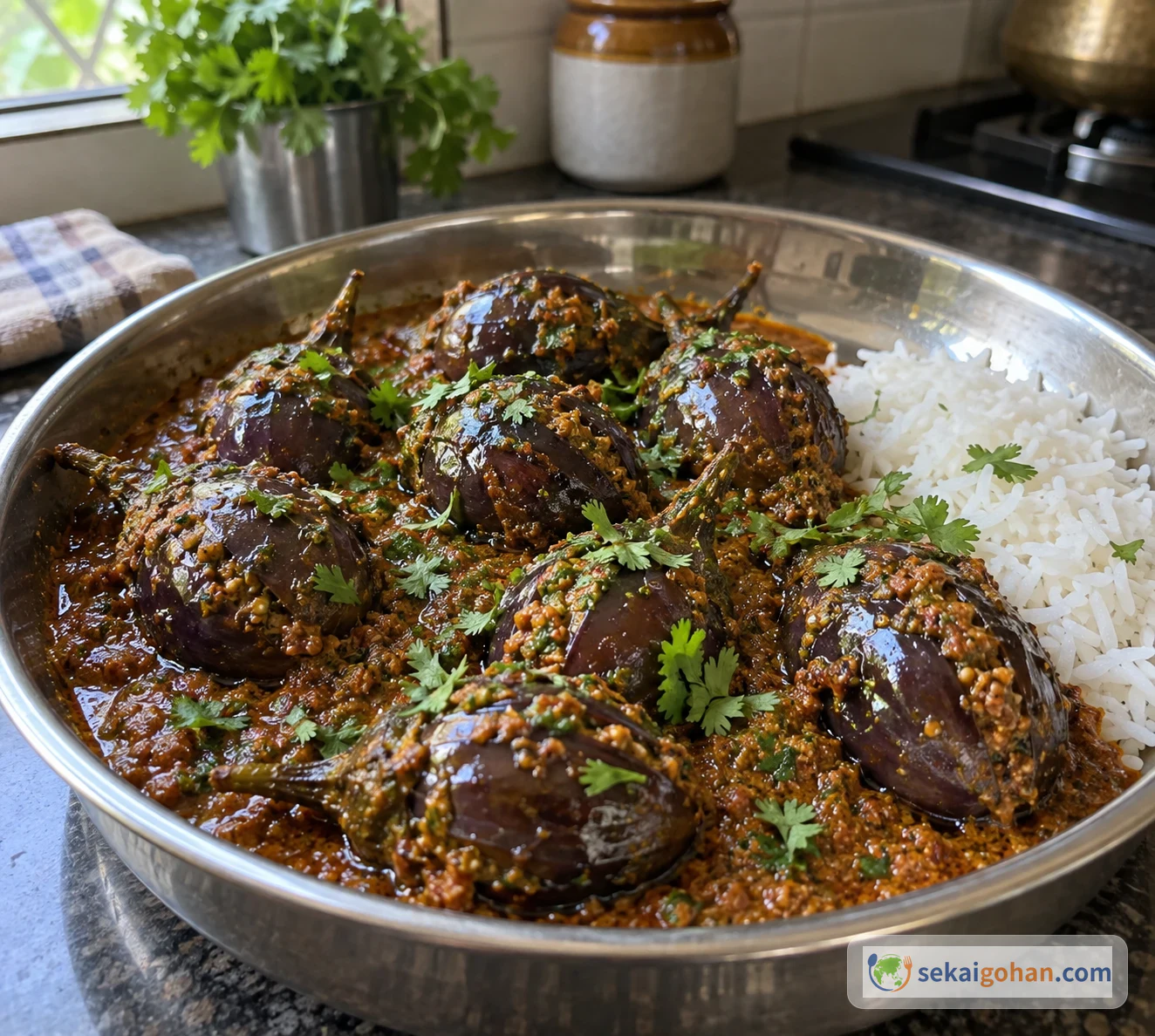
Ingredients
Toasty paste
| Ingredient | Amount | Substitutes & notes |
|---|---|---|
| Baby eggplants (purple, round or egg-shaped) | 8 (about 1.25 lb (600 g)) | Firm stems and few blemishes. With large eggplants, use 4 (about 1.25 lb (600 g)) cut lengthwise into 4–6 pieces and check early for collapsing |
| Unsalted peanuts (skin on) | 2.75 oz (75 g) | Avoid salted ones. Unsalted raw peanuts also work |
| White sesame seeds | 20 g (2 tbsp) | Black sesame changes the color and aroma. Ground sesame has a weaker roasted aroma |
| Unsweetened coconut (shredded or powdered) | 20 g (2 tbsp) | Fresh or frozen grated coconut also works; reduce the hot water according to its moisture |
| Hot water | ½ cup (120 ml) | For blending the paste. Don't make it too loose; add 2 tsp (10 ml) at a time only if needed |
For simmering the eggplants and sauce
| Ingredient | Amount | Substitutes & notes |
|---|---|---|
| Baby eggplants | the 8 above | Leave the stems on and cut 4 lengthwise slits |
| Onion | 5.5 oz (150 g) (1 medium) | Sliced 0.25 inch (5 mm) thick. Red onion works but changes sweetness and color |
| Ginger | 15 g | Minced. Tubed ginger is wet and needs longer cooking |
| Garlic | 10 g (2 cloves) | Minced. Scorching makes the sauce bitter |
| Oil | 2 tbsp (30 ml) | Neutral oil such as rice bran or canola. Split 1 tbsp (15 ml) for the eggplants, 1 tbsp (15 ml) for the sauce |
| Tamarind paste | 1.5 oz (45 g) | With block tamarind, use 2.75 oz (75 g) soaked in ¾ cup (180 ml) hot water for 15–20 minutes and strain the pulp. Adjust to the product's sourness |
| Hot water | ¾ cup (180 ml) | Dissolves the tamarind and sets the thickness of the sauce. If it threatens to scorch, add up to 3.5 tbsp (50 ml) more |
| Jaggery or dark brown sugar | 10 g | Rounds off the sharp edges of the acid. With raw cane sugar, start from 8 g and adjust |
| Cumin seeds | 2 g (1 tsp) | Ground cumin changes how the aroma rises |
| Turmeric | 1 g (1/4 tsp) | For color. Too much turns bitter |
| Coriander powder | 4 g (2 tsp) | The aromatic axis. If you have none, omit it rather than increasing the cumin |
| Red chile powder | 1 g (1/2 tsp) | Start with half for heat. Color and heat vary by type of chile powder |
| Salt | 6 g (1 tsp) | Split between the paste and the simmering liquid; adjust to the saltiness of the tamarind product |
| Curry leaves | 10–15 leaves | Add if available. If not, omit; don't force another leaf in as a substitute |
| Cilantro | 10 g | For finishing. Omit if you dislike it, though the local herbal feel will be weaker |
Steps
1Cut the eggplants and dry the surface
10 min
Wash 8 baby eggplants and wipe off all moisture completely with paper towels. If they are not dry, the oil will spatter in later steps. With the stems up, cut 4 lengthwise slits from the bottom to just short of the stem, about 2/3 of the length deep, so they open like a wedge. Leave the stem end uncut so the eggplants don't fall apart. If the slits are too shallow, the sauce won't reach the inside; if they cut through, the eggplants split easily later. Before moving on, check that the surface and the inside of the slits are dry and the shape holds.
2Dry-roast the nuts and sesame and make the paste
10 min
Set a frying pan over medium-low heat and dry-roast 2.75 oz (75 g) peanuts for 3–4 minutes, until pale golden and fragrant, then take them out. In the same pan, roast 20 g white sesame for 1–2 minutes until a few seeds pop, and finally add 20 g coconut and warm for just 30 seconds to release the aroma. Take it off the heat before the color turns dark brown. Let it cool for about 2 minutes, then transfer to a mortar or food processor and add ½ cup (120 ml) hot water 2 tsp (10 ml) at a time, making a thick paste with some grains remaining. It has worked when the powdery feel is gone and a spoonful drops in a clump. If blackened, scorched grains get mixed in, the bitterness cannot be removed, so don't reuse that batch.
3Sear the eggplant surfaces in oil
8 min
Put 1 tbsp (15 ml) oil in the pan, warm over medium heat for 30 seconds, and arrange the dried eggplants without overlapping. Turn them through all 4 sides, about 1 minute 30 seconds to 2 minutes per side, until the skin has a deep purple sear and small blisters. Take them out onto a plate when the area around the stem is slightly softened, pressing with chopsticks dents only the surface, and the eggplants hold their shape without toppling. Blackening them quickly over high heat, or softening them all the way through at this stage, makes them collapse in the final simmer. The goal here is not to cook through but to build a base that resists collapse and gives toasty flavor.
4Make the aromatic sauce and simmer the eggplants over low heat
25 min
Add the remaining 1 tbsp (15 ml) oil to the pan the eggplants came out of, put in 2 g cumin seeds and 10–15 curry leaves, and warm over medium heat for 30 seconds until the aroma rises and fine bubbles appear. Cook 5.5 oz (150 g) onion, sliced 0.25 inch (5 mm) thick, over medium-low heat for 6–8 minutes until translucent with edges pale golden, then add 15 g minced ginger and 10 g garlic and cook 1 more minute. Add the nut paste and cook over medium-low heat for 3 minutes, until oil seeps at the edges and the powdery feel is gone, then add the turmeric, coriander, chile and salt and stir for 1 minute. Add 1.5 oz (45 g) tamarind paste, ¾ cup (180 ml) hot water and 10 g jaggery and mix, and when the liquid boils, return the seared eggplants in a single layer. Cover and cook over low heat for 15–20 minutes, turning them over just once at the 10-minute mark. It is done when a fork goes into the center without resistance, the sauce clings to the eggplants, and they still hold their shape. If the bottom of the pot threatens to dry, add boiling water 3.5 tbsp (50 ml) at a time; don't dilute it all at once. Avoid scraping up and stirring in a scorched bottom, since that spreads bitterness through the whole dish.